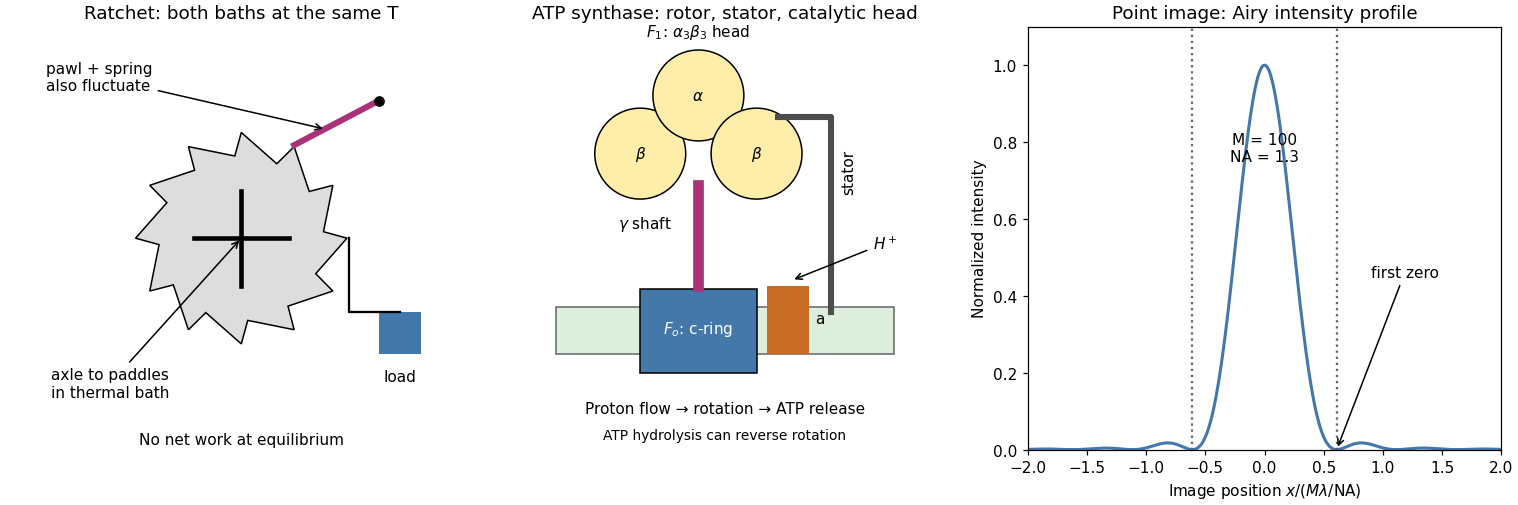
The left panel below shows paddles in a bath connected by an axle to an asymmetric toothed wheel, aspring-loaded pawl and a load. A naive argument lets random paddle kicks turn the wheel in one direction while the pawl blocks reverse motion, apparently extracting work from a single bath. The missing ingredient is the pawl's own thermal fluctuations. At the same temperature, it sometimes lifts and allows reverse slips. Correct forward and reverse transition rates obey detailed balance, so no sustained directed rotation can do work at single-bath thermal equilibrium. The device illustrates, rather than disproves, the Second law of thermodynamics.
A macroscopic shaken ratchet is driven far from thermal equilibrium: imposed shaking supplies organized mechanical energy, and friction or inelastic collisions dissipate it. Its kilogram-scale parts are not moved appreciably by molecular thermal fluctuations. Rectification requires broken spatial symmetry from the teeth or pawl and appropriate dynamical coupling: the shaking must sometimes disengage or drive the pawl over atooth while contact and dissipation prevent equal reverse motion. The load must remain below the available meandriving torque. Isotropic, aperiodic shaking can satisfy these conditions because the asymmetric mechanism breaks directional symmetry; without the external energy supply, a working rectifier and dissipation, there is no guaranteed directed motion.