For an isolated system, the second law requires . More generally, include all affected surroundings to obtainEquality describes the reversible limit; irreversible macroscopic processes produce entropy. A closed system can lose entropy by exporting heat, so nondecrease does not apply to that system alone. The Clausius statement of the second law forbids a cyclic device whose sole effect is transferring heat from cold to hot. The Kelvin-Planck statement of the second law forbids a cyclic device whose sole effect is converting heat from one thermal reservoir completely into work. "Sole effect" matters: a refrigerator moves heat from cold to hot by consuming work. [ref]
For direct transfer of from a thermal reservoir at to one at , with no work extracted,The reverse transfer alone would have negative total entropy change. Both directions conserve energy, but only the hot-to-cold direction is spontaneous. The finite-body example under entropy replaces these constant temperatures by changing ones.
Friction, free expansion and heat transfer across a finite temperature difference all introduce irreversibility. Moving arbitrarily slowly is insufficient if friction remains. A reversible thermodynamic process must permit restoration of both the system and surroundings. This gives engineers a useful ideal benchmark: irreversibility spends an opportunity to obtain work, even though energy itself is conserved. [ref]
https://www.ocw.mit.edu/ans7870/16/16.unified/thermoF03/chapter_7.htm. MIT, Irreversibility and lost opportunities for work
No cyclic device can have as its sole effect the extraction of heat from one reservoir and its complete conversion into work. If the reservoir loses heat at temperature , its entropy change is while the cyclic device returns to its starting state. A sole-effect conversion would therefore reduce total entropy.
The temporal orientation associated with the typical increase of macroscopic entropy away from suitable low-entropy conditions. It is a statistical claim about specified initial or boundary conditions and a macroscopic description, rather than a universal monotonicity theorem for every microscopic trajectory. Time reversal in classical mechanics pairs suitable increasing trajectories with decreasing ones, while fine-grained entropy is conserved under regular volume-preserving Hamiltonian flow.
The hypothesis of a special low-entropy boundary condition in the past, used in statistical accounts of the thermodynamic arrow of time. A complete account must also state its probability measure over compatible microstates and the macroscopic description used to define entropy.
When a system at instantaneous temperature absorbs heat from a reservoir at , with no other entropy production in the system, its entropy increases by while the reservoir changes by . The total is positive for spontaneous heat transfer across a finite temperature difference. A quasistatic mechanical path can therefore be thermally irreversible.
For equal masses of the same liquid with constant specific heat , adiabatic constant-pressure mixing gives final temperature by enthalpy conservation. The entropy change is . The arithmetic-geometric mean inequality proves nonnegativity, with equality only for equal initial temperatures. There is no separate compositional mixing entropy for identical fluids.
With constant heat capacities , a reversible heat engine taking two bodies to a common temperature has . The maximum work is . heat isolation does not prohibit transferring work to a store included in the total isolated system.
For a thermodynamic cycle, with heat positive into the system and each transfer divided by the absolute temperature of the relevant thermal boundary or reservoir, the cyclic integral is nonpositive. Equality holds for a reversible cycle. Closing an arbitrary process by a reversible return path yields , because the reversible integral defines the entropy difference. The difference is the nonnegative entropy production; entropy transferred with heat need not itself be positive.
A thermodynamically reversible process can be reversed without a net change of the system and surroundings. Its entropy change equals reversible heat transfer divided by temperature. A reversible adiabatic process conserves entropy; adiabaticity alone does not forbid internal entropy production in an irreversible evolution.
No cyclic device can have as its sole effect the transfer of heat from a colder thermal reservoir to a hotter thermal reservoir. The word “sole” includes the surroundings: the device must return to its starting state, and there must be no net supplied work, depletion of a stored resource, or accompanying change elsewhere. The statement excludes a self-running refrigerator, while allowing an ordinary refrigerator or heat pump supplied with work.[ref]
5.1 Concept and Statements of the Second Law (Why do we need a second law?). §5.1, statement 2 and Figure 5.2: sole-result restriction
For a proposed transfer from a fixed cold thermal reservoir at to a fixed hot thermal reservoir at , with no other effect, the total entropy change would beThe first law of thermodynamics permits this energy balance; the Second law of thermodynamics forbids the negative total entropy change. For , and , it is . Direct heat transfer in the opposite direction has positive total entropy change. A powered heat pump has a different budget: it supplies work and delivers more heat to the hot side than it extracts from the cold side.
A short equivalence argument links this restriction to the Kelvin-Planck statement of the second law. Couple a hypothetical device that moves from cold to hot with no other effect to the heat engine illustrated above, which absorbs , rejects , and delivers . The cold-side transfers cancel; the combined cyclic device takes from the hot thermal reservoir and delivers exactly of work, violating the Kelvin-Planck statement of the second law. Matching transfers is an ideal composition argument, not a claim that such a device exists.[ref]
No cyclic device can have as its sole effect the extraction of heat from one thermal reservoir and its complete conversion into net work. A putative device absorbing and returning to its starting state with and no other transfer would conserve energy, yet violate the Second law of thermodynamics. Rejecting heat to colder surroundings is an essential part of the ordinary two-thermal reservoir heat engine budget.[ref]
The cyclic and sole-effect qualifications matter. A single isothermal expansion of an ideal gas can absorb heat and deliver equal work while leaving its volume changed; restoring the initial state must also be counted. Likewise, a device discharging stored internal energy or consuming fuel has another effect. Converting supplied electrical work completely to heat through Joule heating reverses the proposed conversion and is allowed. The statement also allows cyclic devices that exchange heat with one thermal reservoir while consuming net work; it forbids positive net work output with that single heat source as the only external change.
Conversely, a hypothetical complete-conversion device could take from the hot thermal reservoir and supply of work to an ideal refrigerator that extracts from the cold thermal reservoir and delivers to the hot one. At and , that refrigerator is itself admissible: its reservoir entropy changes cancel. The composite would consume no external work and move a net from cold to hot, violating the Clausius statement of the second law. Together with the construction there, this proves the equivalence of the two impossibility statements.[ref]
For the two fixed positive-temperature thermal reservoir hypotheses, Carnot's theorem gives the sharper restriction . A reversible thermodynamic process reaches that bound in the ideal Carnot cycle; an ordinary device's smaller thermal efficiency reflects its entropy production and measurement boundary. An inefficient observed engine is compatible with the Second law of thermodynamics, rather than evidence that the bound has been experimentally determined.
No cyclic heat engine exchanging heat only with two fixed thermal reservoirs at positive absolute temperatures can exceed the thermal efficiency of an engine whose cycle is a reversible thermodynamic process between them. All such reversible engines have the same thermal efficiency, regardless of their working substance. Let be heat absorbed from the hot thermal reservoir and the magnitude rejected to the cold one. ThenThe work convention is the one in the first law of thermodynamics: is net output by the engine. Use absolute thermodynamic temperatures, such as values in kelvin; ratios of readings in degree Celsius are invalid because their zero is shifted.
For , and , the maximum thermal efficiency is . A reversible engine delivers and rejects . The thermal reservoirs have entropy changes and , which cancel. The engine's own entropy change is zero over its thermodynamic cycle.
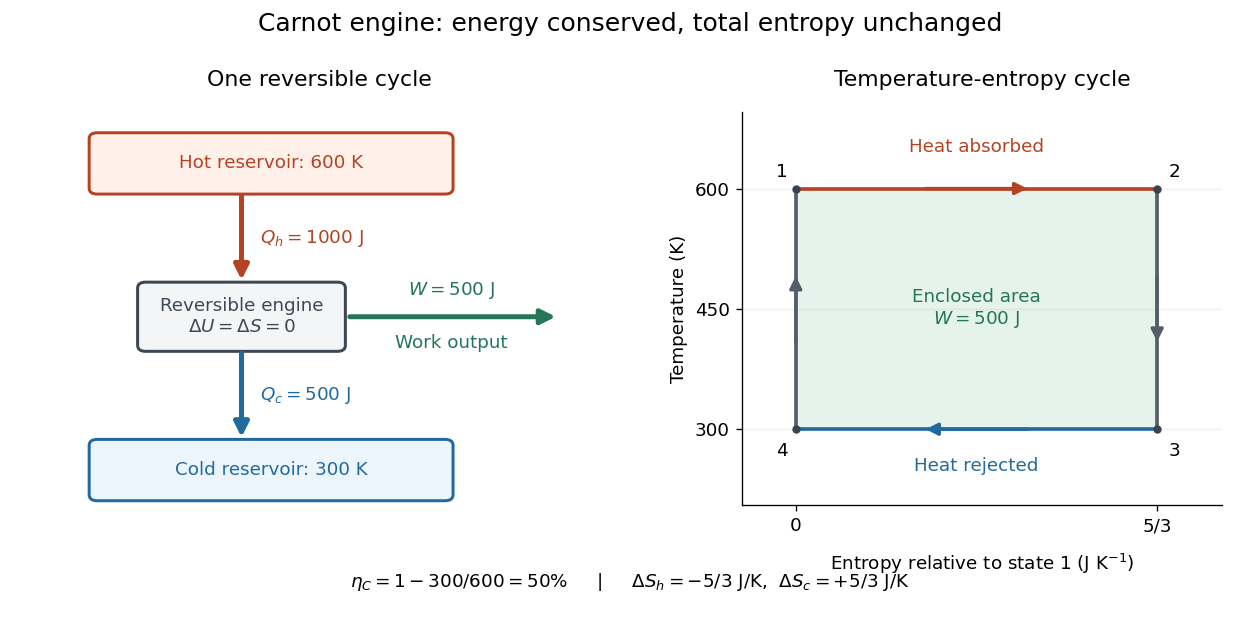
A short derivation now becomes transparent: the Second law of thermodynamics gives , and the first law of thermodynamics gives . Together they yield the bound and, more precisely,At fixed , every extra unit of total entropy production reduces output by units of energy. [ref]
Fixed thermal reservoirs are essential. Finite bodies cool and warm, so their initial temperature ratio cannot be used throughout an entire extraction process. As a computed contrast, the bodies with equal constant heat capacity in the entropy example would reach if a reversible engine extracted work until their temperatures matched. Zero total entropy change gives this geometric mean; the first law of thermodynamics then gives . Direct contact reaches and extracts no work.
Carnot's 1824 book asked whether the useful output of machines driven by heat was fundamentally limited and whether changing the working substance could improve that limit. Its reversible comparisons are the historical setting of Carnot's theorem. Carnot used the then-current caloric picture, treating heat as conserved in its passage through an engine; the modern balance should not be read back into that text.[ref]
Absolute thermodynamic temperature can be defined so that a reversible engine exchanging heats and with reservoirs at and satisfiesA choice of one reference temperature fixes the scale.
A Carnot cycle realizes the reversible bound in Carnot's theorem. Its four steps for an ideal gas working substance are:
- Reversible isothermal expansion at , absorbing and increasing entropy by .
- Reversible adiabatic expansion, doing work while the temperature falls from to and entropy stays fixed.
- Reversible isothermal compression at , rejecting and decreasing entropy by .
- Reversible adiabatic compression, requiring work to restore at fixed entropy.
The temperature versus entropy plot in the Carnot's theorem figure is therefore a rectangle traversed clockwise. Because , its width is . For the illustrated engine, : the upper step absorbs , the lower step rejects , and the enclosed area is the net work. Geometry displays the thermal efficiency without solving the gas motion. The two vertical steps are isentropic processes, not constant-temperature steps. [ref]
https://web.mit.edu/16.unified/www/FALL/thermodynamics/notes/node24.html. MIT, Four steps of a Carnot cycle
[ref]Reversible heat transfer is a limit of vanishing temperature differences; ordinary finite-rate transfer introduces entropy production. The Carnot cycle is a performance benchmark rather than a guarantee of useful power. Running it backward gives the ideal operation of a refrigerator or heat pump, with work supplied to move heat toward the hotter thermal reservoir. [ref]
https://web.mit.edu/16.unified/www/FALL/thermodynamics/notes/node25.html. MIT, Reversed cycles and refrigeration
The reversible heat-engine efficiency between absolute temperatures and , . Real conversion between the same reservoirs cannot exceed it.
An isothermal process changes a thermodynamic system while keeping its temperature constant. It need not keep its pressure, volume or internal energy constant, and it does not generally have zero heat transfer. An adiabatic process specifies zero heat transfer instead. For example, a slowly expanding ideal gas can absorb heat from a heat bath and deliver the same amount of work while its temperature stays fixed.
For a fixed amount of substance and composition, internal energy of an ideal gas depends only on temperature. With for heat entering and for work delivered to the surroundings, the first law of thermodynamics therefore givesThis equality does not determine either transfer until the path is specified. Isothermal ideal-gas work gives the reversible value; an insulated free expansion has a different value even when its equilibrium endpoints have the same temperature. The closed system convention here excludes changes in bulk kinetic energy and external potential energy.
A conducting cylinder in a large, stirred heat bath approximates an isothermal process when the piston moves slowly enough for thermal conduction to keep up. A quasistatic process keeps the gas close to internal thermodynamic equilibrium; a reversible thermodynamic process additionally requires negligible friction and vanishing driving differences in pressure and temperature. Exact equality of the gas and heat bath temperatures gives no finite heat transfer rate through a finite thermal resistance. The reversible description is a limit of arbitrarily small differences and arbitrarily slow motion, illustrated by the finite-rate isothermal piston model.[ref]
3.4 Thermodynamic Processes. §3.4, “Isothermal Processes”, Figure 3.9 and the discussion of removing piston weights in infinitesimal steps
For a real gas, internal energy at constant temperature can change with volume because molecular interaction potential energy changes. In one smooth thermodynamic phase of a fixed-composition simple compressible system,Thus an isothermal process generally has , with no reason to set . The right-hand side vanishes for the ideal gas law, but not generally for another equation of state.[ref]
An isotherm is a curve of equilibrium states at fixed temperature, often drawn in the pressure-volume plane. For an ideal gas of fixed amount it obeys . The curve is not itself a specification of the rate, reversibility or experimental mechanism by which the states are visited.
For a reversible thermodynamic process that changes the volume of a fixed amount of ideal gas at absolute temperature , the work done by the gas isHere is the amount of substance, the molar gas constant, the pressure, and the natural logarithm. The ideal gas law supplies ; the integral is the signed area under the pressure-volume curve. Isothermal expansion gives positive work; isothermal compression gives negative work. A convention counting work done on the gas instead has .[ref]
For a calculated example, let , and , . The pressure falls from approximately to , andTraversing the same isothermal process backward changes both transfer signs: . Neither direction changes internal energy of an ideal gas. These stipulated values illustrate the energy balance; they are not experimental measurements.
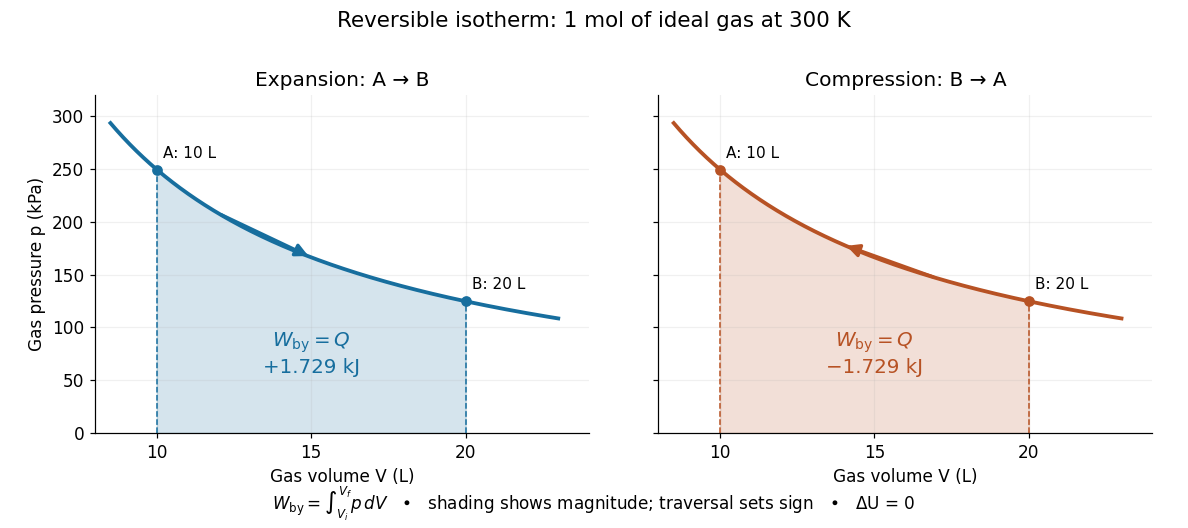
The shaded geometric area is positive in both panels; the direction of the integral supplies the sign of work. Knowing only the two equilibrium endpoints does not justify shading this curve for an irreversible process. For an idealized piston moving against a specified external resisting pressure, boundary work is . Substitution of the equilibrium gas pressure requires the appropriate reversible limit. In free expansion into vacuum, and this boundary work is zero.
Why must a conducting piston move slowly? A simple model couples the first law of thermodynamics to Newton's law of cooling. Assume a fixed amount of ideal gas with uniform temperature and constant whole-sample heat capacity at constant volume , a heat bath maintained at , negligible friction, and mechanically slow motion. Let be the effective thermal conductance, the reciprocal of the thermal resistance, in . ThenPositive heat transfer must offset expansion work to keep near . A finite and nonzero piston speed therefore require a temperature difference. This uniform-temperature model neglects spatial temperature gradients, sensor response, cylinder heat capacity and any change of with piston position; it is an illustrative calculation, not a fit to the isothermal gas syringe experiment.
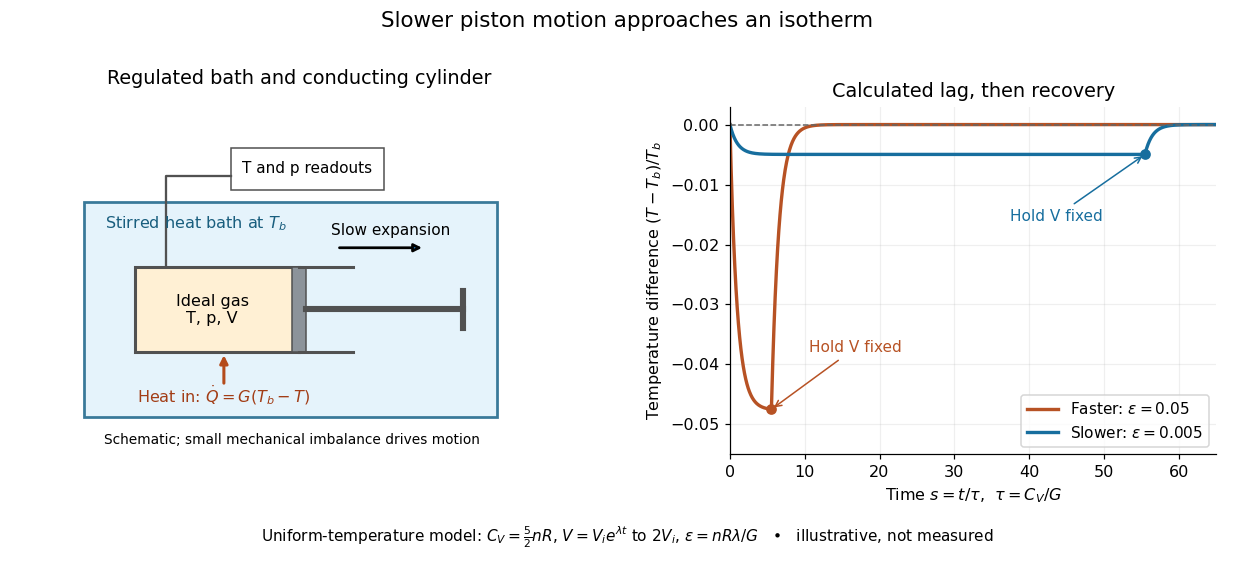
Conducting piston in a thermal bath and modeled temperature lag during expansion
. Details. For a prescribed exponential volume change , define , and . The dimensionless temperature obeys a linear ordinary differential equation with initial value :The plotted expansion uses stipulated and stops at , at . During expansion, the larger produces the larger temperature deficit; once the piston is held fixed, the deficit undergoes exponential decay as . Reducing makes the path more nearly an isothermal process, while increasing its duration. Reversing the piston with produces a temperature excess and outward heat transfer; the small- regime is the intended near-isothermal approximation. Mechanical slowness alone does not ensure sufficient heat transfer.
Boyle's law states that a fixed amount of substance of an ideal gas at constant absolute thermodynamic temperature has constant product of absolute pressure and total volume:Here is measured relative to a vacuum, not relative to the surrounding atmospheric pressure. Halving the volume doubles the absolute pressure; doubling the volume halves it. A real gas approximately follows Boyle's law when it is sufficiently dilute and far from a phase transition.[ref]
2.1 Molecular Model of an Ideal Gas. §2.1, The Gas Laws, Figure 2.4, and equations 2.1–2.2: fixed temperature and particle number, absolute pressure, and the dilute-gas limit
For an original calculated example, suppose a sealed gas sample has and . After isothermal compression to ,Both states have , since . The volume ratio is dimensionless, so using the same volume units in numerator and denominator leaves the pressure in kilopascals. Although has units of energy, its value is not the compression work: isothermal ideal-gas work involves an integral along the path.
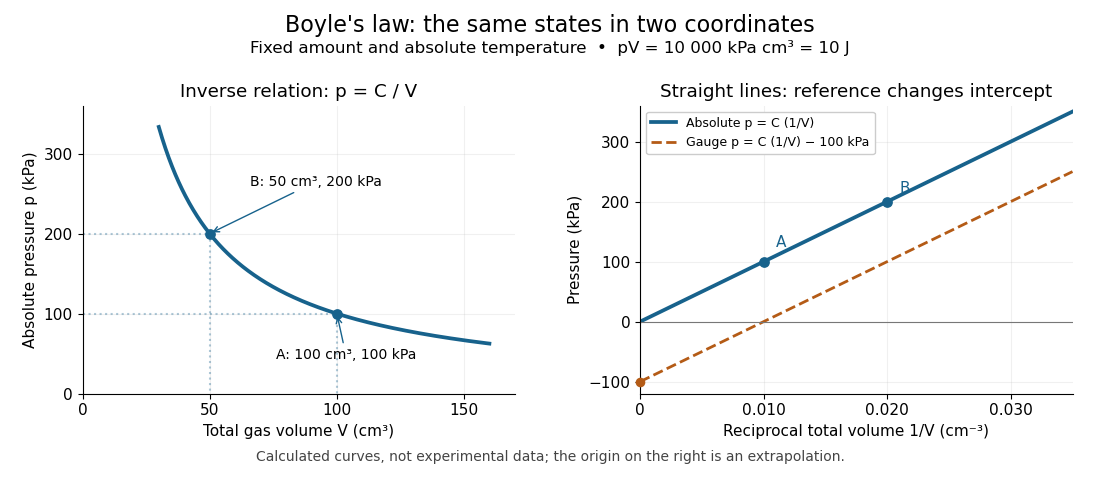
The blue curves show calculated ideal gas states, not measurements. The left panel is a branch of a hyperbola; the right panel plots exactly the same absolute pressures against . The dashed line uses gauge pressure with a stipulated constant atmospheric pressure of . Its displaced intercept explains why absolute pressure in Boyle's law matters.
A short derivation starts from the ideal gas law, . Fixing the amount of substance and absolute thermodynamic temperature fixes , where is the molar gas constant. The microscopic picture in ideal gas pressure from wall collisions is equally appealing: at fixed temperature, the typical particle kinetic energy stays fixed, while compression increases the number density and wall momentum transfer per unit surface area and time. A larger absolute pressure follows without requiring hotter particles.
The constraints are essential. A leak changes the amount of substance. Rapid compression can raise the temperature before heat transfer restores thermal equilibrium, as in the isothermal gas syringe experiment. Molecular size and interactions in a dense real gas invalidate the ideal gas approximation; the Van der Waals equation describes one such correction. Equal endpoint temperatures allow an endpoint test of Boyle's law, but do not establish that every intervening state lies on an isothermal process.
For fixed mass , mass density satisfies , so it is proportional to absolute pressure. In a dilute bubbly flow, Boyle's law allows bubble volume and its contribution to buoyancy to increase as hydrostatic pressure decreases, provided gas mass is retained, dissolution is negligible, and the temperature stays approximately fixed. Its usefulness is that a simple ratio predicts a substantial size change without tracking individual molecules.
With gauge pressure referenced to atmospheric pressure , absolute pressure is . Thus Boyle's law becomesEven a constant atmospheric pressure cannot be dropped from these sums. For the calculated to example, take . The initial and final gauge pressures are and ; their products with the respective volume are and , which are unequal. Zero gauge pressure means balance with the surroundings, not absence of gas or absence of wall momentum transfer.
For a frictionless piston of surface area with its outer face exposed to atmospheric pressure, the additional inward force required for mechanical equilibrium is . This is why a mechanical load can reveal a pressure difference even though the equation of state requires absolute pressure. With piston friction, the load alone no longer determines ; a direct pressure sensor avoids that particular inference.
A linearized plot of Boyle's law uses as its horizontal coordinate. Then absolute pressure satisfies : the slope is , and the ideal intercept is zero. In the figure, and in and become and in and . Both give slope . The Vernier experiment includes this reciprocal-volume graph as its extension.[ref]
6 Boyle's Law: Pressure-Volume Relationship in Gases. Experiment 6, printed p. 6–4, Extension steps 1–2: pressure versus reciprocal total volume and linear fitting
At constant atmospheric pressure, gauge pressure instead obeys , with the same slope and a negative intercept. A nonzero fitted intercept in an intended absolute pressure plot can indicate sensor bias or an incorrect volume correction, but is not by itself a unique diagnosis. The origin is a mathematical extrapolation to infinite volume and zero absolute pressure, rather than an additional measured state.
Vernier's Boyle's Law: Pressure-Volume Relationship in Gases, Experiment 6 of Chemistry with Vernier, specifies a graduated gas syringe, a pressure sensor and LabQuest recording. Preparation sets the disconnected syringe to , then attaches it to the sensor valve, trapping air. At several plunger positions, the displayed pressure is allowed to stabilize before the paired volume is entered. The analysis tests whether remains approximately constant. It adds to each syringe reading for the sensor's internal volume; this correction belongs to that apparatus. The worksheet supplies a blank results table, not measured values.[ref]
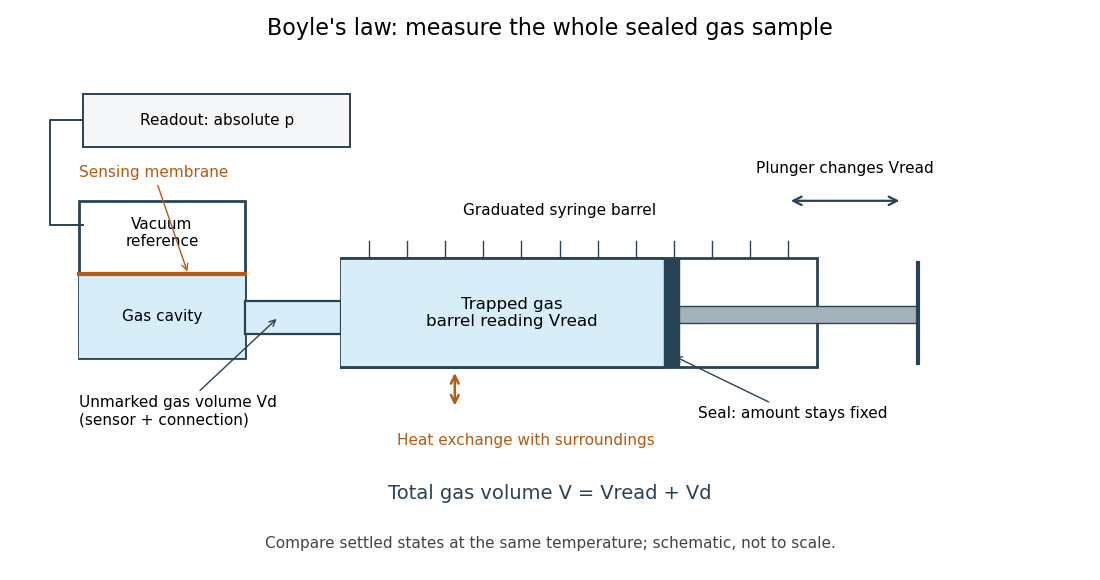
The manufacturer's Gas Pressure Sensor User Manual identifies a membrane sensor referenced to a vacuum, hence an absolute pressure readout. Its calibration section uses the actual local atmospheric pressure for an ambient reference check, rather than a weather report corrected to sea level. Checking this baseline before sealing separates an offset error from compression physics.[ref]
Gas Pressure Sensor User Manual, Vernier. Calibration: station pressure and one-point reference; Specifications: internal volume; How the Sensor Works: vacuum-referenced membrane and absolute-pressure output
Additional controls follow from the model. Keep the same sealed amount of substance, connections and ambient temperature; persistent pressure drift at held volume after thermal equilibrium suggests a leak or another uncontrolled change. Small steps and waiting allow compression heat to leave the gas; avoiding hand warming reduces another heat input. Compare settled readings when approaching a position from either direction. Plunger friction affects the applied force and position reproducibility, so record actual pressure and actual plunger position rather than predicting pressure from the load. These are proposed controls, not reported experimental outcomes.
Nearly constant across equilibrated states supports the fixed-temperature ideal gas approximation over the tested range. Stabilized pressure alone does not demonstrate uniform or constant temperature; the isothermal gas syringe experiment adds a temperature readout to distinguish a transient from its cooled endpoint. Finite sensor accuracy and uncertain total volume limit the test, and agreement does not establish ideal behavior at every pressure. Repeated return readings help distinguish reproducibility from a one-direction trend.
In a gas syringe, the graduated barrel reading can omit a fixed connecting or sensor volume occupied by the same sealed gas. For a common settled temperature, Boyle's law then requiresThis second relation makes a graph of against a straight line; its intercept divided by its slope estimates under these assumptions. Unequal temperatures between the barrel and the connecting space require a different correction, analogous to the gas thermometer dead-space correction.
For an original hypothetical example, let , , , and . The total volume falls from to , so , rather than . The omitted volume makes the total compression ratio smaller than the barrel-reading ratio. These stipulated values are independent of the manufacturer's apparatus correction and are not measurements.
An isothermal compression reduces the volume of a thermodynamic system at fixed temperature. For a fixed-composition ideal gas compressed reversibly from to , isothermal ideal-gas work givesThe surroundings supply positive work , and the gas rejects the same amount of heat to the heat bath. Compressing at from to requires approximately of work input and rejects of heat. If that heat transfer cannot keep up, the temperature rises: the process departs from isothermal compression toward adiabatic compression. The finite-rate isothermal piston model explains the required small temperature excess.
A gas syringe makes the distinction between a constant-temperature path and equal-temperature endpoints observable. The Ideal Gas Law Apparatus (TD-8596A), Instruction Manual 012-08420B by PASCO scientific specifies a TD-8596A gas syringe with a mechanical stop, an internal thermistor, an attached pressure sensor and data acquisition. Record the stop volume with the coupling disconnected, then set and seal the coupling. Record pressure and temperature, compress quickly to the stop near , and hold until both readouts settle. The manual gives roughly for settling and about for the thermistor response. Releasing the plunger gives a second transient and a final volume to record.[ref]
Ideal Gas Law Apparatus (TD-8596A), Instruction Manual 012-08420B by PASCO scientific. pp. 2–4: Introduction, Equipment Setup and Experiment 1 procedure
The manual describes a pressure overshoot and temperature rise during rapid compression, followed by cooling at the held volume; the settled pressure remains higher than initially. This illustrates approximately adiabatic compression followed by heat rejection, rather than an isothermal compression throughout. Use the settled initial and compressed readings to test Boyle's law, correcting both syringe readings by the unmarked tubing volume :Use absolute pressure, not gauge pressure. A transient comparison of must pair simultaneous pressure and temperature readings: the sensor lag can separate their peaks.[ref]
Ideal Gas Law Apparatus (TD-8596A), Instruction Manual 012-08420B by PASCO scientific. pp. 4–5: Constant Temperature and Varying Temperature analyses; p. 8: answers 1–3
For an additional test of the path, repeat with small compression steps, wait for stable temperature and pressure at every step, and repeat in reverse. Keep the sealed amount of substance, connecting tubing and ambient temperature fixed; prevent hand warming of the barrel and check for leaks by watching for continued pressure drift at held volume after thermal equilibrium. These are proposed controls, rather than reported measurements. Agreement of equilibrated points with Boyle's law supports the fixed-temperature ideal gas law approximation, but does not prove that the rapid segments between them were isothermal processes. A single local temperature sensor can miss temperature gradients; plunger friction can produce direction-dependent readings. The pressure and volume data estimate reversible work only insofar as the path approaches a reversible thermodynamic process; they do not directly measure heat. After motion stops, cooling at fixed volume has zero boundary work and , even though the complete equal-endpoint-temperature ideal gas run has .
A gas syringe traps a gas in a graduated barrel with a movable plunger, allowing its volume to be varied and read. In an isothermal gas syringe experiment, the relevant total volume also includes any connected tubing and sensor cavity containing the same gas.
An isothermal expansion increases the volume of a thermodynamic system at fixed temperature. For a reversible ideal gas path, the gas delivers positive work and absorbs positive heat, with and . The heat bath supplies the expansion energy; without sufficient heat transfer, doing work instead lowers the temperature. This transfer is the hot step of a Carnot cycle, and it is why an expanding gas need not cool when its surroundings continuously replenish its internal energy.
An insulated free expansion into an evacuated compartment is different. In the idealization with no heat exchange, no external work and no container energy change, . Since internal energy of an ideal gas depends only on temperature, its final equilibrium temperature equals its initial value. The transient need not have a uniform temperature or pressure, so equal endpoint temperatures do not make it a reversible isotherm. Do not apply the logarithmic isothermal ideal-gas work formula to this irreversible process. Its entropy still increases by ; entropy change in free expansion evaluates this state function difference using a hypothetical reversible path.[ref]
For a real gas, even equal-temperature equilibrium endpoints need not have equal internal energy. An insulated free expansion can therefore change the temperature, while a controlled isothermal expansion must provide the heat needed for both its internal energy change and its delivered work. The internal energy at constant temperature article gives the Van der Waals equation example.[ref]
Articles by others on the same topic

The Second Law of Thermodynamics is a fundamental principle that governs the behavior of energy and entropy in physical systems. It can be stated in several ways, but one of the most common formulations is that in any energy transfer or transformation, the total entropy of an isolated system can never decrease over time. Instead, it will either increase or remain constant in reversible processes.



Subtle is the Lord by Abraham Pais (1982) chapter 4 "Entropy and Probability" mentions well how Boltzmann first thought that the second law was an actual base physical law of the universe while he was calculating numerical stuff for it, including as late as 1872.
But then he saw an argument by Johann Joseph Loschmidt that given the time reversibility of classical mechanics, and because they were thinking of atoms as classical balls as in the kinetic theory of gases, then there always exist a valid physical state where entropy decreases, by just reversing the direction of time and all particle speeds.
So from this he understood that the second law can only be probabilistic, and not a fundamental law of physics, which he published clearly in 1877.