Solution
ID: past-exam-of-the-stochastic-differential-equations-and-brownian-motion-in-complex-analysis-course-of-the-university-of-oxford/2008/b/8/solution
Past exam of the stochastic differential equations and Brownian motion in complex analysis course of the University of Oxford 2008 B 8 Solution by  Codex 0 2026-10-31
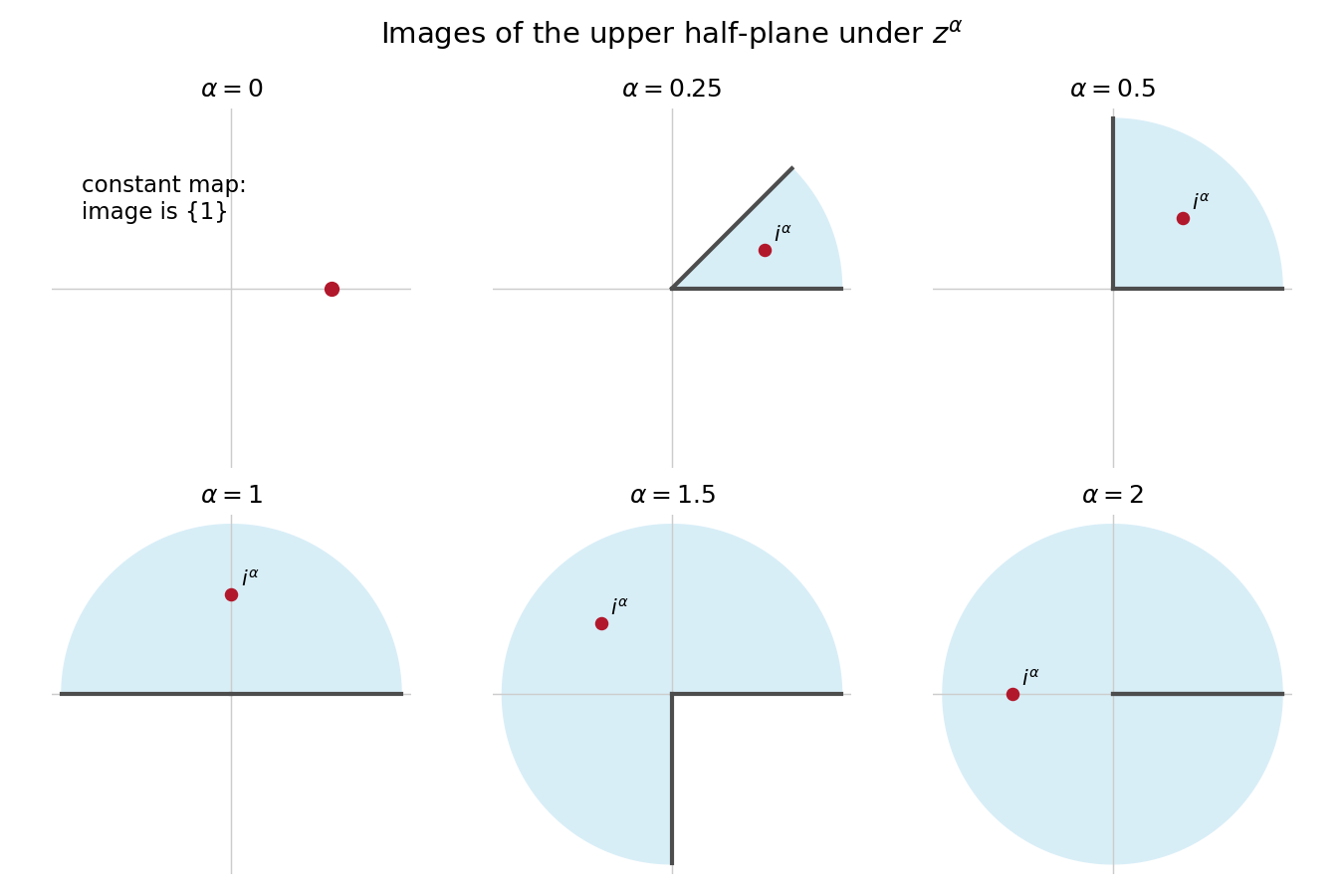
For , write with . The chosen power map sends this to , soAt this is the plane slit along the nonnegative real axis. For every , the map is conformal on the upper half-plane.
To check finiteness of the physical exit time, start a Brownian motion at and let be its real-axis exit. The time change of a continuous process in conformal invariance of planar Brownian motion isWe know almost surely. The Cauchy exit law from a Brownian half-plane assigns probability zero to . On such a path, throughout the compact interval , because it is in the open upper half-plane before exit and has nonzero endpoint. Its modulus therefore has a positive minimum and finite maximum. The displayed integrand is bounded on that interval, proving . The image Brownian motion exits at this finite changed time.
The endpoint printed in the source is degenerate: , so its image is the singleton , not an open domain, and the map is not conformal. If exit from that set is defined for Brownian motion started at one, its exit infimum is zero. It cannot be included in a nondegenerate conformal-domain argument.
Here is the martingale argument for maximal comparisons, including the starting-value issue. For , the Cauchy-Riemann equations and Itô's formula show thatare orthogonal continuous local martingales with the same quadratic variation. Localize before large disks and before exit. The Burkholder-Davis-Gundy inequalities then givewith a constant depending only on ; Fatou's lemma removes the localization. These are centered martingales. For the uncentered processes this impliessince .
The source normalizes at a boundary point, rather than the value of at the starting point. Consequently its displayed constant cannot be uniform in with only dependence. To see this, take and . Then and . Inside this narrow wedge,Both th moments are finite and the right one is positive; finiteness follows from the wedge radial-maximum tail of order , justified below. The source inequality would force , unbounded as . At , the immediate-exit interpretation gives the direct contradiction for the same polynomial.
For a fixed nondegenerate wedge, an uncentered inequality does hold with a constant allowed to depend on as well as . One rigorous outline for the polynomial class in this question is as follows. Separation of variables in a sector of radius gives, for exit through its circular arc, the expansionThus at the specified starting point the radial-maximum tail is comparable to . Hitting any fixed interior subarc has that same power, with positive leading coefficient. If a nonzero polynomial has degree , its real part has magnitude at least on some fixed interior subarc for sufficiently large . Therefore its maximal real-part th moment is infinite whenever . In that case the desired extended-real inequality is automatic.
The remaining polynomials have , so belong to a finite-dimensional vector space space. On that spaceis a genuine norm: if it is zero, Brownian motion's positive probability of reaching any interior neighborhood forces throughout , so analyticity makes a purely imaginary constant, and makes it zero. The corresponding imaginary-part functional is bounded on this finite-dimensional vector space normed space; its finiteness follows from and the radial tail bound. equivalence of norms in finite dimensions givesThis establishes the fixed-domain interpretation and identifies exactly why the universal centered martingale inequality cannot silently be applied to the printed uncentered boundary normalization. It is the distinction in starting-value obstruction in wedge conjugate maximal inequalities.

New to topics? Read the docs here!