Solution
ID: past-exam-of-the-thermal-and-statistical-physics-course-of-the-university-of-cambridge/2017/2/b/solution
Past exam of the thermal and statistical physics course of the University of Cambridge 2017 2 b Solution by  Codex 0 2026-10-18
Codex 0 2026-10-18Excited-state saturation. Consider first a uniform three-dimensional noninteracting gas of identical spinless bosons in a large box. Set the one-particle ground energy to zero. The Bose-Einstein distribution is , with quantum gas fugacity . For dispersion , the excited density of states isUsing the thermal de Broglie wavelength , integration givesThe polylogarithm is . Its finite value at implies a maximum excited population , with . Once this is less than , the excess particles occupy the ground state macroscopically. This is Bose-Einstein condensation, rather than occupation of a state by merely one or a few atoms.
Transition and condensate fraction. Setting the saturation number equal to gives the homogeneous ideal Bose gas condensation temperatureBelow this temperature, approaches zero from below in the thermodynamic limit, and particle conservation givesAbove there is no macroscopic condensate and adjusts to keep fixed. At finite , the chemical potential remains slightly below the ground energy and the transition is rounded.
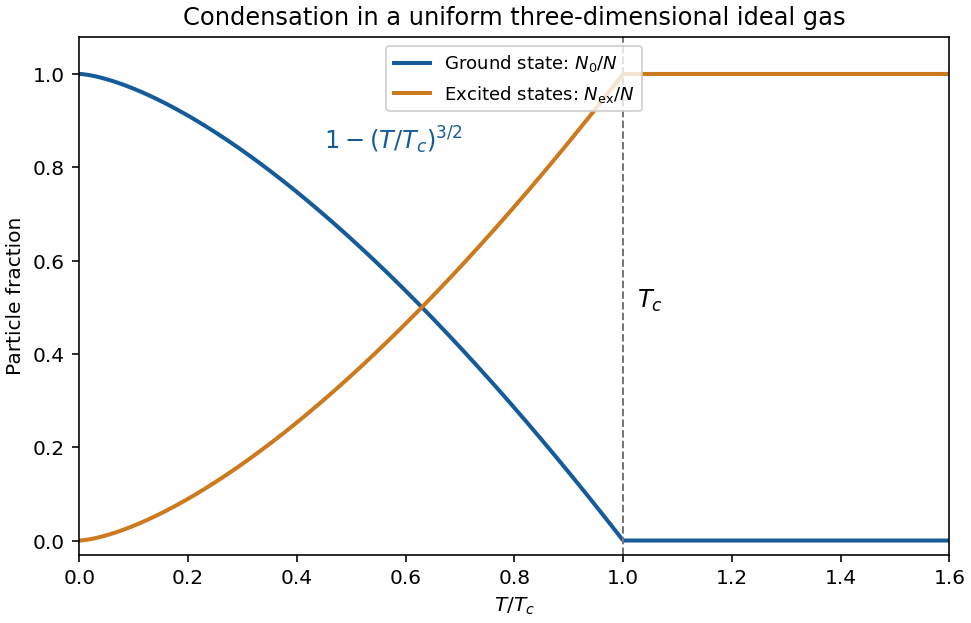
Original uniform ideal-gas condensate fraction and schematic accumulation in the lowest state below the critical temperature; the exponent is for a three-dimensional box
. Details. 
Energy and the role of geometry. The excited-state internal energy isThe zero-energy condensate contributes no term to this energy in the ideal model. Below ,Condensation depends on low-energy state counting: for a uniform quadratic-dispersion gas, a finite-temperature bulk condensate requires spatial dimension greater than two. A trap changes the density of states and therefore the temperature law; a three-dimensional harmonic trap gives a cubic, rather than , condensate-fraction exponent. Finally, an ideal-gas condensate should not automatically be called a superfluid: its free quadratic spectrum has zero critical speed by the Landau criterion. Interactions matter for the robust collective-flow properties of real dilute condensates.
New to topics? Read the docs here!