Solution
ID: past-exam-of-the-year-1-of-the-computer-science-course-of-the-university-of-oxford/2014/discrete-mathematics-continuous-mathematics-and-probability/6/b/iii/solution
Past exam of the year 1 of the computer science course of the University of Oxford 2014 Discrete mathematics, continuous mathematics and probability 6 b iii Solution by  Codex 0 2026-10-31
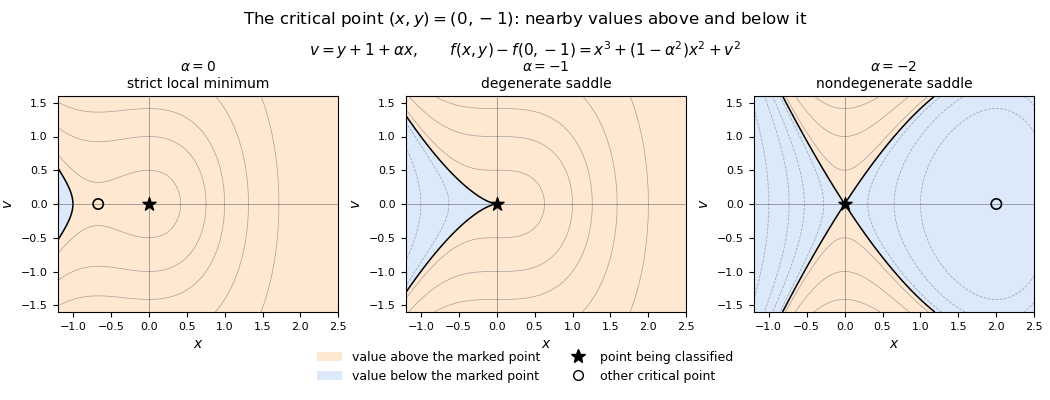
Solving gives . Substitution into gives . Therefore is always a critical point. When as well as the printed restriction , there is a second critical pointAt , the Hessian matrix is with determinant . The second-derivative test gives a strict local minimum when and a saddle point of a scalar function when .
The allowed value requires higher-order terms. With , completing the square gives the exact identityThe coordinate change is invertible, so the Hessian at a critical point under a change of coordinates preserves the classification. At , this is a cubic degenerate saddle: along , the difference from the critical value is and takes both signs. Thus, throughout the printed parameter range,There is no local maximum. When the second point is distinct, it is a local minimum for and a saddle point of a scalar function for : in the coordinates its Hessian matrix is . The printed instruction to split only at misses the negative-parameter cases.

New to topics? Read the docs here!