Persistent current in a superconducting loop experiment
ID: persistent-current-in-a-superconducting-loop-experiment

The persistent current in a superconducting loop experiment prepares a closed cold path, changes the externally linked magnetic flux, and follows the resulting superconducting persistent current through its magnetic field. The essential measurement starts after the inducing magnetic field has stopped changing.
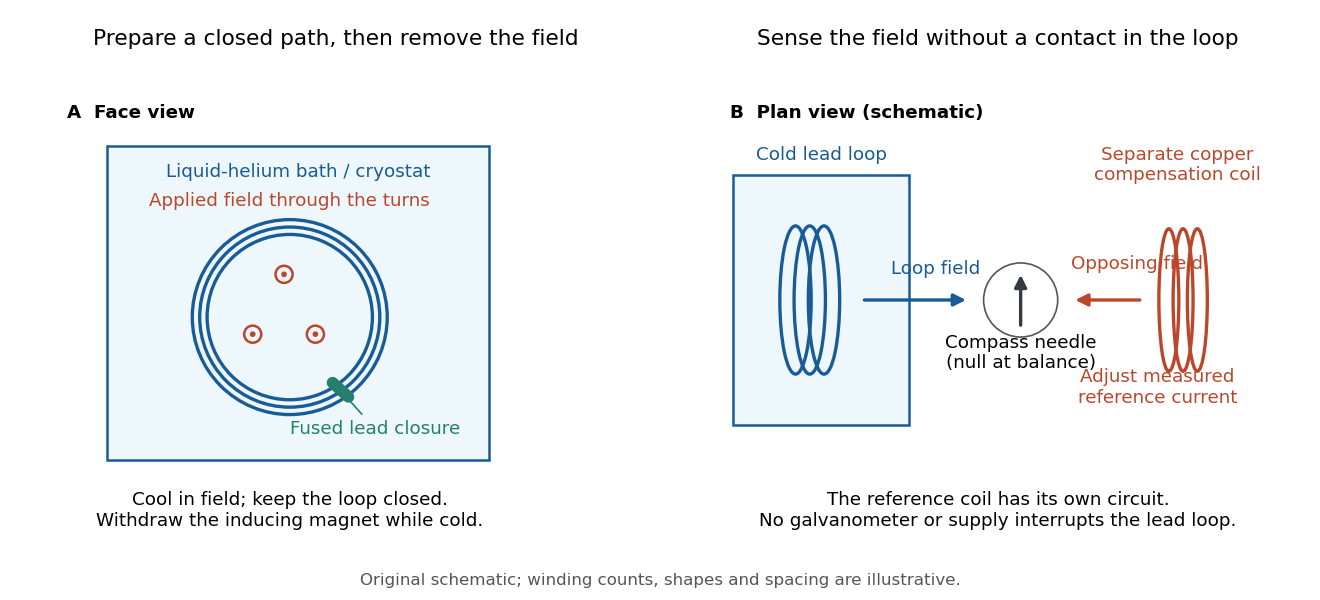

Heike Kamerlingh Onnes's 1914 Communication 140c describes a lead coil closed by fused lead connections. Cooling in a magnetic field and removing the inducing magnet prepared the circulation. A magnetic compass sensed it without contacts; a separate copper coil, cooled in liquid air, supplied a measured balancing magnetic field. Reversing orientation and compensation reduced offsets. [ref]
Further Experiments with Liquid Helium, J (Continued) by Heike Kamerlingh Onnes. Communication 140c (1914), §5, pp. 278–280; §7, pp. 280–281
The liquid-helium cryostat maintained low temperature, but refilling temporarily warmed the apparatus and changed the inferred electric current. A later run used a smaller initial electric current. Apparatus deformation and needle-zero drift limited comparison; cutting the closure still left a smaller magnetic signal, warning against assigning every signal to circulation around the whole loop. The report consequently gave an upper bound under a residual Ohm's law hypothesis. [ref]
Further Experiments with Liquid Helium, J (Continued) by Heike Kamerlingh Onnes. Communication 140c, §5, pp. 279–280; §6, p. 280; §8, pp. 281–283
For interpreting such a measurement, write a locally calibrated magnetic signal asHere is the coupling and gain, while contains the background magnetic field and readout offset. Only after establishing stable and correcting does a ratio of signals determine a ratio of electric currents. A gradual change in geometry, a drifting background magnetic field, or a change of temperature can imitate or conceal a decay. A pickup coil connected only to a voltage meter obeys Faraday's law of induction and detects a changing linked magnetic flux; its zero steady output cannot demonstrate that the underlying static magnetic field has disappeared. A magnetic compass can respond to that static magnetic field.
Opening the path, reversing the preparation, and repeating with smaller initial electric current are useful controls for separating whole-loop circulation, magnetic background and a superconducting critical current. Keep the temperature and external magnetic field stable during the interval used to infer electrical resistance. A sudden reduction near a superconducting critical current is not evidence for the constant- exponential decay model at smaller electric current. Persistence also does not replace the Field-cooled Meissner experiment: transport around a hole and magnetic expulsion from the material test different properties.
New to topics? Read the docs here!