
Peter M. Aronow develops statistical methods for causal inference, particularly design-based inference. Yale's institutional biography identifies research on complex experimental designs, network settings and incomplete survey data alongside appointments spanning political science and statistics.[ref]
Peter M. Aronow profile by Yale School of Public Health. Titles and Biography, design-based methodological research
His joint work with Cyrus Samii studies how to estimate sampling variance when a sampling design never observes some pairs together. A missing product cannot simply be deleted from the population variance formula: doing so can produce either sign of bias. Their construction uses Young inequality to bound unobserved products by individually estimable powers and obtain a conservative variance estimator.[ref]
Conservative variance estimation for sampling designs with zero pairwise inclusion probabilities by Peter M. Aronow and Cyrus Samii. Section2.2, Proposition1; Section3.1, Proposition2; Section3.2, quadratic special case
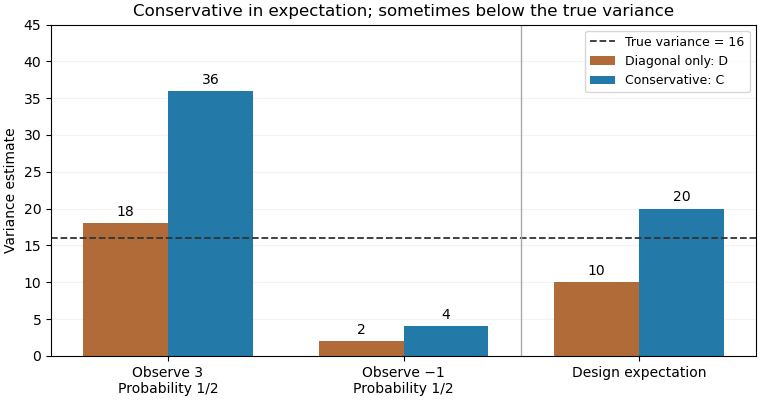
For an original exact illustration, choose one of two fixed values with equal probabilities. As in the single-draw variance identifiability obstruction, the Horvitz-Thompson estimator has true variance . Retaining only diagonal contributions gives , withOpposite signs therefore produce downward bias. The elementary inequality , obtained from , instead givesConsequently is a conservative variance estimator for this stipulated sampling design; its excess in expected value is exactly .
With , the true variance is16. The two possible values of are18 and2, averaging10; those of are36 and4, averaging20. Although , a realized value of can be below16. Conservativeness here is an expectation inequality, rather than a bound for every sample. By itself it also does not prove a specified confidence interval coverage probability.

New to topics? Read the docs here!