
For the overlapping monochromatic wave components, let be the thickness and the vacuum wavelength. Define using the slow and fast refractive indices. With complex amplitude convention , the accumulated slow-minus-fast phase difference isThis is the optical path difference expressed as a wave phase. It is a signed accumulation convention; with the opposite time convention the sign reverses. The outgoing polarization of an electromagnetic wave depends on modulo . Here the positive slow-minus-fast differs from the signed principal-index used in the parent birefringence entry when .
For an original worked example, stipulate at and a uniform thickness . These are design assumptions, not measured material data. The optical path difference is , soIt is a quarter-wave plate. At the same wavelength and refractive indices, doubling to gives , a half-wave plate. A thickness increase changes by , or ; retaining the same birefringence at would instead give for the plate. Real refractive indices also vary with wavelength, so this last calculation explicitly neglects optical dispersion.
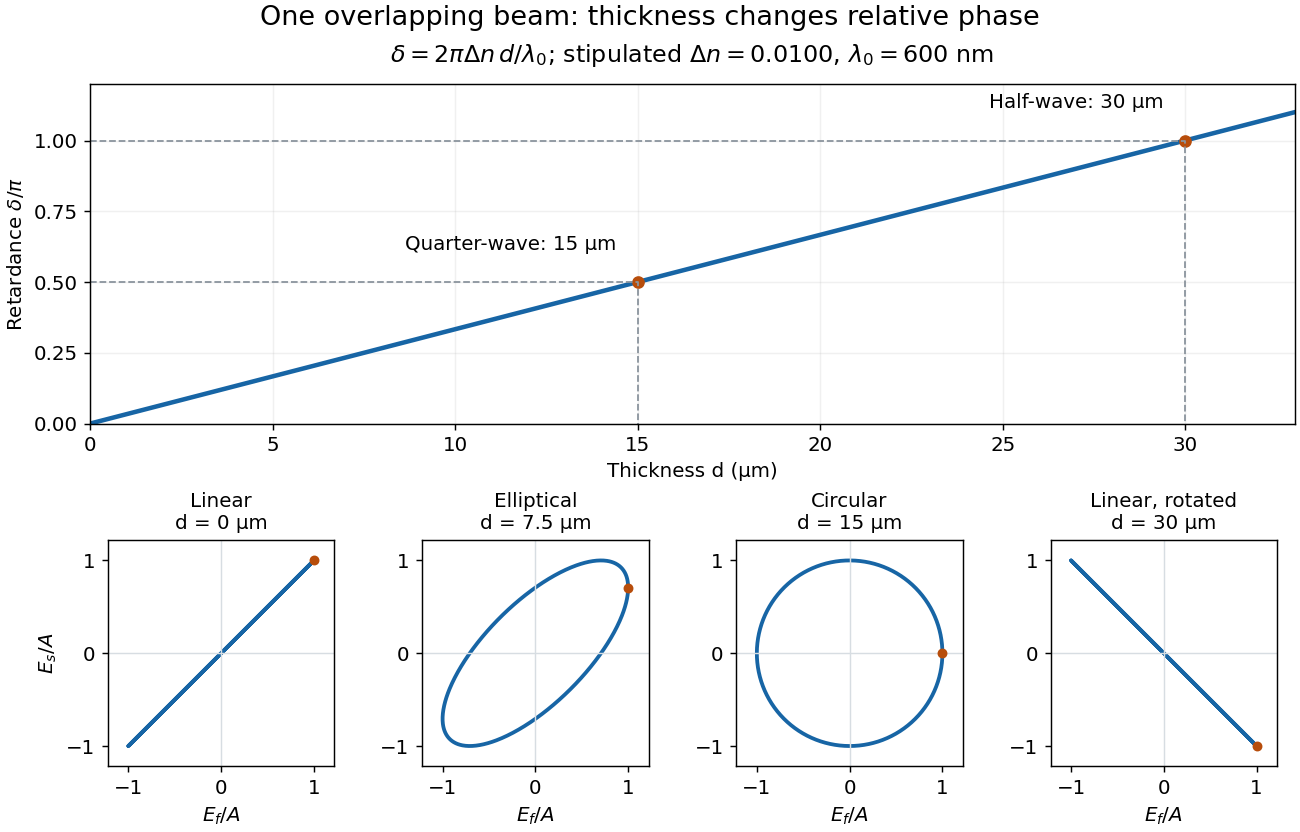
Phase retardation grows with thickness while overlapping components change polarization of an electromagnetic wave
. The stipulated , model gives quarter-wave and half-wave thicknesses of and . Insets trace the normalized electric field at a fixed point for equal fast/slow wave amplitudes, with and . The intermediate ellipse, circle and rotated line require no spatial beam separation. Details.
For these equal transmitted wave amplitudes, orthogonal projection onto a polarizer crossed with the initial linear polarization gives a simple independent readout. After removing a common wave phase, the component complex amplitudes are proportional to ; orthogonal projection onto gives . Squaring its modulus yields : zero at , one half at , and one at . This assumes ideal polarizers, negligible specular reflection and wave absorption, overlapping components and stable relative wave phase. It measures a periodic function of phase retardation, so one brightness measurement cannot determine the thickness uniquely.
New to topics? Read the docs here!