
For , a Poisson random variable has probability mass functionThe exponential function series verifies normalization. At , define with certainty. The equality of mean and variance is a distinguishing model property, though it does not by itself characterize the law.
When counting events in a homogeneous Poisson process, distinguish its rate from the distribution parameter: an interval of duration has . A rate measured per minute times a duration measured in minutes gives a dimensionless expected count. This process assumes independent increments, a constant rate, and a negligible chance of multiple events relative to interval length in a sufficiently short interval. A rate alone does not establish a Poisson distribution. See Bertsekas and Tsitsiklis, chapter 6 summary, pages 46-47.
For a constructed arrival model with events per minute over minutes, . The mean and variance are both three, andThe probability of at least one event is . These results describe the specified process, not every arrival mechanism with the same average rate.
The Poisson limit theorem, often called the law of rare events, connects this law to the binomial distribution. Keep fixed and let for integers . For each fixed nonnegative integer and sufficiently large ,There are more opportunities, each less likely to succeed, while the mean stays and the variance approaches . For , the probability of three successes is at , at , and at , approaching the Poisson distribution value .
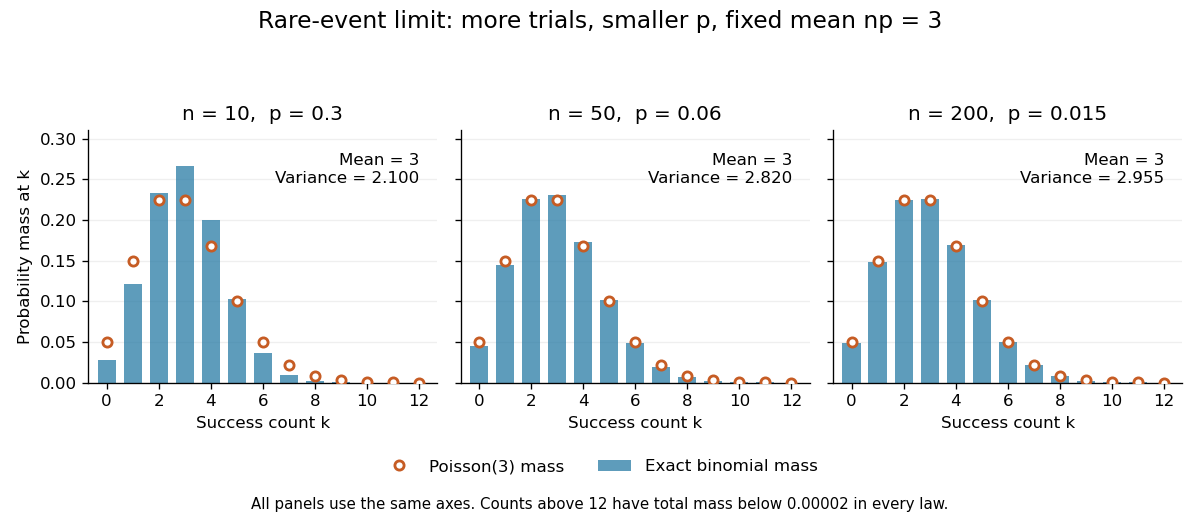
The panels show the same count scale and the same Poisson distribution reference. At , is not especially small and the difference is visible. No universal trial-count cutoff guarantees an adequate approximation for every event.
The independence assumption matters even when every success is rare. For , if all indicator random variables equal one shared Bernoulli random variable of parameter , their sum is zero with probability and with probability . Its mean is three, yet its zero-count probability tends to one, not . Some dependent counts still admit approximation through the Stein-Chen method, but this requires additional control of dependence.
For historical orientation, the BnF records Poisson's original probability treatise, Recherches sur la probabilité des jugements, as published in Paris in 1837. This bibliographic fact alone does not establish when the modern distribution terminology arose. See BnF record of Poisson's 1837 treatise.


The Poisson distribution is a discrete probability distribution that expresses the probability of a given number of events occurring within a fixed interval of time or space, assuming these events occur with a known constant mean rate and independently of the time since the last event. It is particularly useful for modeling the number of times an event occurs in a specific interval when the events happen independently.
New to topics? Read the docs here!