
At a point of a smooth surface, a normal section of a surface can bend by different amounts depending on its tangent vector. The principal curvatures are the largest and smallest signed normal curvatures among unit tangent vectors. Equivalently they are the two eigenvalues of the shape operator, with an orthonormal basis of corresponding principal directions. Here the labels follow the selected directions, without requiring . [ref]
https://ghomi.math.gatech.edu/Classes/Math497C/LectureNotes10.pdf. Ghomi, Lecture Notes 10, §2.3.3: normal curvature and principal curvatures
For a unit tangent vector making angle with , Euler formula for normal curvature givesThe normal curvature is a weighted average of the principal curvatures; the extremes occur in the principal directions. If the principal curvatures coincide, every direction in the tangent plane is a principal direction: this is an umbilical point. The Gaussian curvature and mean curvature summarize the pair by
For an outward-oriented sphere of radius , both principal curvatures are , so the normal curvature is in every direction. For an outward-oriented circular cylinder, choose around the circumference and along the axis. The principal curvatures are , giving ; halfway between the principal directions, .
At the origin of the upward-oriented hyperbolic paraboloid , the principal directions are the coordinate axes and the principal curvatures are in the chosen length unit. Thus , with zero normal curvature at . Zero normal curvature in these directions coexists with Gaussian curvature : the shape operator is not zero. The mean curvature is zero at this point; this does not say that the whole hyperbolic paraboloid is a minimal surface.
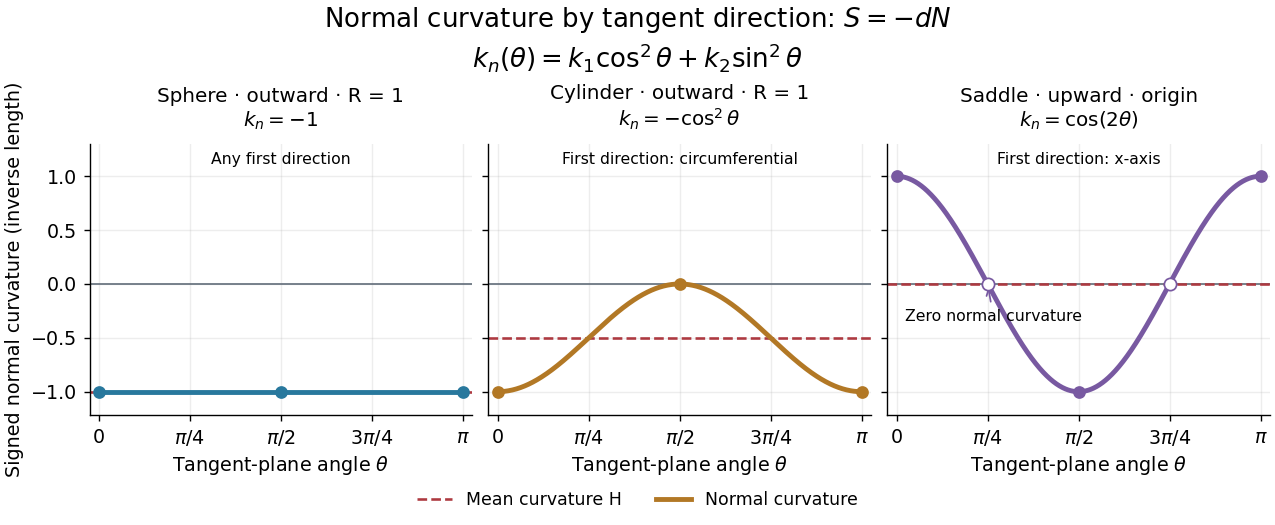

Each graph uses angle in the tangent plane, measured from the indicated first principal direction. The sphere and circular cylinder have ; the saddle graph refers only to the origin. Reversing the unit normal reflects each normal curvature graph through zero, negates both principal curvatures and the mean curvature, and preserves their product, the Gaussian curvature.
New to topics? Read the docs here!