Radiant exposure of a Gaussian beam
ID: radiant-exposure-of-a-gaussian-beam

The radiant exposure of a Gaussian beam is its time-integrated transverse irradiance. At a fixed plane normal to a circular Gaussian beam, suppose the Gaussian beam radius is unchanged during a pulse and denotes the radius where irradiance is of the on-axis value. With total laser pulse energy ,The primary beam account specifies this radius convention and the corresponding irradiance normalization; the radiant exposure parent derives its time integral.[ref]
Propagation of a Gaussian Beam Through a Thin Lens by Francesco D'Angelo. Gaussian Beam: Definition and Characteristics, equation1 and radius definition
An original aperture example asks how much of that energy a finite receiver collects. Integrating over a centred disk of radius gives the encircled radiant energy of a Gaussian beam:For stipulated , and , the receiver collects only percent, or . Its spatially averaged radiant exposure is about , compared with on-axis . Dividing the total by this receiver's area would count energy that missed it.
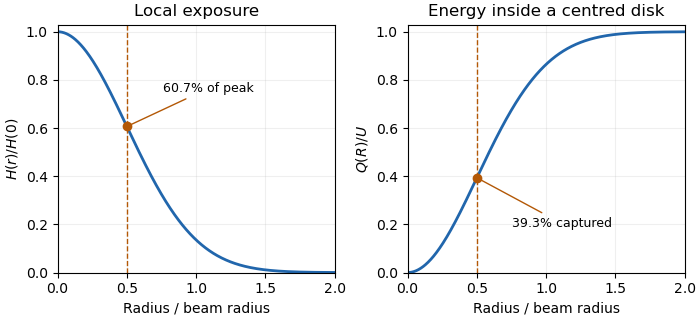
Local Gaussian radiant exposure and cumulative energy capture describe different functions of radius.
Details. 
To collect a chosen fraction under this ideal model, the centred aperture needs . For95percent, . A possible experimental check measures integrated received energy through several known apertures and compares their ratios. Aperture centring, detector linearity and any profile change during the pulse affect that comparison. A time-varying radius must remain inside the time integral rather than being replaced by an unspecified average radius.
New to topics? Read the docs here!