The radiant exposure of a Gaussian beam is its time-integrated transverse irradiance. At a fixed plane normal to a circular Gaussian beam, suppose the Gaussian beam radius is unchanged during a pulse and denotes the radius where irradiance is of the on-axis value. With total laser pulse energy ,The primary beam account specifies this radius convention and the corresponding irradiance normalization; the radiant exposure parent derives its time integral.[ref]
Propagation of a Gaussian Beam Through a Thin Lens by Francesco D'Angelo. Gaussian Beam: Definition and Characteristics, equation1 and radius definition
An original aperture example asks how much of that energy a finite receiver collects. Integrating over a centred disk of radius gives the encircled radiant energy of a Gaussian beam:For stipulated , and , the receiver collects only percent, or . Its spatially averaged radiant exposure is about , compared with on-axis . Dividing the total by this receiver's area would count energy that missed it.
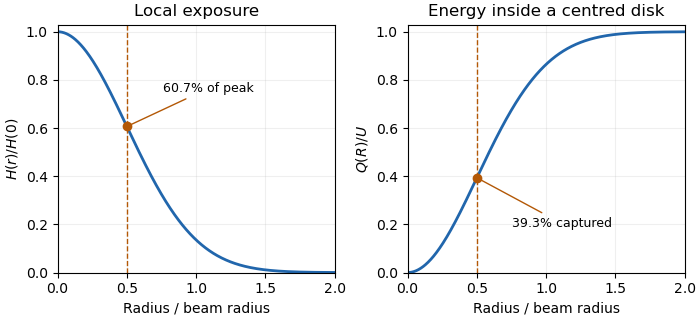
Local Gaussian radiant exposure and cumulative energy capture describe different functions of radius.
Details. 
To collect a chosen fraction under this ideal model, the centred aperture needs . For95percent, . A possible experimental check measures integrated received energy through several known apertures and compares their ratios. Aperture centring, detector linearity and any profile change during the pulse affect that comparison. A time-varying radius must remain inside the time integral rather than being replaced by an unspecified average radius.
The encircled radiant energy of a Gaussian beam is the radiant energy inside a centred circular receiver at a specified transverse plane. For fixed Gaussian beam radius and total laser pulse energy ,The radiant exposure of a Gaussian beam contains the radial integration and aperture-capture plot. Its is the irradiance radius, as specified in the primary beam account.[ref]
An original annular example distinguishes energy near an axis from energy between two radii. Subtracting two encircled values givesChoose , , and . The annulus receives , or 47.12 percent of the full beam energy. A bright central point does not imply that most energy lies in an arbitrarily small disk around it.
Indeed, the radial radiant-energy density of a Gaussian beam is , where is local radiant exposure. For this profile it is largest at , even though is largest at zero radius. Increasing a centred aperture and comparing integrated detector readings can test the cumulative prediction. Detector linearity, aperture alignment and the finite collection boundary must be controlled; a displaced aperture is not described by the centred formula.
The radial radiant-energy density of a Gaussian beam gives energy per increment of radius, rather than per unit surface area. For local radiant exposure and encircled radiant energy of a Gaussian beam ,Its units are , while has units . The primary Gaussian profile uses as the irradiance radius.[ref]
For an original narrow-annulus comparison, take and . The central disk from zero to receives about . The annulus from to receives about . Both span the same radial width, but the outer annulus has much more area. Equal radial width is not equal receiving area.
The shell density is maximal at and vanishes at , despite the local exposure being largest on axis. Dividing by gives a probability density function over nonnegative radius: it is a Rayleigh distribution with scale . This is an energy-weighted mathematical representation, not an additional photon-counting assumption. Differences between successive centred-aperture energy measurements estimate shell energies; dividing by their radial separation approximates when that separation is sufficiently small.
Articles by others on the same topic
There are currently no matching articles.