Ratiometric measurement
ID: ratiometric-measurement

A ratiometric measurement infers a quantity from a ratio of two measured signals chosen to share an unwanted multiplicative variation. The useful question is which inputs actually share that variation: a reference resistor error or a change in the sensor itself generally survives the cancellation.
In a shared-excitation resistance ratio measurement, a current source passes the same electric current through a sensor of electrical resistance and a reference resistor . Their electric potential differences are and . An ideal normalized analog-to-digital converter reading is thereforeThe current source need not have a perfectly constant output for this cancellation, provided both measurements sample the same electric current, the denominator is nonzero, and the converter stays within its operating ranges. This is a standard arrangement for a resistance thermometer.[ref]
A Basic Guide to RTD Measurements by Joseph Wu. §2.1.3, pp. 10–11, shared-current resistance measurement
For an original ideal example, take , and . Then , and . Increasing by gives and : the ratio remains . If the converter instead uses an independent fixed reference and the calculation assumes the original , the inferred electrical resistance becomes .
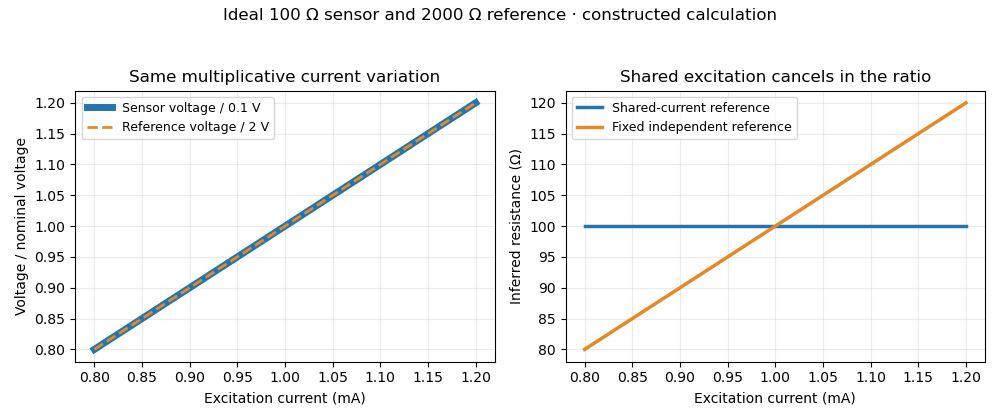
Shared excitation cancels in a resistance ratio; a fixed independent reference retains the excitation error. Original ideal calculation, not measured data.
Details. 
The reference-resistor error in ratiometric resistance measurement remains even with perfect shared excitation. If the actual reference resistor is but the calculation uses its nominal value, thenThus a reference error makes the nominal estimate of a true sensor about . Reference accuracy and its variation with temperature still matter.[ref]
Nor does the ratio remove sensor self-heating in a ratiometric resistance measurement. Joule heating dissipates , which is in the example. A temperature rise changes the actual electrical resistance of a resistance thermometer; the ratio then measures that changed resistance. Reducing the electric current or comparing several currents can reveal this physical effect.[ref]
The law of propagation of uncertainty makes the role of covariance explicit. For small perturbations of nonzero mean signals, the first-order measurement uncertainty of obeysThe contribution from a shared excitation fluctuation cancels through the covariance term. Treating the two signals as independent random variables would discard that cancellation. Other errors need their own inputs in the complete model.[ref]
For time-varying excitation, ratiometric cancellation with matched signal and reference filters requires matching dynamics as well as shared wiring. With constant resistances and identical linear time-invariant systems of impulse response , the filtered signals are and , so their ratio is still wherever defined. Here denotes convolution. Different filters or different sampling times can leave an excitation-dependent error.[ref]
RTD Ratiometric Measurements and Filtering Using the ADS1148 and ADS1248 Family of Devices by Luis Chioye. First-page abstract and low-pass filter design discussion, matching input and reference filters
A simple proposed bench test first replaces the sensor by a stable calibrated resistor, sweeps the electric current within the instrument limits, and records both electric potential differences and their ratio. That separates electrical cancellation from changing sensor temperature. Repeating with a resistance thermometer in a stable bath then tests Joule heating; changing the reference resistance or one filter tests the predicted failure modes. These are proposed checks of the model, rather than reported experimental results.
New to topics? Read the docs here!