A thermometer that infers temperature from a calibrated electrical resistance. Measuring current can heat its sensing element; extrapolation toward zero current controls that bias in the saturation-pressure equilibrium measurement.
A resistance thermometer using platinum as its sensing material. It provides the temperature readout in the saturation-pressure equilibrium measurement.
Transduction turns electrical resistance into a temperature indication. A uniform wire has , with electrical resistivity , length , and cross-sectional area . Stronger atomic vibrations at higher temperature scatter Electrons more, increasing platinum's electrical resistivity; impurities and crystallographic defects also contribute.[ref]
Guide on Secondary Thermometry: Industrial Platinum Resistance Thermometers by Jonathan Pearce and others. Guide on Secondary Thermometry: Industrial Platinum Resistance Thermometers, §2.1, printed pp. 6–7: resistivity, electron scattering, and impurities
A small known electric current and measured electric potential difference give through Ohm's law; a resistance bridge can instead compare the element with a reference resistor. Inverting the calibrated response then gives the sensing element's temperature. This makes electrical readout convenient, but the platinum resistance thermometer lead resistance error, resistance thermometer self-heating, and resistance thermometer immersion test explain why a stable display alone is insufficient. The gas thermometer supplies a contrasting route through an equation of state; the saturation-pressure equilibrium measurement shows why a trustworthy independent temperature readout matters.
A standard platinum resistance thermometer uses very pure, annealed platinum with strain-limiting construction. An industrial platinum resistance thermometer commonly uses supported wire or a film. Their response curves differ.[ref]
The word standard describes the instrument's metrological role. Calibrated SPRTs realize specified interpolation intervals of the International Temperature Scale of 1990 and transfer reference temperatures to other thermometers.[ref]
Mercury Thermometer Alternatives: Platinum Resistance Thermometers (PRTs) by National Institute of Standards and Technology. Platinum Resistance Thermometers, opening explanation: SPRTs as ITS-90 interpolation tools
They are primary standards for realizing that practical scale, but their electrical resistance alone does not determine absolute thermodynamic temperature without calibration. Primary thermometry such as the corrected gas thermometer obtains thermodynamic temperature from a physical law. A reference in a comparison bath may be an SPRT; an individually calibrated industrial platinum resistance thermometer can also serve as a working reference with an appropriate uncertainty.An industrial platinum resistance thermometer is a platinum resistance thermometer built for practical measurement conditions. The label Pt100 specifies a nominal reference electrical resistance, not an SPRT, a calibration certificate, or a universal accuracy. Calibrate the probe together with its readout when the desired result is the performance of the complete indicating system.
A Pt100 has nominal electrical resistance at .[ref]
Mercury Thermometer Alternatives: Platinum Resistance Thermometers (PRTs) by National Institute of Standards and Technology. Platinum Resistance Thermometers, opening explanation: conventional 100-ohm element at 0 °C
Here is the reference for the nominal element designation; it is distinct from the water triple point used in SPRT calibration. The following Pt100 local linear model deliberately stipulates one approximate response for calculations.Choose the illustrative local modelHere is the Celsius temperature, measured relative to , so is dimensionless. For this chosen affine function, the derivative and inverse relation areCalculated values are , , , and . These are model outputs, not measurements or an assertion that any real Pt100 follows this line exactly. The number here is the chosen slope parameter; it is not a universal local derivative for all platinum resistance thermometers. Curvature, manufacturing differences, and the fitted calibration interval matter. A wider-range calibration uses a validated response curve rather than extrapolating this line indefinitely.
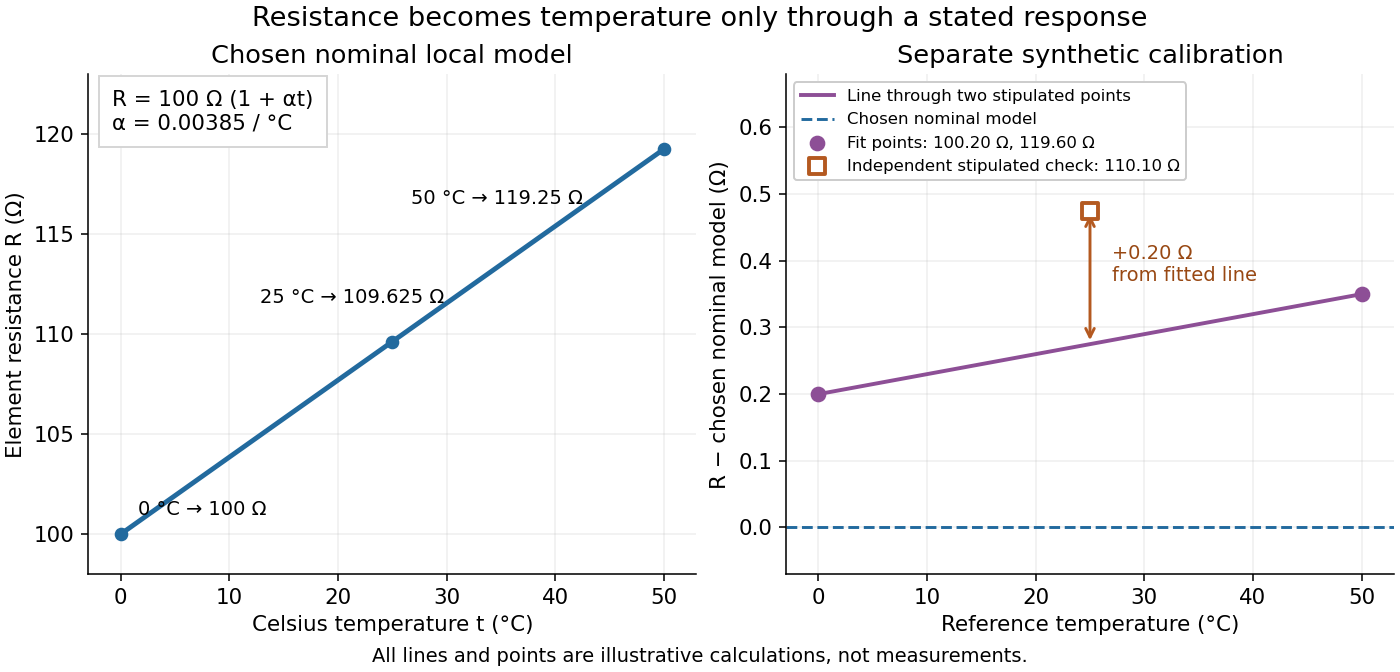
Chosen Pt100 line and an illustrative calibration with an independent check
. The left panel plots the Pt100 local linear model. The right panel uses stipulated values for a different illustrative element: two points set a line, while a third point tests it. Every point is synthetic; none is measured calibration data or a tolerance band. Source. Details.
For a separate synthetic thermometer calibration, stipulate at and at . A two-point affine function has slope and givesThus would indicate . If an additional synthetic check at reference instead supplied , the line would indicate . The residual exposes disagreement that two fitted points cannot reveal. This separate example changes both offset and slope; it is not a replacement specification for the nominal Pt100 local linear model.
A 1998 NIST account describes stirred comparison baths, a reference SPRT with a 30 Hz resistance bridge, and a temperature-controlled reference resistor. The test IPRTs used a current source, a scanner, and an 8½-digit voltmeter. Separate current and voltage leads made each test probe a four-terminal device; readings in both current directions supplied voltage ratios to the reference resistor.[ref]
A New NIST Automated Calibration System for Industrial-Grade Platinum Resistance Thermometers by Gregory F. Strouse and others. A New NIST Automated Calibration System for Industrial-Grade Platinum Resistance Thermometers, §§3.1, 3.3 and 4.2, printed pp. 2–6: baths, readout, four-terminal devices and reversed current
Its program bracketed test readings with reference SPRT readings and repeated a block if bath drift was excessive. A check SPRT monitored the system; reference water-triple point measurements checked stability. Sensor depths were matched, and unfamiliar probes underwent immersion tests. Ice and water-triple point readings before and after calibration checked changes. Additional points could test the fitted curve. Reported calibration uncertainties excluded transport, subsequent drift, hysteresis, and the user's measurement system. These are controls and limits of that documented apparatus, not an accuracy promise for all platinum resistance thermometers.[ref]
The inference is a pair: reference temperature from the SPRT, test electrical resistance from the electrical readout. Record measuring electric current, wiring, immersion, and the stated reference scale with each pair. A bath controller's setpoint is not itself the calibrated reference temperature. Returning to a reference and checking intermediate points distinguishes a fitted relation from a reproducible calibration over the intended interval.
With two shared leads of electrical resistances , Ohm's law givesUsing the Pt100 local linear model, positive lead electrical resistance appears as a warmer temperature. At true , stipulated leads of each change into , producing : a calculated bias of about . Subtracting a measured loop correction works only while that loop electrical resistance remains appropriate; cable temperature changes can invalidate it.
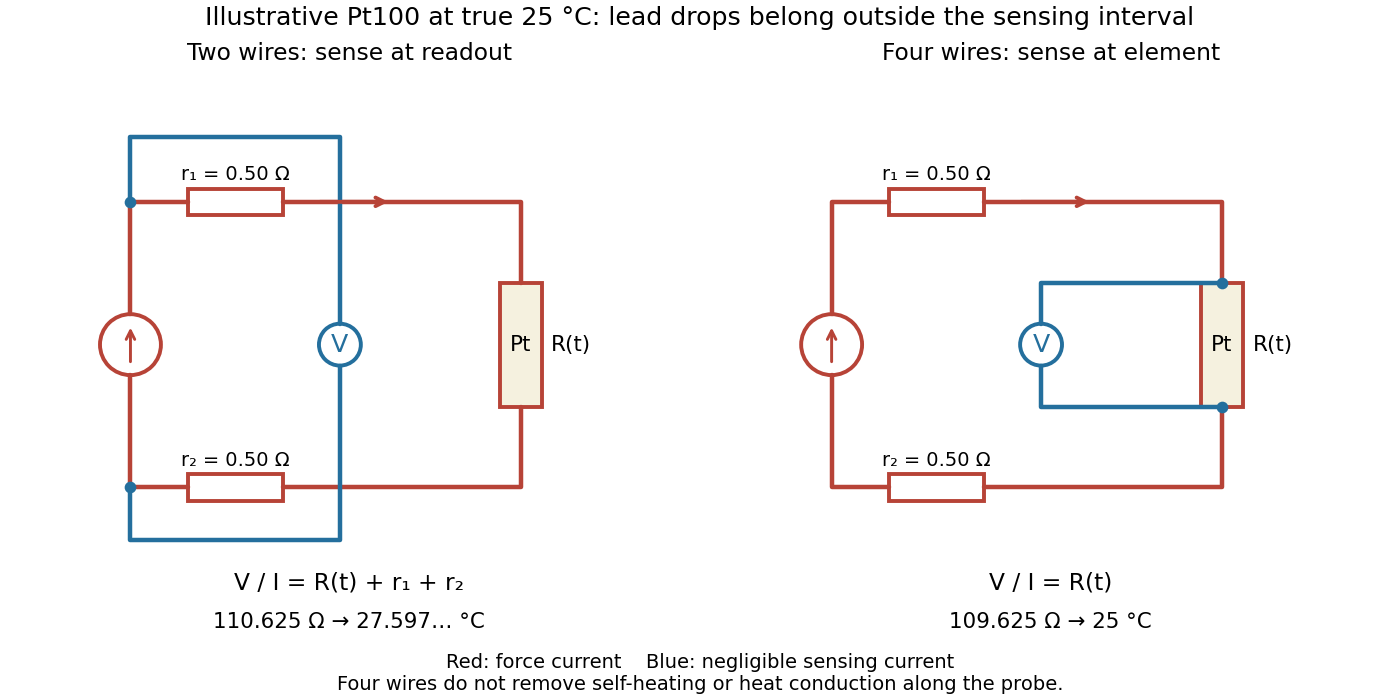

Four-terminal sensing separates the electric current and electric potential difference leads. Negligible sensing electric current suppresses sensing-lead drops; force-lead drops lie outside the interval. Real voltmeter loading, connections, and leakage still need checking.[ref]
For a stable offset from the thermoelectric effect, two signed electric potential differences obey and . The current-reversal calculation in four-terminal sensing yieldsAt stipulated , and , and recover exactly in this model. If the offset or sample temperature changes between readings, cancellation is incomplete. Reversal also leaves Joule heating unchanged because it depends on .
Measuring electric current creates Joule heating, raising the sensing temperature. At fixed bath temperature, compare settled readings at and and extrapolate the approximately linear dependence toward zero current.[ref]
Guide on Secondary Thermometry: Industrial Platinum Resistance Thermometers by Jonathan Pearce and others. §4.1, printed pp. 24–26, equation (4.1.1): self-heating, two-current extrapolation, and medium dependence
Under the local model ,For synthetic readings at and at , the extrapolated value is . The lower-current excess corresponds to in the Pt100 local linear model. At , dissipates ; power alone does not specify a temperature rise without a thermal coupling model. These stipulated values are not measurements.
Repeat the comparison after settling and test the approximation if necessary. Changing from liquid to air changes heat transfer; a self-heating correction need not transfer unchanged. The saturation-pressure equilibrium measurement provides an existing example of controlling this disturbance in resistance thermometry.
A probe's sheath and leads carry heat between the sensing region and the surroundings through thermal conduction. In a stable, sufficiently uniform heat bath, compare the indicated temperature as insertion depth increases, allowing settling each time. A plateau supports adequate immersion for that apparatus and required uncertainty; it does not prove that every depth or medium works. Keep the sensing element and reference thermometer at comparable depths, and check bath gradients independently, so moving the probe does not merely sample a different temperature. The documented platinum resistance thermometer comparison calibration includes these controls.
Articles by others on the same topic
There are currently no matching articles.