Richardson hot-wire emission experiment
ID: richardson-hot-wire-emission-experiment

In his Nobel lecture, delivered on 12 December 1929 for the 1928 prize, Owen Willans Richardson recalled heating wires for weeks while hand-pumping away gas released by the apparatus. With platinum, he found a finite emission per unit area that rose rapidly with temperature. His initial 1901 formula used ; he preferred the form in 1911.[ref]
Thermionic Phenomena and the Laws which Govern Them by Owen Willans Richardson. Nobel Lectures, Physics 1922–1941; pp. 224–225 and 229, preparation and chronology
The early apparatus surrounded a heated platinum wire with a metal cylinder connected to earth through a galvanometer. Wire electrical resistance supplied the temperature readout. After checking collection saturation, Richardson measured at a wire potential of , over roughly –; reversing polarity suppressed the negative discharge.[ref]
O. W. Richardson and the Electron Theory of Matter, 1901–1916 by Ole Knudsen. Histories of the Electron: The Birth of Microphysics edited by Jed Z. Buchwald and Andrew Warwick; pp. 229–231, resistance thermometry and Fig. 7.2, reproducing the 1903 apparatus
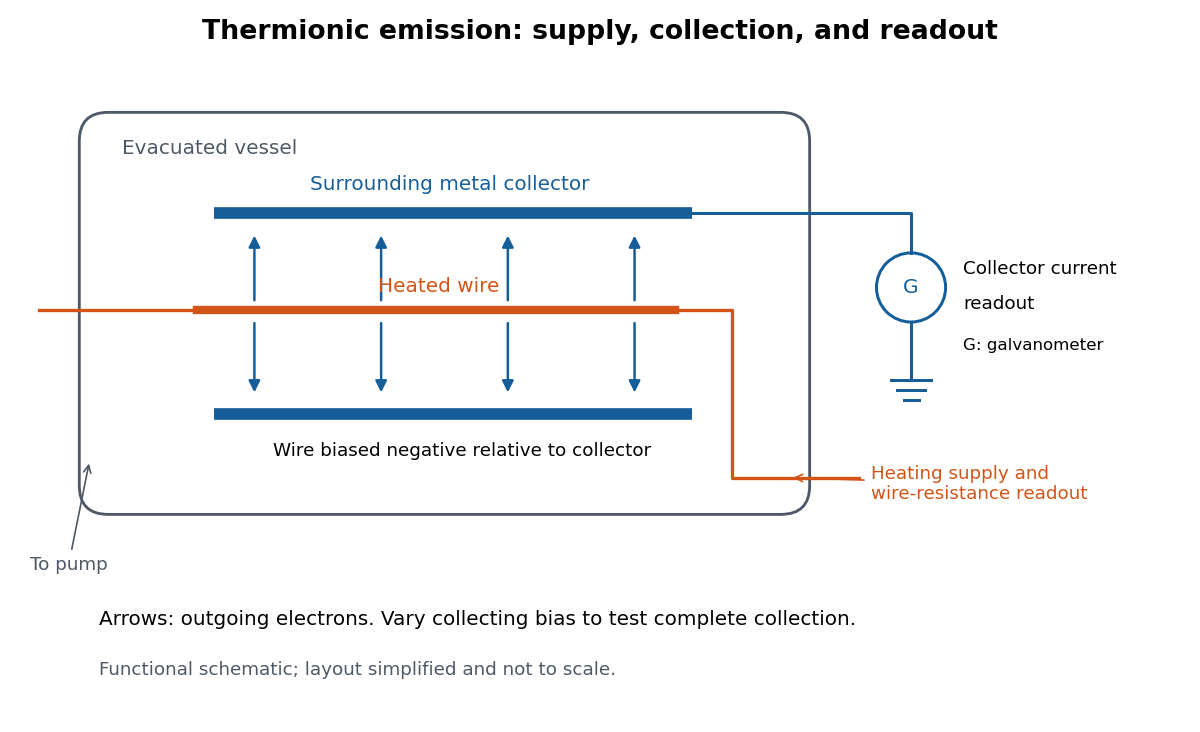
Heated-wire emission and separate collection and temperature measurements
. Original functional schematic of the measurement principle, with a wire and surrounding collector shown in section. The layout is simplified; no dimensions or instrument performance are asserted. Details.
The inference rests on several controls. A temperature sweep probes thermal escape; reversing the collecting electric field tests the sign of the mobile electric charge; varying collection voltage tests whether transport is limiting. Prolonged pumping and heating test whether a transient gas release is responsible. These controls address different alternatives, and none by itself establishes a clean, uniform surface.
For a modern repetition, stabilize each temperature, measure the collector electric current against collecting electric potential difference, and record the pressure and surface preparation. Repeat selected temperatures after cooling to reveal drift. Use the collection plateau and the actual emitting area to construct a Richardson plot. The resulting slope estimates the work function only within the stated surface and transport assumptions; it does not turn an uncontrolled wire into a reference material.
New to topics? Read the docs here!