Ruby pressure uncertainty worked example
ID: ruby-pressure-uncertainty-worked-example

Construct a synthetic local calibration to show the calculation independently of the historical data. Choose reference pairs , with shifts in and pressures in . The reference zero is already subtracted. Treat the shifts as exact for this fit and give the three reference pressures equal weights. Minimizing the ordinary least squares objectiveand setting its derivative to zero givesThe regression residuals are . Their weighted moment vanishes, as required by the least-squares normal equations. An unknown reference offset requires fitting an intercept instead; forcing it to zero can bias the slope. If shift errors matter, this elementary fit is insufficient.
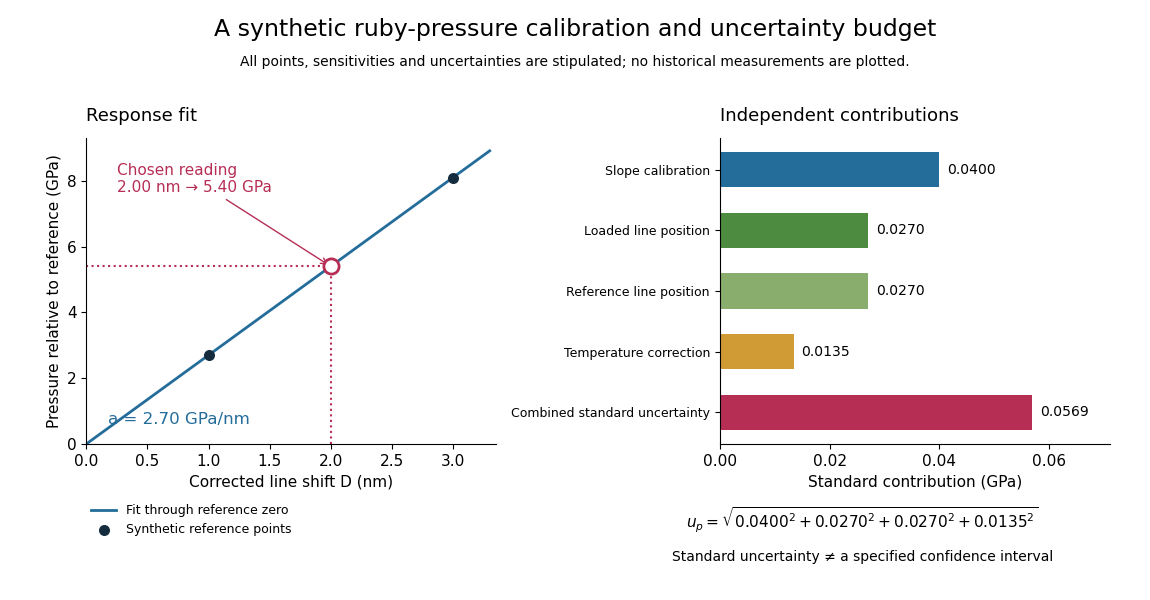
Synthetic ruby pressure scale: fitting the response and propagating measurement uncertainty
. Original stipulated reference points and calculations, not measured historical calibration. The left panel shows the fitted slope and a chosen reading. The right panel separates independent contributions to standard uncertainty; bar lengths are standard contributions, which combine by sums of squares. The assigned slope standard uncertainty includes a hypothetical reference-scale contribution and is not estimated from the three residuals. Details.
Use the local measurement modelHere denotes pressure relative to the reference, is calibrated sensitivity, and is a local wavelength sensitivity to temperature at fixed pressure. Choose , and a reading at . The inferred pressure is . These coefficients and readings are stipulated, not measured ruby constants. With the same pressure, a increase in temperature would add to the shift in this model; neglecting it would overestimate pressure by .
Assign independent standard uncertainties , and for the temperature difference. Here is an independently assigned calibration uncertainty, not an estimate from the regression residuals above; treat as exact in this example. First-order propagation of uncertainty follows by differentiating the measurement model:The four standard contributions are , giving . This is a standard uncertainty, not automatically a interval. Correlated reference and loaded wavelength readings require the corresponding covariance term; common wavelength-axis drift may cancel in their difference. Uncertain , nonzero , model inadequacy and unresolved deviatoric stress require a broader budget. Taking more optical readings reduces some random errors while leaving a common reference-scale error.
New to topics? Read the docs here!