Sequential bond-dissociation energies
ID: sequential-bond-dissociation-energies

Equivalent chemical bonds in an intact molecule need not have equal successive bond-dissociation enthalpies. Once one chemical bond is removed, the next reactant has a different electronic quantum state and may relax to a different molecular geometry. The successive steps compare different species. This distinction also explains why a tabulated average chemical bond strength is not necessarily the cost of the first cleavage.[ref]
7.5 Strengths of Ionic and Covalent Bonds. “Bond Strength: Covalent Bonds”, methane paragraph: equivalent initial bonds and unequal sequential breaking costs
For an invented species , stipulate the following gas-phase steps, with all enthalpies at the same temperature and the same standard states:The symbols stand for hypothetical species with consistently chosen electronic states. They are not values for water or another measured molecule. By Hess's law, the total enthalpy of atomization for is ; the arithmetic mean per broken chemical bond is . Neither individual step equals that mean. Nor must the second step be cheaper: here it is deliberately more expensive. An exact sequence sums exactly; substituting averages taken from other molecules generally gives only an estimate.
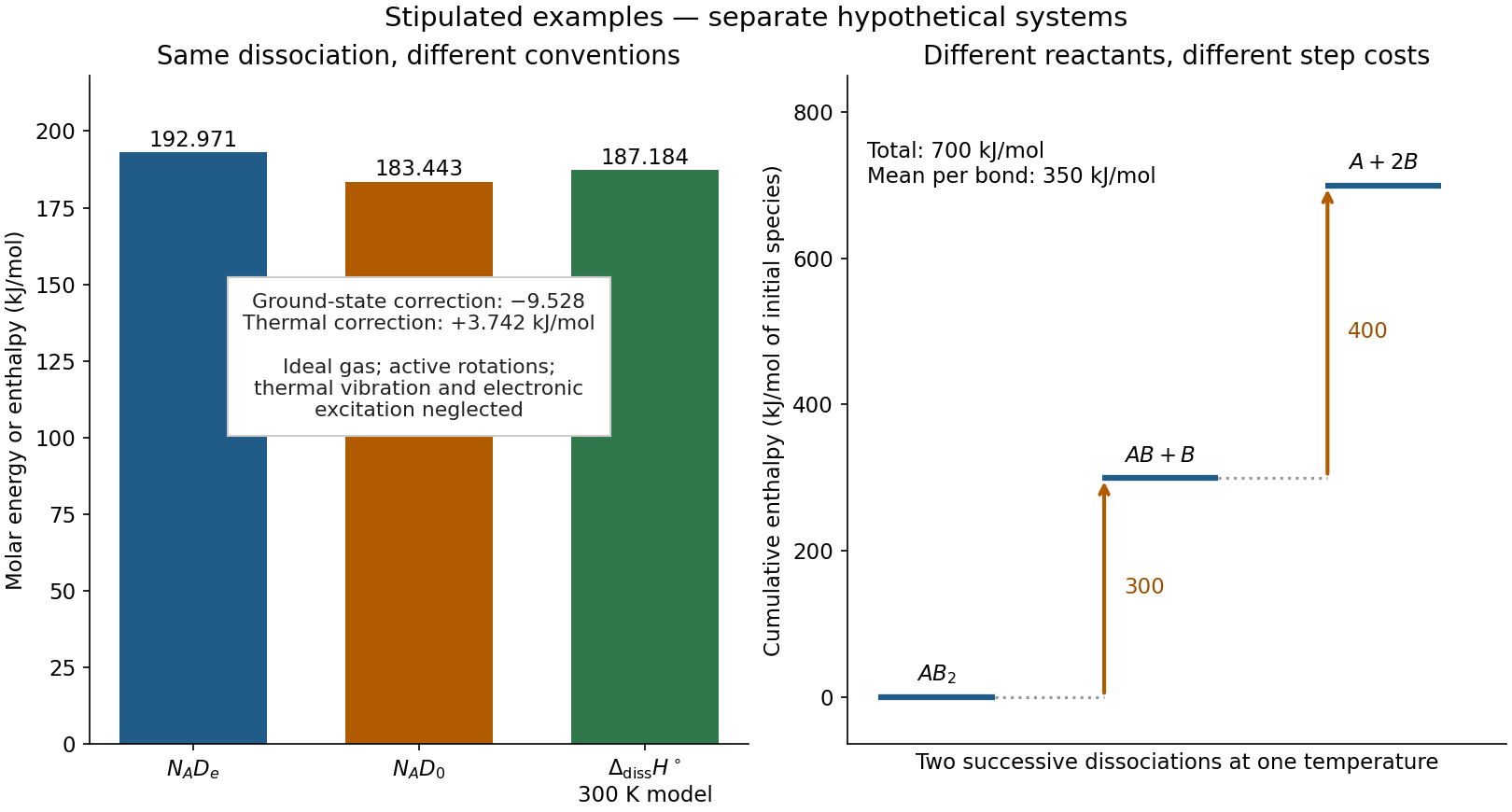
Two stipulated examples: changing the energy convention for one dissociation, and changing the reactant during sequential cleavage
. Left: , , and the model bond-dissociation enthalpy at . Right: cumulative enthalpy levels for two successive steps, with costs and and mean . The panels are separate hypothetical systems; neither contains molecular measurements. Details.
New to topics? Read the docs here!