Sequential excited-state population kinetics
ID: sequential-excited-state-population-kinetics

Sequential excited-state population kinetics describes transfer from an initially prepared excited state into another excited state that subsequently decays. The measured rise and decay are consequences of both population flow and the detection model. A single fitted exponential function need not identify a unique molecular step.
Let upper-state loss rate be , lower-state loss rate and transfer rate . Starting with , ,For ,The transfer branching fraction is . If upper-state loss has competing channels, not every initial excitation reaches the lower state.
The equal-rate limit is finite, although the displayed difference quotient looks singular. Taking givesFor stipulated in consistent inverse-time units, the lower population peaks at with value . The apparent denominator singularity is a numerical representation issue, not infinite population.
For unequal rates, the peak time isWith and , it is about 9.21 ps. This differs from the upper-state time constant of 1 ps: a population maximum and a single-step time constant are not interchangeable observations.
An instrument-response limit in sequential population inference enters when observed fluorescence is a convolution of the radiative population signal with the instrument response, plus background. Temporal broadening can obscure a very fast rise. Spectral overlap can also mix upper- and lower-state contributions. A proposed analysis fits the response-convolved model to multiple assigned signals rather than interpreting an unresolved rise as an exact molecular rate.
For same-multiplicity electronic states, molecular internal conversion supplies one physical transfer mechanism. IUPAC defines it as a radiationless transition with vibrational excitation possible in the lower electronic state.[ref] The equations above are original kinetic models; their parameters require experimental determination for the molecule and conditions studied.
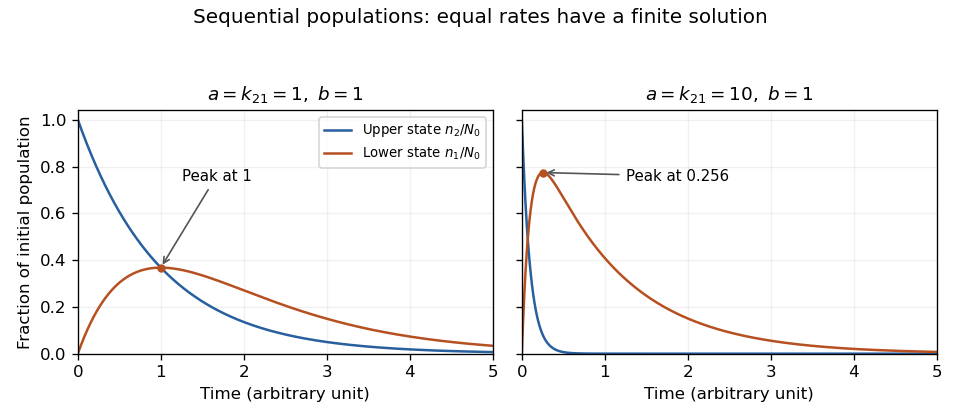
Exact sequential population solutions for coincident and separated loss rates. The equal-rate limit is finite and its lower-state population peaks after the upper-state population has begun to decay.
Details. 
New to topics? Read the docs here!