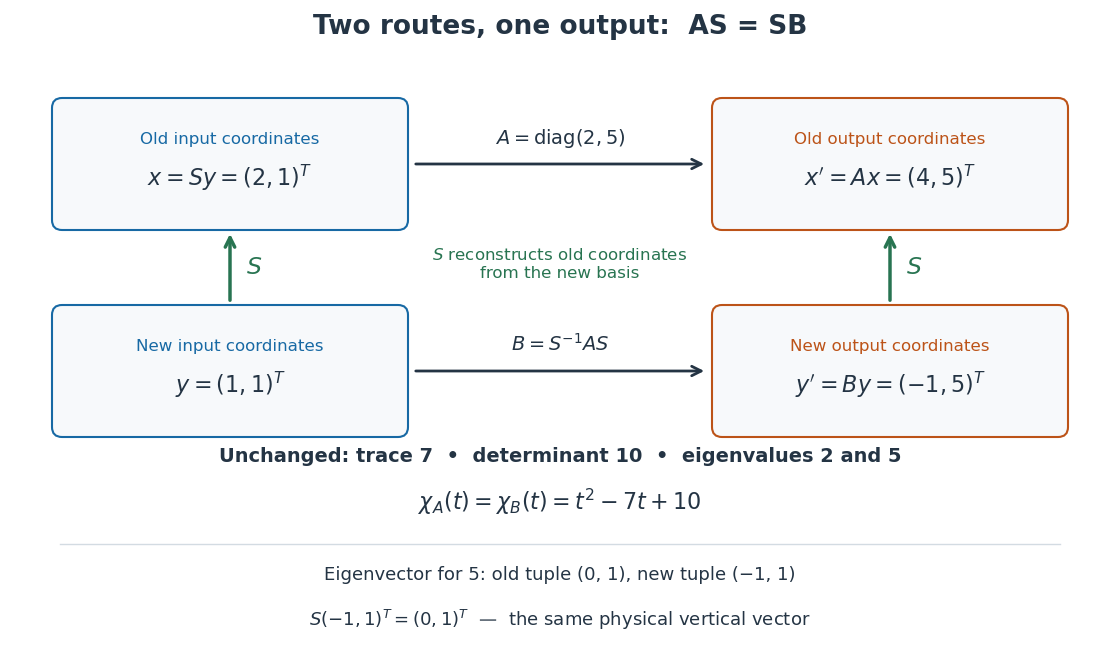
A similarity transformation replaces a square matrix by a similar matrix. With the change-of-basis matrix convention , it sends to : reconstruct the input in old coordinates, apply , then extract the output's new coordinates. These three operations explain the order of the factors.
The equivalent formula uses as the conversion from old to new coordinates, reversing the role assigned to above. For the opening example's numerical , this opposite conversion gives . If the old basis is , the new basis vectors in that convention are the columns of , namely and . Both formulas are similarity transformations; the direction of the coordinate conversion decides which one describes a specified basis.
An especially useful form is the intertwining operator equationIt says that applying before reconstruction by gives the same physical output as reconstructing first and applying . Given an invertible matrix , multiplying this equation by proves matrix similarity. Without invertibility, the equation alone does not prove matrix similarity.

For real matrices, orthogonal similarity is the special case with an orthogonal matrix. Then a symmetric matrix remains symmetric, because . The expression describes the reverse conversion and has the same property. An orthonormal basis retains the ordinary dot product formula for its coordinate vectors.
An arbitrary change of basis need not preserve entrywise symmetry. In the opening example, is a symmetric matrix but is not. The geometric inner product has not disappeared: in the new coordinates it is represented by the Gram matrixFor with new coordinate vector , the squared Euclidean norm is , agreeing with . The naive coordinate sum would use the wrong inner product.
If , direct multiplication givesThis is self-adjointness expressed in the new inner product, rather than entrywise symmetry relative to the identity matrix. For the example, both products equal . Thus arbitrary matrix similarity preserves the linear operator, while its geometric interpretation requires transforming the Gram matrix as well. Matrix congruence supplies the corresponding rule for a bilinear form and should be distinguished from matrix similarity.
If a real matrix has a positive diagonal matrix such that is a symmetric matrix, then is a symmetric matrix related to by a similarity transformation: gives . Thus is a diagonalizable matrix with real eigenvalues. If for all real vectors , its eigenvalues are nonpositive. This converts symmetry in a weighted inner product into Euclidean symmetry.
Let a real tridiagonal matrix have diagonal entries , positive upper entries , and positive lower entries . Set , and . Then is a symmetric matrix with diagonal and adjacent entries . Indeed its two adjacent entries are and , which are equal by construction. All other zeros are preserved. This matrix similarity implies real eigenvalues and diagonalizability, by the spectral theorem for real symmetric matrices. No sign assumption on is needed. In the weighted formulation of positive diagonal symmetrization of a matrix, the positive diagonal matrix is .
Every unital algebra automorphism has the form for some invertible . One proof transports the matrix units through , chooses compatible bases for their rank-one images, and reconstructs the common similarity transformation.
Articles by others on the same topic
There are currently no matching articles.