Single-phonon neutron scattering model
ID: single-phonon-neutron-scattering-model

Consider an original ideal one-dimensional monatomic harmonic oscillator chain with neighbor separation , mass and nearest-neighbor restoring coefficient . Its displacement equation isSubstitute the normal mode . Since ,Choose ångströms and . This is one acoustic phonon branch, distinct from the two-atom elastic example. It has and .
For coherent creation of one phonon in a crystal, the excitation's wave vector and the measured transfer obey , with a reciprocal lattice vector. To connect the dispersion relation to an illustrative intensity, take zero temperature, longitudinal displacements and the first interval , choosing . Expand the scattering phase to first order, . The constant term supplies elastic scattering; the linear term creates one phonon. Its displacement matrix element is proportional to , so the squared amplitude has weight , apart from common factors. Normalize this weight to one at :The limit follows from . Set and replace the ideal sharp line by a normalized Gaussian function:This chosen broadening illustrates readout width; it is not a measured resolution or a full spectrometer resolution function. Integrating over all gives . The small negative-energy tail is a broadening artifact, not a zero-temperature phonon-annihilation signal.
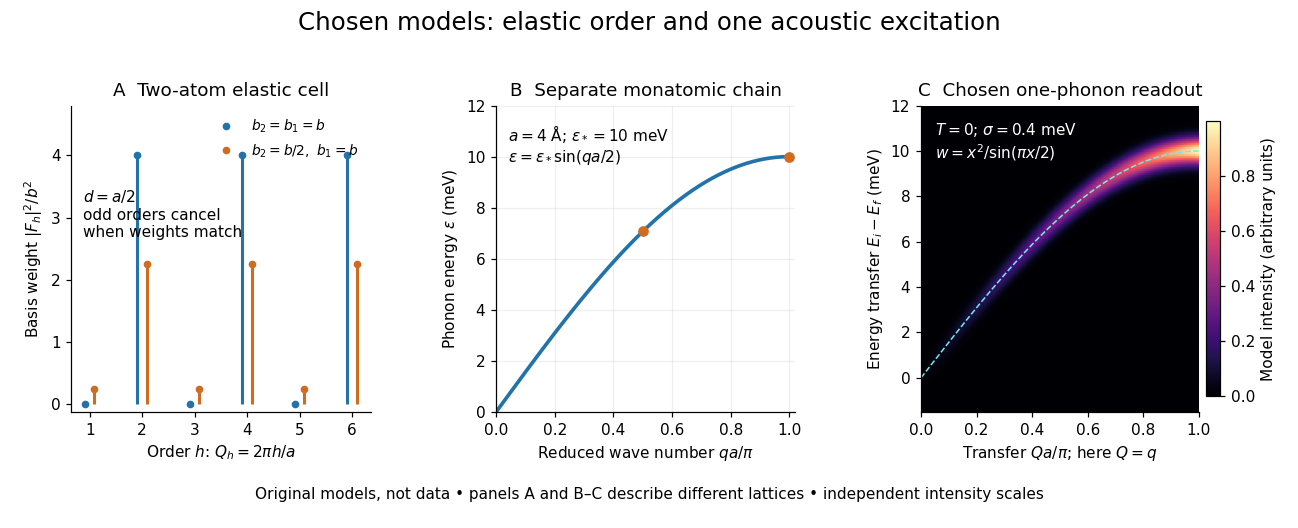

These panels separate three kinds of information: allowed reciprocal lattice positions, cancellation within a crystal basis structure factor, and an excitation's energy as a function of wave vector. The chain has no magnetic degrees of freedom, optical branches, damping or multi-phonon processes. It illustrates how one excitation could be read; it proves nothing about the completeness of a real material's excitation spectrum.
New to topics? Read the docs here!