Stationary distribution
ID: stationary-distribution

A stationary distribution is a probability distribution preserved by a Markov chain's evolution. For a Discrete-time Markov chain in the row convention,Thus is a normalized nonnegative left eigenvector of the transition matrix for eigenvalue one. Starting with distributed as makes every have that same probability distribution. For a time-homogeneous Markov chain, the path probabilities are also unchanged by shifting all observation times together: the process has strict stationarity. This does not mean its individual paths are constant. See Hao Wu's MIT lecture 2, stationary distributions.
For the sunny/rainy transition matrix, write . The sunny component of gives , so andMoreover,These equal stationary flows verify detailed balance and show that the Markov chain is reversible. The diagonal detailed balance equations hold automatically. Only of the stationary days are rainy, but of the days following a rainy day are rainy: stationarity permits dependence.
A finite Markov chain that is an irreducible Markov chain has a unique stationary distribution. If it is also an aperiodic Markov chain, for every initial probability distribution. The sunny/rainy example satisfies both conditions: both directions are possible and each state has a positive holding probability of a Markov chain. See Hao Wu's MIT lecture 4, convergence theorem. For an infinite state space, the additional positive recurrence hypothesis in the countable-state Markov chain convergence theorem matters.
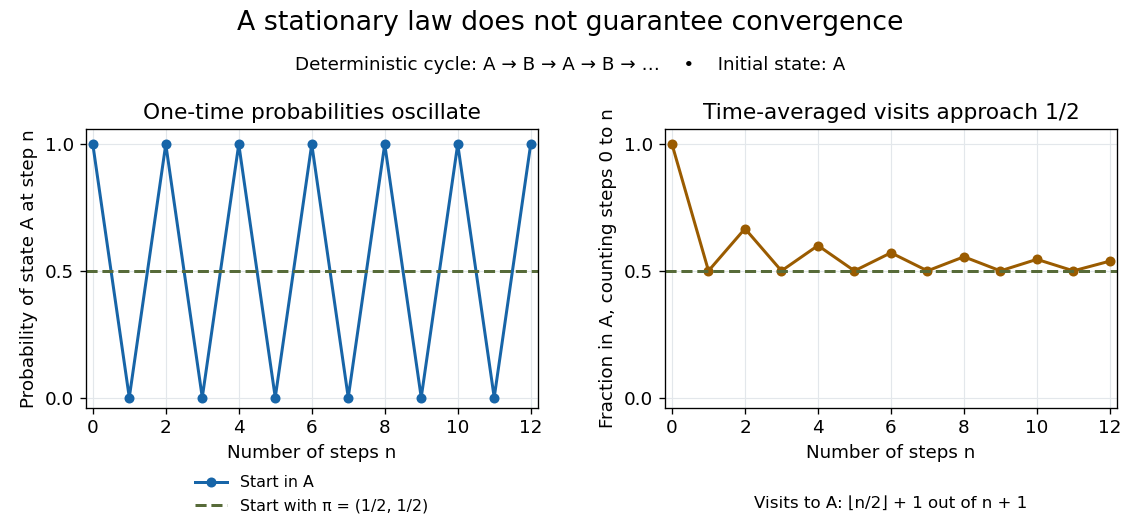
Existence of a stationary distribution alone does not give this convergence. Consider the deterministic two-cycleHere , but starting in the first state gives alternating probability distributions . Its period of a state in a Markov chain is two. The running fraction of visits to either state nevertheless tends to , illustrating the Markov chain ergodic theorem. Starting with instead keeps the one-time probability distributions stationary even though every path alternates.


A **stationary distribution** is a concept primarily used in the context of Markov chains and stochastic processes. It refers to a probability distribution that remains unchanged as time progresses. In other words, if the system is in the stationary distribution, the probabilities of being in each state do not change over time.
New to topics? Read the docs here!