A chemical equation represents a chemical reaction using chemical formulas, with reactants on the left and reaction products on the right. A balanced chemical equation has the same number of chemical atoms of each chemical element on both sides. For molecular hydrogen and molecular oxygen forming water,The coefficients give the relative numbers of molecules; the coefficient is normally omitted. Count hydrogen as on the left and on the right, and oxygen as on the left and on the right. See Flowers et al., Chemistry 2e, §4.1: writing and balancing chemical equations.
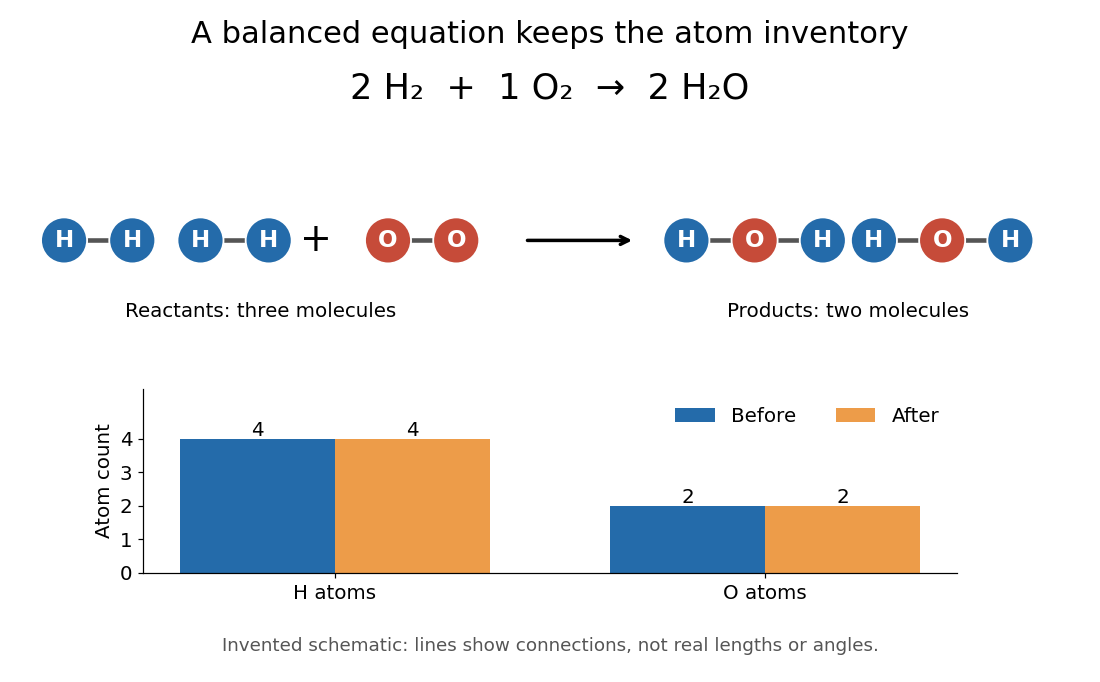

To balance the initial expression , first put before water to match the two oxygen chemical atoms. This creates four hydrogen chemical atoms on the right, so put before molecular hydrogen. Changing a coefficient multiplies the entire chemical formula. Changing a subscript changes composition and usually the chemical substance: is two water molecules, whereas is one hydrogen peroxide molecule. Never balance a chemical equation by changing its subscripts.
The bookkeeping follows from conservation of the atomic nuclei in ordinary, non-nuclear chemical reactions; chemical bonds and the distribution of Electrons can change. For a chemical equation involving ions, total electric charge must also match. For example, the existing self-ionization of water equation has zero total electric charge on each side, since the of hydronium cancels the of hydroxide. See 2.6 Ionic and Molecular Compounds (§2.6: nuclei and ions).
The same ratio relates changes in amount of substance: two moles of molecular hydrogen consumed per mole of molecular oxygen correspond to two moles of water formed. A mole is a defined unit, not one molecule; the little whole-number picture is an abstract counting model, not a claim that a macroscopic sample contains just five molecules. See molecular count and amount of substance for the exact conversion and BIPM, SI base unit: mole for the definition.
This is why a balanced chemical equation is useful: stoichiometry turns the same atom accounting into relations between measurable quantities. It does not determine reaction rate, the final conversion set by chemical equilibrium, or the actual yield of recovered reaction products. The limiting reagent gives an upper bound under the specified chemical reaction.
Articles by others on the same topic
There are currently no matching articles.