Thermal equilibration of two finite bodies
ID: thermal-equilibration-of-two-finite-bodies

Consider two rigid bodies forming an isolated system, with fixed composition and constant whole-body heat capacity at constant volume values and . Their initial temperatures are and . Assume each body remains internally uniform, their contact stores negligible energy, no phase transition occurs and no work is done or extracted. These are stipulated model values, not material measurements.
Because , write with arbitrary fixed reference constants . The conserved relative internal energy isThis is an energy reference convention, not a claim about actual heat capacities down to zero temperature. At thermal equilibrium the two temperatures equal , so the first law of thermodynamics givesThe larger heat capacity pulls the common temperature closer to its initial value: body 1 warms by , while body 2 cools by .
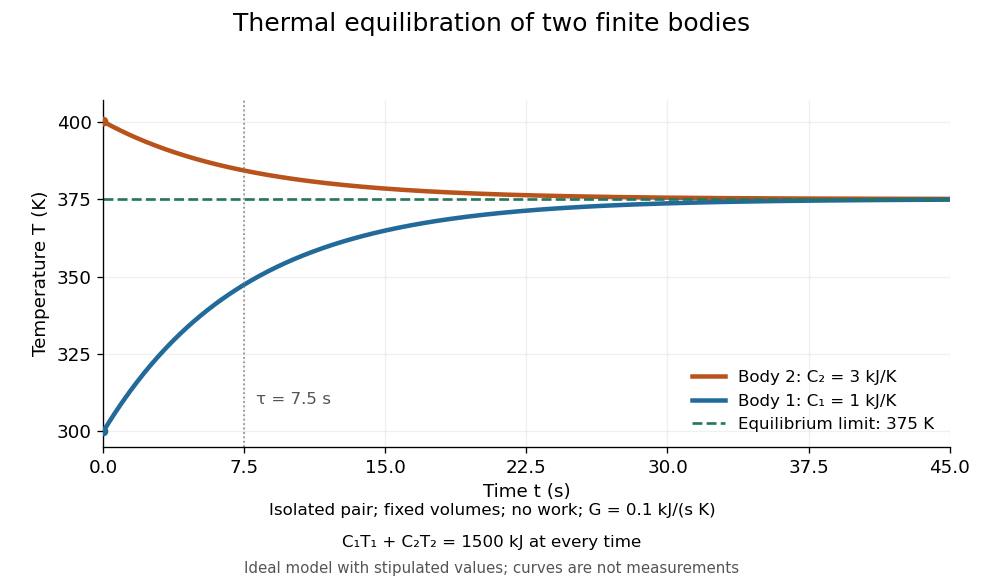
Two finite bodies approach thermal equilibrium at
. Ideal model with and and contact conductance . The weighted temperature stays at and the relative internal energy stays at ; the plotted curves are model predictions. Details.
To predict a timescale, stipulate a constant contact conductance , the reciprocal of the contact's thermal resistance. The rate of heat transfer into body 1 is , givingAdding proves conservation of . Subtracting gives exponential decay of the temperature difference, with time constantand thereforeExact equality is approached as in this ideal model. Changing changes the rate but not : equilibrium and the speed of reaching it are separate predictions. Real bodies can have internal temperature gradients, changing heat capacities and contact losses, so the plotted is an assumed model timescale.
New to topics? Read the docs here!