Three-sublevel optical pumping model
ID: three-sublevel-optical-pumping-model

Consider an original hypothetical atom with a lower angular momentum multiplet , , and one opposite-parity excited level . Stipulate that all spontaneous emission returns to these three lower quantum states, with no other decay channel. This is an isolated four-state model, not the actual sodium or rubidium D-line structure. In particular, the physical rubidium cell above contains multiple hyperfine structure levels.
The electric-dipole selection rule permits here; absorption with excites only . Decay from has three equal integrated branching probabilities : rotational symmetry gives equal squared Clebsch-Gordan coefficients. The emitted photons carry the three permitted angular momentum projections; equal integrated branching does not imply equal intensity in every observation direction. Thus and are both dark. The chosen beam cannot prepare a unique pure state.
Let be the absorption rate of an atom in , and let be the excited-state spontaneous emission rate, both in inverse seconds. Assume , negligible stimulated emission, and no maintained quantum coherence between sublevels. Eliminating the short-lived excited population gives normalized lower populations to this approximation. At each scattering event the atom leaves with probability ; the remaining simply returns it there.
Model depolarizing collisions and other population relaxation by resets to the unpolarized distribution at rate . The rate equations areThis relaxation prescription assumes that Zeeman splitting is small compared with thermal energy, so the unpolarized distribution approximates thermal equilibrium. It is not an energy-independent relaxation law at arbitrarily low temperature.
Every transfer has a nonnegative rate: optical transfers and each have rate , and relaxation transfers between each distinct pair have rate . These define a continuous-time Markov chain. The three derivatives sum to zero, and at the corresponding derivative cannot be negative. Hence the model conserves population and preserves nonnegative populations. Optical cycles that return to contribute to scattering even though they cause no net population transfer.
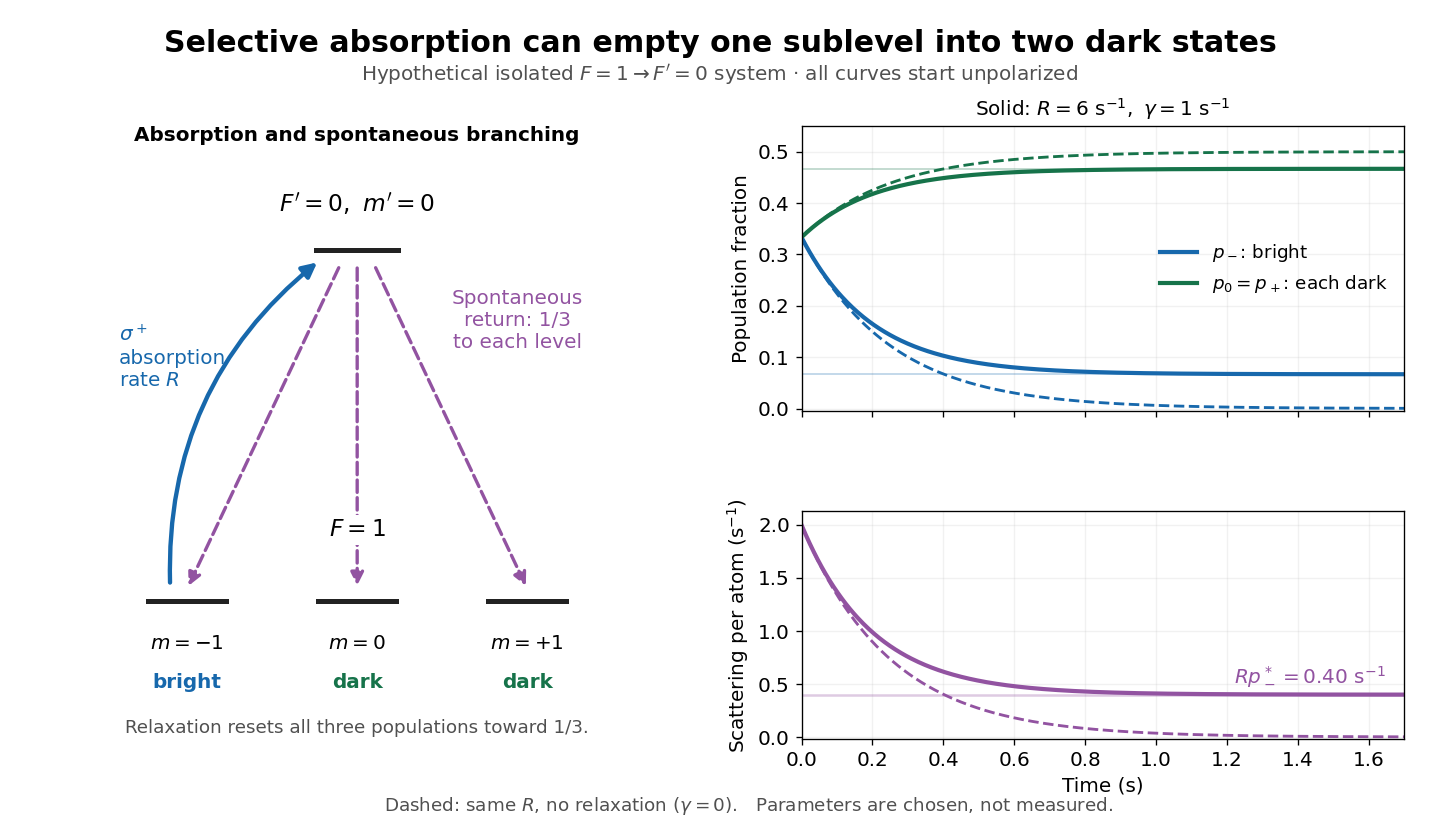
Three-sublevel pumping, spontaneous branching and dark-state dynamics
. Original hypothetical model. Solid blue shows selective absorption; dashed purple arrows show equal spontaneous branching. Two lower states are dark to the selected beam. Curves start unpolarized and compare pure pumping with chosen . Rates and curves are stipulated examples, not historical data or a model of the full rubidium spectrum. Details.
New to topics? Read the docs here!