Tie-line phase-fraction sensitivity
ID: tie-line-phase-fraction-sensitivity

Tie-line phase-fraction sensitivity measures how an inferred phase fraction changes when the overall composition or the measured liquid-liquid tie line endpoints change. A sensitivity coefficient is a local partial derivative of the inference formula, rather than an uncertainty by itself. It becomes an uncertainty contribution only after combination with the input covariance matrix.[ref]
Guide to the expression of uncertainty in measurement by JCGM. §§5.1.3–5.1.4, sensitivity coefficients and their experimental determination
For one composition coordinate of a binary mixture, write the lever rule aswhere are endpoint mole fractions, is the overall mole fraction and is the mole-based amount of phase . Differentiating the mass balance givesThus a measurement error in the overall composition and an equal measurement error in the phase- endpoint have different effects. The conditioning of tie-line phase-fraction inference deteriorates as the endpoint separation becomes small: the same composition measurement error then produces a larger change in the inferred phase fraction.
For an original example, take , , , giving . Increasing only by gives a first-order change . Direct substitution gives , a change of . For the closer endpoints , and balanced composition , the local sensitivity to the same endpoint error is ten times larger. This is a property of the inference geometry; it does not establish whether either hypothetical pair is in liquid-liquid equilibrium.
The multidimensional tie-line phase-fraction fit has an additional detail away from an exactly balanced composition. On independent mole fraction coordinates, hold a symmetric positive-definite matrix fixed and definewith distinct endpoints. Define row vectors and . Differentiating the generalized least squares normal equation givesThe residual correction in tie-line sensitivity vanishes when . Otherwise, moving an endpoint also rotates the fitted line relative to the nonzero ternary tie-line consistency residual. Omitting that contribution is an additional approximation. If itself changes with the measured inputs, its derivative must also enter the calculation.
These formulas describe the unconstrained fit locally. Imposing introduces boundary effects, and coincident endpoints make this inference undefined. A practical sensitivity check recomputes the fit after small positive and negative perturbations of one measured coordinate, keeping composition closure and the stated weight matrix. Agreement as the perturbation shrinks tests the derivative calculation; it does not validate the underlying equilibrium model.
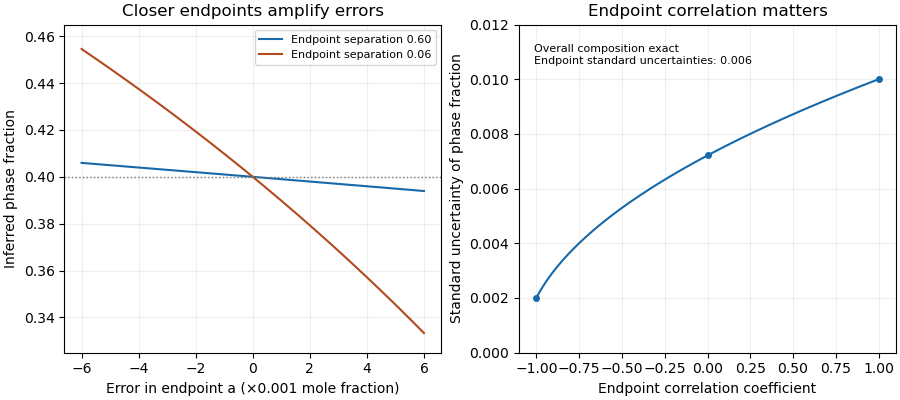
Closer tie-line endpoints amplify composition errors; endpoint correlation changes the inferred phase-fraction uncertainty
. Original binary examples with phase fraction0.40. Left: exact endpoint perturbations at separations0.60 and0.06. Right: first-order standard uncertainty with uncertain endpoints and exact overall composition; common calibration of all three measurements is a different model. Details.
New to topics? Read the docs here!