
A topological space is a set together with a topology , a family of subsets satisfyingHere is the power set; the union may have arbitrarily many members, while the intersection must be finite. The members of are the open sets. These are axioms about subsets, with no assumed metric or surrounding Euclidean space. [ref]
https://www.maths.ox.ac.uk/system/files/attachments/Preliminary%20Reading%20%281%29.pdf. Richard Haydon, Oxford topology preliminaries, Definition 0.1
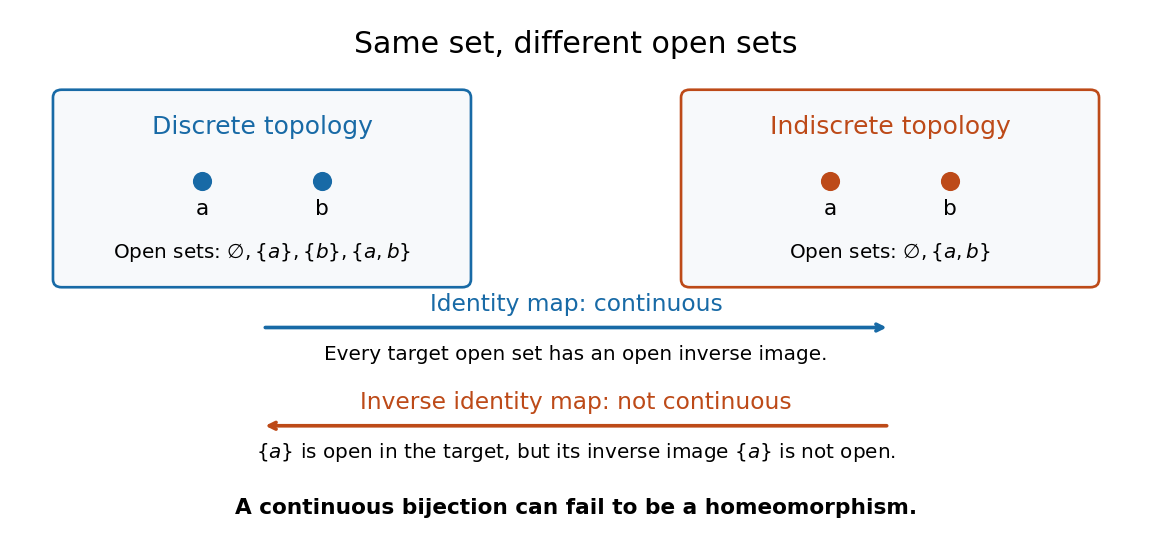
For , the discrete topology is , while the indiscrete topology is . Both satisfy the axioms. They describe different topological spaces on the same set: the first is Hausdorff and disconnected, while the second is connected and not Hausdorff. Each is compact because is a finite set.
The identity function is a continuous map: the only target open sets have inverse images and . Its inverse is not a continuous map, since the target open set has inverse image , which is not an open set in . Thus even a continuous bijection need not be a homeomorphism.

A **topological space** is a fundamental concept in the field of topology, which is a branch of mathematics that studies properties of space that are preserved under continuous transformations. A topological space is defined by a set of points, along with a structure that tells us how these points relate to one another in terms of "closeness" or "continuity.


New to topics? Read the docs here!