Trapped-ion sideband pulse model
ID: trapped-ion-sideband-pulse-model

Consider an original ideal calculation with no heating, decoherence, detuning or spectator modes. In the ordered basis for , the red motional sideband has . Here is the Pauli matrix exchanging the two basis states. Since , its unitary time evolution isThus , and excitation from has probability . For it vanishes. The blue motional sideband similarly gives . A red Rabi pi pulse calibrated for has ; it is not a Rabi pi pulse for every occupied .
Choose , and . The red Rabi pi pulse lasts . Let motion have the Boltzmann distribution of a quantum harmonic oscillator, with chosen mean occupation :Here , and . Reindex the red sum using and : for equal resonant pulse parameters, even outside the short-pulse limit. At times with , the ratio therefore gives . A nonthermal distribution, unequal drive strengths, detuning or state-detection bias can invalidate that thermometer. Ground-state population cannot generally be deduced from the mean alone without specifying the distribution.
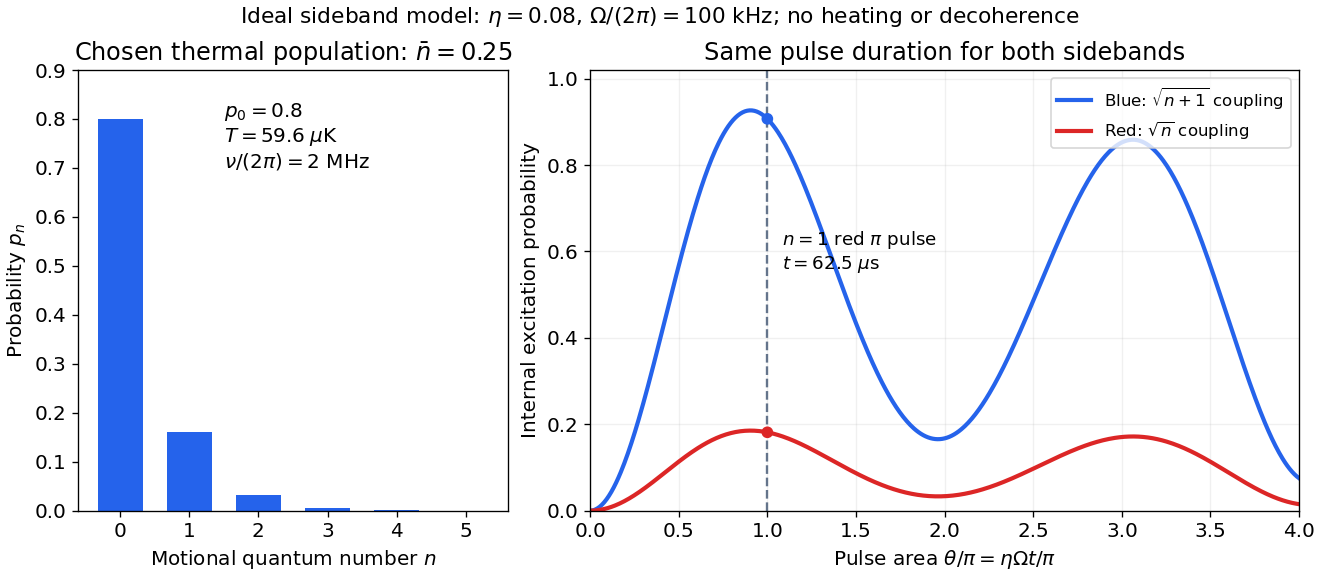

The chosen pulse gives and . These are internal excitation probabilities, not quantum gate fidelities or cooling-cycle efficiencies. An independent matrix exponentiation of each two-state block agrees with the sine formula and preserves normalization. Summing omits probability ; because every sine squared lies between zero and one, this also bounds each omitted response. The thermal relation supplies a separate dimensional check:Here is the Boltzmann constant. Substitution recovers ; the thermal root-mean-square expansion parameter is . This checks the populated part of the Lamb-Dicke regime, while exponentially rare large still exceed any fixed small-parameter criterion. The pulse is a leading-order model; it does not bound corrections from the full coupling or experimental noise.
New to topics? Read the docs here!