For a constant-amplitude square pulse on resonance, a Rabi pi pulse lasts and gives in the rotating frame. A half-duration pulse prepares . The quantum pulse area determines these rotations only under the stated resonant, constant-axis assumptions; a detuned drive rotates about a different axis.
As an original numerical illustration, choose and hence . These are chosen model parameters, not historical apparatus settings. Holding that duration fixed givesThus , , and . The last zero comes from completing a full rotation about the tilted axis, rather than switching the drive off. At zero Rabi detuning, doubling the pulse duration restores the ground-state population; continuous driving does not keep transferring population irreversibly.
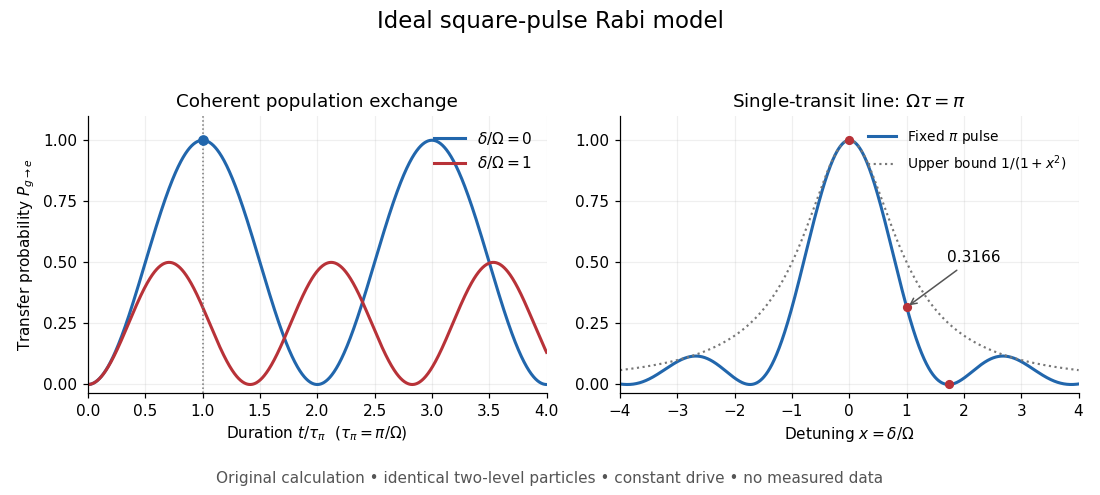

For the Driven two-level Rabi model at fixed resonant pulse duration , put . Its transfer probability isThe sine-squared numerator differs from one only at order , while the denominator gives . Thus the leading population-transfer error is . For a target transfer error , the frequency mismatch in cycles per second should satisfy in this small-detuning regime. This is not a complete characterization of every coherent gate error.
Articles by others on the same topic
There are currently no matching articles.