Two-level sudden quench
ID: two-level-sudden-quench

Take an isolated two-level system, or a spin one-half qubit, with Pauli matrices . Let and . The initial and final Hamiltonian operators areThe energy gaps are . Prepare the initial ground state , with energy eigenvalue . A final orthonormal eigenbasis isDirect matrix multiplication gives and . The unchanged initial quantum state is . Its new probability amplitudes are the inner products ; the Born rule gives . The angle between the real amplitude vectors is , whereas the Hamiltonian axis on the Bloch sphere rotates through .
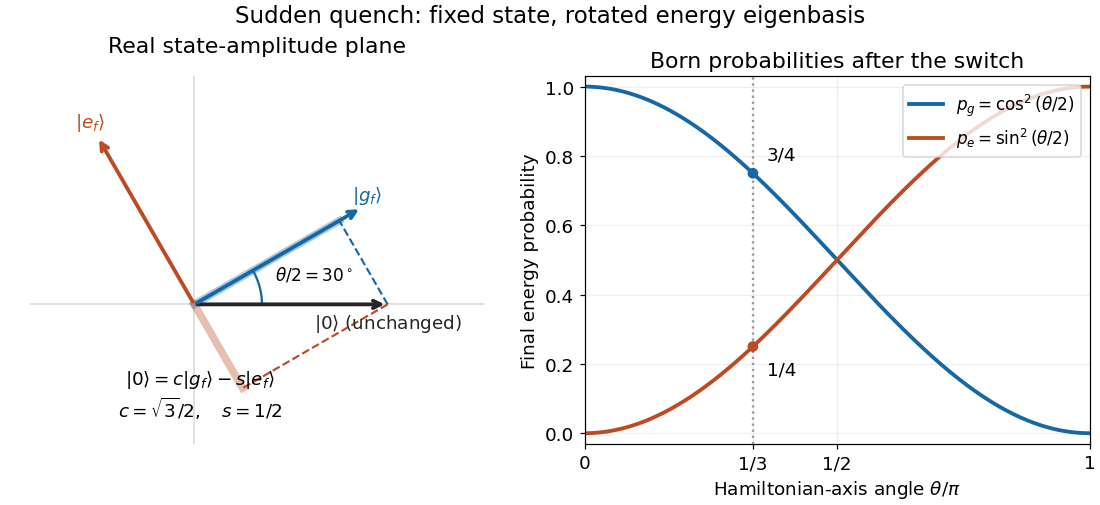

At , and , so the final energy measurement gives with probability and with probability . At the initial ground state remains the final ground state; at it is the final excited energy eigenstate. These statements are about the new energy labels, not an instantaneous physical rotation of the quantum state.
New to topics? Read the docs here!