Two-toss sample space
ID: two-toss-sample-space

Model two fair independent coin tosses, recording their order. Here denotes heads and tails, andThe power set includes every question expressible as a subset of these four outcomes. The mass comes from the fairness and independence assumptions. These are exact model probabilities, rather than measured toss frequencies.
Let be the event that the first toss is heads and the event that the second toss is heads. ThenThe union means “at least one head,” while the intersection means “both heads.” Their probabilities are and . Counting the union through the inclusion-exclusion principle gives ; alternatively its complement of an event is , of probability .
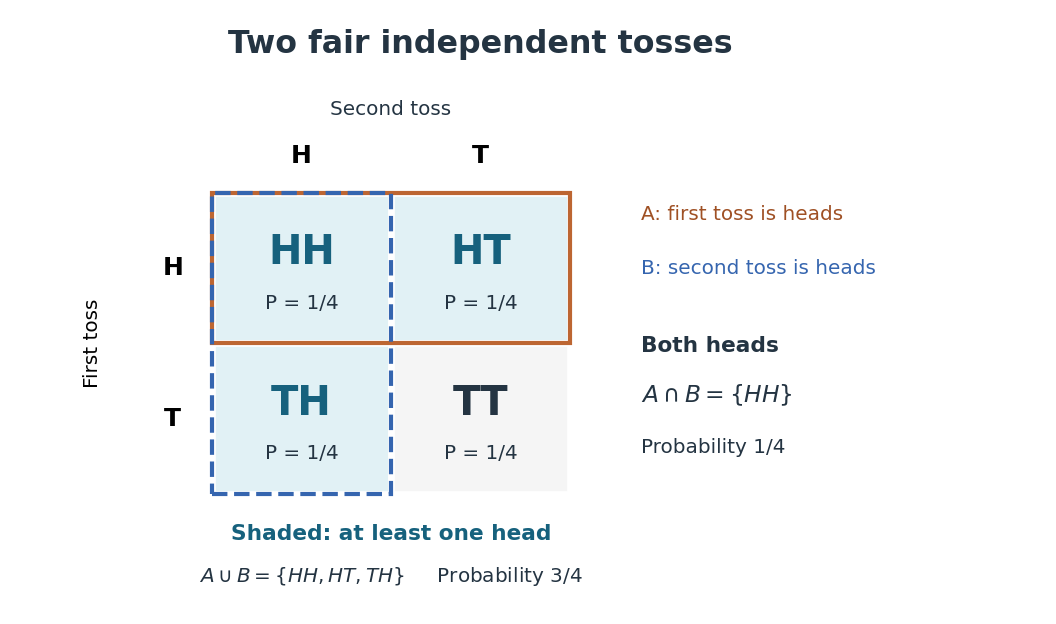
Four ordered outcomes and the event of at least one head
. Rows record the first toss and columns the second. Each cell has probability under fair independent tosses. The highlighted union includes , , and ; the overlap contains only . Details.
On the same sample space, assigning masses to would still make each toss fair: . But , so the tosses would be dependent. The event of at least one head would have probability . Changing the probability measure changes the answer even when the sample space and the single-toss probabilities stay the same.
New to topics? Read the docs here!