Zero-dimensional planetary energy balance
ID: zero-dimensional-planetary-energy-balance

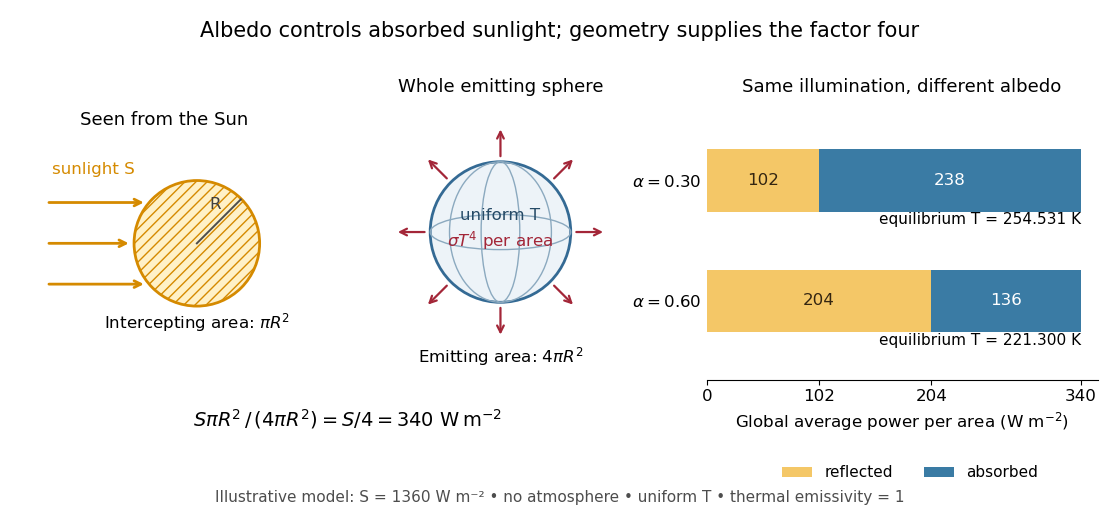
Consider an idealized planet that is a sphere of radius , illuminated by parallel sunlight of irradiance , measured on a plane perpendicular to the rays. Its intercepting projected area is , whereas its total surface area is . Therefore the incoming power averaged per unit total surface area iswhere is the broadband Bond albedo. The factor four is a sphere geometry result, not an atmospheric transmission factor. Local sunlight still varies over the illuminated hemisphere and vanishes on the dark side.
Now stipulate a single spatially uniform temperature , no atmosphere, no internal heating, and emissivity one for outgoing thermal radiation. This is a thermal blackbody model using the Stefan–Boltzmann law; the prescribed solar-band reflection is treated separately, so the body is not a perfect absorber at all wavelengths. Let be the effective heat capacity per unit surface area, in . Conservation of energy gives the ordinary differential equationHere is net heating per unit surface area, in , and is the Stefan-Boltzmann constant. Use , rounded from the exact constant reported by NIST. [ref]
https://physics.nist.gov/cgi-bin/cuu/Value?sigma%7Csearch_for=stefan+boltzmann. NIST, CODATA value: Stefan-Boltzmann constant
The uniform temperature is a model assumption: generally the surface average of differs from the fourth power of the surface-average temperature.For fixed Bond albedo , radiative equilibrium requires , givingWith the illustrative solar constant , the global incoming average is :
| Fixed Bond albedo | Reflected average () | Absorbed average () | Equilibrium temperature () |
|---|---|---|---|
Doubling albedo here lowers the equilibrium temperature by , rather than halving it: the absorbed fraction changes from to , and thermal radiation scales as . These stipulated Bond albedos are whole-planet examples, not measurements of bare water and ice. The model predicts neither Earth's modern surface temperature nor its response to actual climate change; it omits the greenhouse effect, spatial heat transfer and seasons.

Each fixed-albedo equilibrium is a stable equilibrium: for , the derivative is . A small temperature increase produces net cooling, and a small decrease produces net heating. This is the simplest expression of the stabilizing Planck feedback. Allowing albedo to fall with temperature adds a competing term, as in ice-ocean albedo feedback.
New to topics? Read the docs here!