Ice-ocean albedo feedback is the ocean-surface case of ice-albedo feedback: loss of bright sea ice, often covered by snow, exposes darker water, lowers surface albedo and increases absorbed sunlight. The extra stored ocean heat content can promote further melting and delay refreezing. Reversing the sequence can amplify cooling. This is a positive climate feedback, meaning that it reinforces the initial change; the word positive does not mean beneficial, and it does not guarantee runaway warming.
For unchanged downward solar irradiance on a newly exposed opaque patch, the extra absorbed heat flux isFor illustrative local surface albedos and , and , the patch absorbs an additional . This is a local sunlight calculation, not a whole-planet radiative forcing: newly exposed area, illumination, clouds and season determine its global contribution. With no incident sunlight this particular heating pathway vanishes. NASA's notes describe the contrast between reflective ice and snow and darker water. [ref]
https://science.nasa.gov/learn/heat/resource/explore-albedo-activity/. NASA, Explore Albedo Activity
To isolate how a positive climate feedback competes with Planck feedback, retain the assumptions of the zero-dimensional planetary energy balance and prescribe the smooth broadband Bond albedoThe exponential function makes a smooth transition from a bright cold state near to a darker warm state near . The midpoint and width are chosen to illustrate the dynamics. They are not a seawater freezing law, an observed global relation, or a calibration of modern Earth. No evolving ice thickness or latent heat is represented.
An equilibrium satisfies . For a small perturbation , linear stability follows fromSince , gives an asymptotically stable equilibrium, while gives an unstable equilibrium. With , the derivative isThus the optical term is destabilizing, while the thermal radiation term is stabilizing. Their sum, not the optical term alone, decides the linear stability.
For the same and Stefan-Boltzmann constant used above, the bisection method on the intervals , and , with temperature in kelvins, gives:
| Equilibrium temperature () | Bond albedo | () | Behavior |
|---|---|---|---|
| Asymptotically stable cold equilibrium | |||
| Unstable equilibrium | |||
| Asymptotically stable warm equilibrium |
Unrounded numerical zeros of a function have ; the table rounds them for readability. In the positive-temperature domain the sign of alternates between heating, cooling, heating and cooling across these three equilibria. The middle equilibrium separates the basins of attraction of the two stable equilibria. For example, a starting temperature of cools toward the cold state, whereas warms toward the warm state: this is bistability at identical external illumination.
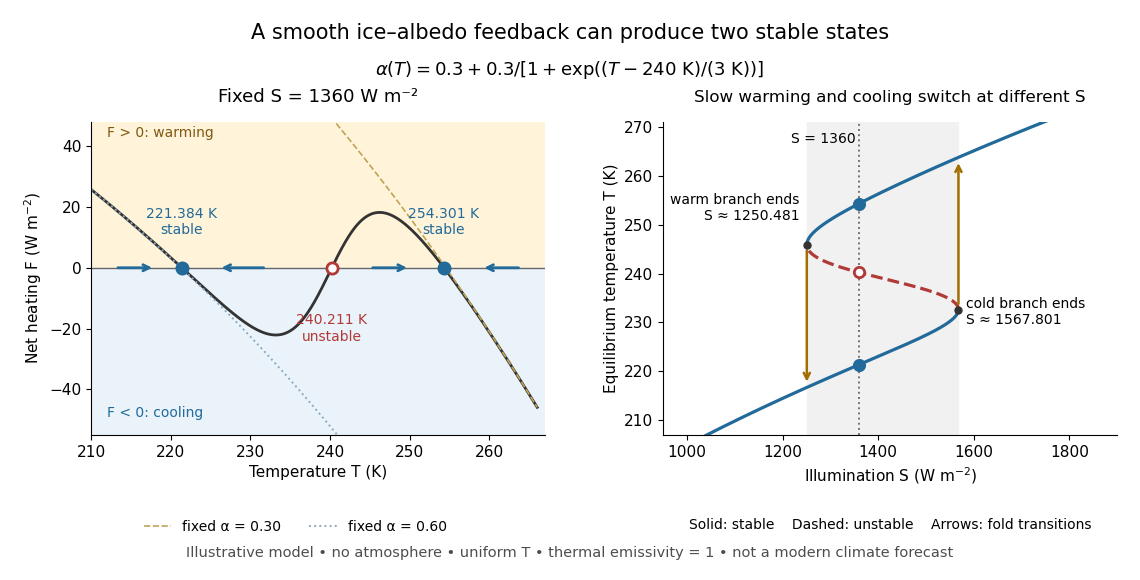

The same model illustrates hysteresis. Its equilibrium curve can be written as . The two turning points, where , are saddle-node bifurcations: approximately and . For illumination strictly between these thresholds there are two stable equilibria and one unstable equilibrium. Under sufficiently slow increase of , the cold branch ends at the upper threshold; under sufficiently slow decrease, the warm branch ends at the lower threshold. The ensuing warming and cooling transitions differ, so the state depends on its history. Finite sweep rates can delay the transitions; these thresholds describe this model's static equilibrium curve, not predicted tipping points for modern Earth.
The striking feature is that a smooth albedo law can produce distinct long-time states and abrupt transitions, although no discontinuity was inserted into the optical law. It is useful for understanding why positive climate feedback can amplify a response while stabilizing thermal radiation still limits it. Here bounds the incoming heating, whereas outgoing thermal radiation grows as ; high enough temperatures therefore cool rather than run away indefinitely.
Historically, M. I. Budyko's 1969 paper coupled changing albedo from expanding ice cover to a latitude-dependent temperature and heat transfer calculation, showing how that coupling amplified the effect of changed sunlight. [ref]
https://cdn.repub.ch/s3/republik-assets/assets/pdf/budyko_1969.pdf. M. I. Budyko, The effect of solar radiation variations on the climate of the Earth, Tellus 21(5), 611–619, 1969, pp. 614–616
William D. Sellers's 1969 paper constructed an annual energy-budget model in 10-degree latitude belts, including planetary albedo, atmospheric infrared transmission and atmospheric and oceanic exchange. [ref]https://acoustique.ec-lyon.fr/chaos/Sellers69.pdf. William D. Sellers, A Global Climatic Model Based on the Energy Balance of the Earth-Atmosphere System, Journal of Applied Meteorology 8, 392–400, 1969
These primary papers provide historical examples of ice-sensitive energy-budget modeling; the smooth single-temperature example above is a separate illustration, not a reproduction of either paper's equations or predictions. Articles by others on the same topic
There are currently no matching articles.