Climate change is a persistent alteration of the statistics of a planet's climate. External radiative forcing, internal variability and climate feedbacks all matter, and the timescale must be specified. A climate model connects mechanisms to observable changes; the radiative-convective climate column separates vertical heat transfer from whole-planet conservation of energy, while the Hasselmann stochastic climate model explains how fast weather can drive slow thermal variability.
A policy mechanism attaching a monetary cost to greenhouse-gas emissions, through taxes, tradable permits or related instruments. Coverage, credibility, enforcement, distribution and complementary policies influence its effect; a price signal alone does not remove every infrastructure or innovation barrier.
The monetary charge per unit emitted, for example currency per tonne of carbon dioxide. Multiplying by an activity's emissions intensity gives its direct carbon-cost increment per unit output. A common accounting basis must distinguish tonnes of carbon from tonnes of carbon dioxide.
Carbon is exchanged among atmospheric, oceanic, biological and geological reservoirs. A model that only redistributes carbon among closed reservoirs cannot permanently remove its total excess burden.
Transfers of carbon among chemical forms and reservoirs.
A linear climate-carbon model with emissions , concentration , effective injection coefficient , baseline and relaxation rate . Constant emissions have equilibrium , and all transients about that equilibrium decay on time . Stopping emissions returns concentration to the baseline in this model. Real multiple reservoirs and long-lived carbon uptake tails prevent treating that one-time-constant assumption as universal.
Equal-capacity reservoirs exchanging carbon symmetrically preserve their total burden. Their difference decays at rate , so a pulse into one reservoir leaves one half there permanently unless an external sink is added. Coupling this response to a faster first-order thermal model produces an initial warming followed by relaxation to a nonzero asymptote.
A persistent forcing increment from a unit emission pulse drives , with . Linear annual damage discounted at positive rate integrates to the displayed value. It assumes constant coefficients, a permanent forcing step and damage valued relative to the emission date. A decaying carbon burden or a different damage law changes the result.
Proposed climate intervention that adds material to the stratosphere to increase reflection of sunlight. Sulfur-dioxide injection relies on conversion into a sufficiently persistent sulfate particle population. A global-mean shortwave forcing target does not uniquely specify regional temperature, rainfall or ozone responses.
A climate model is a mathematical description of the mechanisms and statistics of a planet's climate change and variability. A useful hierarchy starts with conservation of energy in a zero-dimensional planetary energy balance, adds vertical radiative transfer and convection in a radiative-convective climate column, and can resolve three-dimensional fluid mechanics and ocean circulation. Each level answers different questions. A column can explain why changing an absorber changes surface temperature; it cannot locate tomorrow's storm.
Three questions should be kept distinct: what sets an average temperature, how fast does it respond to radiative forcing, and how large are its unforced fluctuations? Climate sensitivity concerns the first, heat capacity controls response times, and the Hasselmann stochastic climate model illustrates the third. An observational test must compare a predicted observable with an instrument's actual readout, as in the satellite test of greenhouse spectral change.
Climate sensitivity quantifies the equilibrium temperature response to a specified change in forcing. Distinguish the response to doubled carbon dioxide from the gain per unit radiative forcing: for a linear net restoring coefficient and constant forcing , the gain is , whereas the equilibrium warming is . The forcing convention and the climate feedbacks permitted to adjust are part of the definition. A transient warming before the ocean heat content has adjusted is a different quantity.
A symmetric positive uncertainty interval for a stabilizing feedback coefficient produces asymmetric uncertainty in its reciprocal. With both cooling magnitude and forcing magnitude uncertain, constant-sensitivity lines are rays ; tangents from the origin to a Gaussian covariance ellipse give a one-parameter profile interval for the ratio. A unit-radius two-variable covariance ellipse is not itself a 68 percent joint confidence region.
The approximately proportional increase in global temperature per cumulative carbon-dioxide emission over a stated regime. Units must distinguish tonnes of carbon from tonnes of carbon dioxide.
Global mean surface warming near the time of carbon-dioxide doubling in an idealized experiment increasing concentration by one per cent per year. Ocean heat uptake generally keeps it below the equilibrium response.
The long-term global surface warming after atmospheric carbon dioxide is doubled and the modeled system reaches equilibrium, with stated feedback conventions. A response to another forcing amplitude must be rescaled before being called the conventional ECS.
A radiative-convective climate column applies a radiative-convective equilibrium model to the vertical thermal structure relevant to climate change. Radiative transfer determines heating and cooling; convective adjustment represents unresolved vertical redistribution when the chosen atmospheric lapse rate is too steep. Radiative equilibrium alone need not give a physically admissible lower-atmospheric profile.
In 1967, Syukuro Manabe and Richard T. Wetherald computed equilibrium with prescribed relative humidity, allowing atmospheric water vapor to change with temperature. Their average-cloud case warmed by for carbon dioxide increasing from 300 to 600 parts per million, versus with fixed absolute humidity. These are model outputs, not measured warming. The comparison isolates an important water-vapor feedback.[ref]
Thermal Equilibrium of the Atmosphere with a Given Distribution of Relative Humidity by Syukuro Manabe and Richard T. Wetherald. Manabe and Wetherald, 1967, abstract; Section 4b, Table 5 and Fig. 16
An original two-temperature calculation exposes the bookkeeping. Let an opaque surface absorb solar irradiance and emit blackbody thermal radiation . A single isothermal atmospheric layer transmits all sunlight and absorbs a fraction of surface infrared emission, emitting both upward and downward. This is a grey thermal-band emissivity, with . Let be upward nonradiative heat flux, and let be heat capacities per unit area. Then conservation of energy givesThe two equations sum toHere is outgoing longwave radiation. Both and downward atmospheric emission cancel internally: they redistribute energy without creating it. The factor two in atmospheric emission counts two faces. Dropping the downward face would spoil the surface budget. Each right-hand term has units ; each has units .
Choose , and . At equilibrium, and , giving and . Direct substitution gives surface balance and atmospheric balance . These deliberately chosen fluxes illustrate the model; they are not an observed global budget or a reconstruction of the 1967 calculation. Prescribing illustrates heat transfer accounting but does not close a realistic convection law.
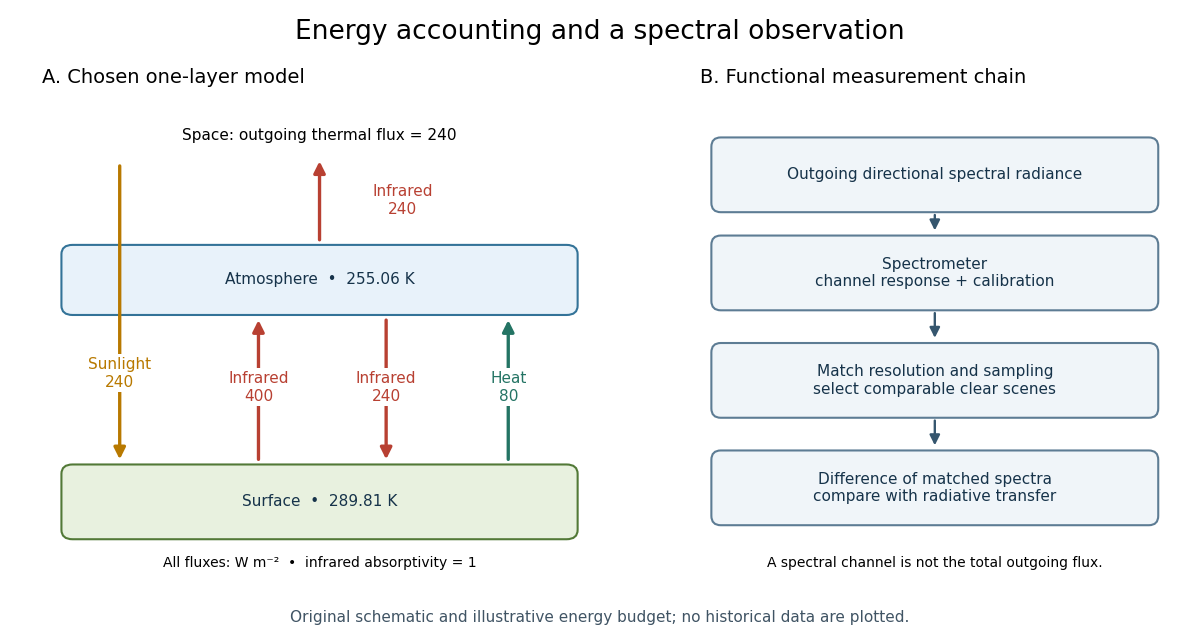
For fixed , the positive-temperature equilibrium is locally stable. Put and . The Jacobian matrix of the temperature equations has trace and determinant . Thus both eigenvalues have negative real part. Temperature-dependent climate feedbacks alter this test. A single grey layer also omits the optical spectrum, cloud structure and the independent thermal behavior of the troposphere and stratosphere.
In a prescribed dry convective column with unchanged surface pressure and upper matching temperature, doubling uniformly mixed grey absorbers halves the pressure of a fixed-optical depth matching level. The adiabat then gives the displayed finite change. This is conditional on the fixed matching and convection assumptions. With strictly constant mass opacity, a purely radiative Eddington grey column instead has , so a gas with is not destabilized into dry convection by that radiative profile alone.
Convective adjustment replaces an excessively steep vertical temperature gradient by an allowed profile while respecting the selected energy budget. It is a closure for unresolved convection, not a direct simulation of individual rising parcels. A prescribed critical atmospheric lapse rate is a modeling assumption; it need not equal the dry adiabatic lapse rate.
For an original dry two-slab example, take fixed equal heat capacities and slab centers separated by . Initially below and above. Stipulate a permitted atmospheric lapse rate . The initial difference exceeds the allowed . Conservation of the sum of the two sensible energies requires , while the adjusted gradient requires . Hence and . Heat removed below equals heat added above. Simply holding the lower slab fixed and raising the upper slab to would introduce external energy.
For unequal constant heat capacities , the same two constraints instead giveApply this adjustment only when the original gradient exceeds the threshold. A moist adjustment also has to account for latent heat and changing composition; conservation of this dry sensible-energy expression alone is then insufficient.
The Hasselmann stochastic climate model represents slowly responding climate variables driven by fast weather fluctuations as well as external forcing. Klaus Hasselmann's 1976 paper separates fast and slow variables, retains fluctuations lost by simple averaging, and explains why stabilizing climate feedbacks are needed to prevent indefinitely growing variability. Its general framework is broader than a single-temperature equation.[ref]
Stochastic climate models Part I. Theory by Klaus Hasselmann. Hasselmann, Stochastic climate models. Part I. Theory, 1976, Section 2; Section 7, summary points 1–4
Consider an original scalar specialization for a spatially averaged temperature anomaly , with an effective ocean mixed layer heat capacity per unit area :Here is imposed radiative forcing, is the net restoring coefficient after the chosen climate feedbacks, and represents random net heat flux from unresolved weather. The anomaly energy per unit area is , so its tendency equals the net input. The weather term represents exchange with omitted degrees of freedom; it does not assert that an isolated ocean creates energy. and have units , and has units .
First set , start from , and switch to constant . The integrating factor givesFor , and , the relaxation time is , about years using 365.25 days per year. At , , with eventual warming . Doubling doubles the response time but leaves this equilibrium unchanged. This separates thermal inertia from climate sensitivity.
Now set and idealize the weather forcing as Gaussian white noise withThe Dirac delta function has inverse-time units, so has units . The rigorous stochastic differential equation iswhere is Brownian motion. This is an Ornstein-Uhlenbeck process. In stationary initialization its variance and autocovariance function areDefine the two-sided angular-frequency power spectral density by . The Fourier transform of the exponential autocovariance function, or the squared response to a sinusoidal input, givesThus fast fluctuations are suppressed; the climate output is red over the frequency range above the corner , with a low-frequency plateau. This is a colored noise spectrum without a periodic driver. The corner is in cycles per second, not . The continuous white input is only an approximation on times longer than weather's correlation time.
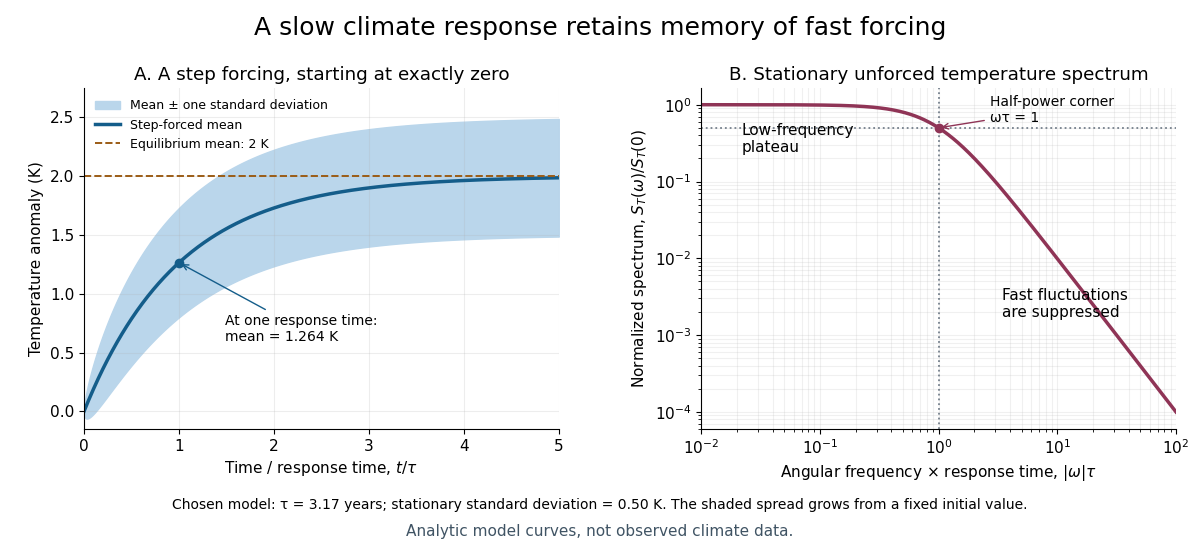
For the same and , and the stationary standard deviation is . From fixed , the variance grows as , even when the forced expected value is predictable. Integrating over all angular frequencies returns , checking the normalization independently. If the unforced variance instead grows as ; if , deviations amplify. Neither case has the stationary spectrum above.
A red spectrum alone cannot establish attribution of recent climate change: internal variability, changing forcing and measurement effects must be distinguished. This scalar model supplies a calculable baseline for variability and persistence, not a universal spectrum for all climate timescales or a full attribution analysis.
A satellite test of greenhouse spectral change compares outgoing radiance with radiative transfer predictions. The 2001 study compared IRIS on Nimbus 4 (1970) and IMG on ADEOS (1997). Matching April–June ocean regions, masking land, screening clouds and correcting resolution and wavenumber controlled comparability. Spectral radiance became brightness temperature readouts. Regional comparisons and independent calculations tested interpretation. Carbon dioxide and methane features supported changed absorption; residual clouds, calibration and interannual variability limited background inference.[ref]
Increases in greenhouse forcing inferred from the outgoing longwave radiation spectra of the Earth in 1970 and 1997 by John E. Harries and others. Harries et al., 2001, pp. 355–357, Table 1, Fig. 1 and Methods
This observational comparison tests radiative transfer; it does not by itself measure equilibrium climate sensitivity or validate a complete climate model.
To understand the readout, write an instrument's spectral channel schematically asHere is spectral radiance in the viewing direction , is a normalized channel response, is calibration offset and is random error. Subtracting two channel readings isolates an atmospheric difference only after their response functions and sampling are comparable. Matching kernels reduces a false difference caused merely by observing a narrow spectral line at different resolutions; it cannot remove every calibration offset.
Outgoing longwave radiation in an energy budget also integrates radiance over upward directions and over the thermal spectrum, with the appropriate projected-angle factor. A brightness temperature converts one spectral radiance to the equivalent blackbody value through Planck's law; it is not automatically surface temperature. This explains why a spectral difference, a broadband radiative flux difference and surface warming are related observables with different units and different inferences.
Polar amplification is greater temperature change at high latitudes than in the global mean. Ice-albedo feedback, the vertical structure of atmospheric warming, the temperature dependence of radiative cooling, ocean heat storage, clouds and energy transport all contribute; the balance differs between the Arctic and Antarctic and between seasons.
Attribution of recent climate change assesses the contributions of anthropogenic forcing, natural forcing and internal variability to observed changes. It combines the physics of radiative transfer, measured forcing agents, energy budgets and spatial, vertical and temporal response patterns. A single weather event or a single trend is insufficient by itself to identify all causes.
Global warming is an increase in Earth's global mean surface temperature. It is one aspect of climate change, which also includes changes in precipitation, circulation, extremes and the cryosphere. Warming driven by additional greenhouse gases can be amplified or moderated by climate feedbacks.
Global mean sea level can rise through changes in ocean volume at fixed mass and through additions of ocean mass. Local relative sea level additionally depends on ocean circulation, gravity and vertical motion of the land. Floating sea ice has already displaced seawater, so its melt has a much smaller direct sea-level effect than transfer of grounded land ice into the ocean.
With positive freshwater runoff , net sea ice melt and precipitation , and evaporation loss , the ocean water-mass budget is . With salt-free ice and fixed total dissolved salt mass, mean salinity satisfies . Gross regional ice melt must not be substituted for net global melt without accounting for ice formation elsewhere and the averaging period.
Eustatic sea level change is a change in global sea level associated with changes of ocean water amount or ocean-basin capacity. For contemporary climate budgets the relevant contribution is principally transfer of water between land and ocean, including melting grounded ice and changes in terrestrial water storage. It is distinct from steric sea level change.
Steric sea level change results from changes of seawater mass density at fixed ocean mass. To first order, thermal expansion gives ; changes in salinity give a halosteric contribution. The reference column, pressure and equation of state must be specified.
Thermosteric sea level change is the thermal expansion part of steric sea level change. For a uniform layer of depth , conservation of mass gives , hence .
The Arctic dipole anomaly describes a pressure pattern with opposed anomalies on the North American and Eurasian sides of the Arctic. It is distinct from the more nearly annular Arctic Oscillation; associated winds can change sea ice export and warm-air advection.
Radiative forcing is a change in the net downward radiative flux caused by an imposed perturbation, evaluated with a specified adjustment convention before the surface climate responds. State the reference period and whether the diagnostic is at the tropopause or top of the atmosphere. A local seasonal ocean heat flux is not directly interchangeable with global annual radiative forcing.
For , a further annual concentration increment produces , whereas the accumulated forcing from the original baseline is . The former can decrease as rises while the latter increases. Maintaining a short-lived compensating aerosol burden also requires replacement, not only compensation of the next increment.
A climate feedback is a response to climate change that alters the initial warming or cooling. Positive feedback amplifies the change; negative feedback opposes it. Positive feedback alone does not prove an irreversible transition.
A perturbation energy balance with positive has a stable lower-temperature root and an unstable upper root for . They merge at ; equality is marginal. Extrapolation of this local model is not an empirical runaway threshold for a real planet.
With positive-downward net top-of-atmosphere flux N, imposed forcing F and positive stabilizing coefficient lambda, a simple global model has . A positive imbalance means energy storage, not an independent measurement of F. Ocean uptake and multiple response times complicate the one-capacity approximation. Feedback sign conventions differ between references; writing the full equation prevents confusion. [ref]
The Earth's Energy Budget, Climate Feedbacks, and Climate Sensitivity by Piers Forster and others. §7.4.1 andBox7.1, forcing–response framework
Lapse-rate feedback is the radiative effect of changes in the vertical temperature profile beyond a vertically uniform temperature change. In the tropics, enhanced warming aloft often increases radiative cooling and is stabilizing. In a stably stratified polar atmosphere, warming concentrated near the surface can yield less compensating cooling aloft and help produce polar amplification. The sign and magnitude depend on the profile and radiation physics.
The Planck feedback is the stabilizing increase in outgoing thermal radiation when temperatures rise, with other properties held fixed. For a blackbody the local derivative is , so a colder emitter has a smaller absolute radiation increase per kelvin. The atmospheric response requires radiative transfer, and cannot be obtained by replacing the entire climate system with a single surface blackbody.
Water-vapor feedback is the climate feedback from changing atmospheric water vapor as temperature changes. Fixed relative humidity allows more water vapor in a warmer column, altering radiative transfer and often amplifying warming. Fixing absolute humidity suppresses this response. The net restoring coefficient must still include the other climate feedbacks; this individual positive contribution does not establish instability.
Warming can mobilize frozen organic material or change sediment conditions, increasing methane emissions and strengthening the greenhouse effect. Production, transport and atmospheric release must be distinguished: methane can dissolve or be oxidized before reaching the atmosphere. Observed seabed bubbles alone do not establish the magnitude or timing of a global atmospheric feedback.
Articles by others on the same topic

Climate change refers to significant and lasting changes in the Earth's climate, particularly those related to increases in global temperatures and shifts in weather patterns attributed primarily to human activities. While the Earth's climate has naturally fluctuated over geological time scales, the term "climate change" commonly focuses on the rapid changes observed since the late 19th century, largely due to the increase in greenhouse gas emissions from burning fossil fuels, deforestation, industrial processes, and various agricultural practices.


