Forms the bacterial cell wall.
From the Wikipedia image we can see clearly the polymer structure formed: it is a mesh with:
- sugar covalent bond chains in one direction. These have two types of monosaccharide, NAM and NAG
- peptide chains on the other, and only coming off from NAM
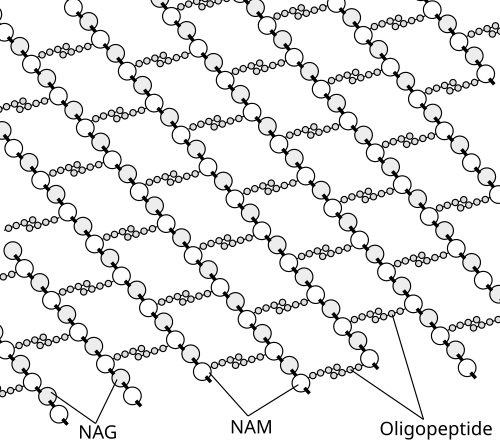
Peptidoglycan polymer structure
. Source. Articles by others on the same topic


A glycoprotein is a protein carrying one or more covalently attached carbohydrate groups. Attachment occurs through glycosylation; the carbohydrate component is part of the modified molecule, rather than simply dissolved beside it. Protein sequence alone therefore need not specify the complete chemical form measured in a biological preparation.
Pmel17 illustrates why the distinction is functional. It is a glycoprotein made as a membrane protein, then processed and organized inside developing premelanosomes. Experiments followed its molecular processing and its localization to internal vesicles and striations.[ref]
Pmel17 initiates premelanosome morphogenesis within multivesicular bodies by Joanne F. Berson and others. 2001, abstract: melanocyte-specific glycoprotein, cleavage and intracellular localization
Calling it a glycoprotein identifies a chemical class; explaining its function still requires knowing its processing, position and interactions with other components.