Some examples:
This is a quick Microarchitectural benchmark to try and determine how many functional units our CPU has that can do an
inc instruction at the same time due to superscalar architecture.The generated programs do loops like:with different numbers of inc instructions.
loop:
  inc %[i0];
  inc %[i1];
  inc %[i2];
  ...
  inc %[i_n];
  cmp %[max], %[i0];
  jb loop;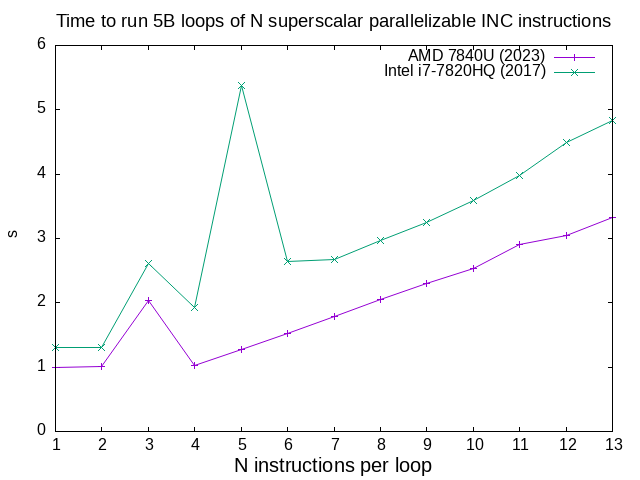
c/inc_loop_asm_n.sh results for a few CPUs
. Quite clearly:and both have low instruction count effects that destroy performance, AMD at 3 and Intel at 3 and 5. TODO it would be cool to understand those better.
- AMD 7840U can run INC on 4 functional units
- Intel i7-7820HQ can run INC on 2 functional units
Data from multiple CPUs manually collated and plotted manually with ../c/inc_loop_asm_n_manual.sh.
Announced at:
This is the only way that we've managed to reliably get a single
inc instruction loop, by using inline assembly, e.g. on we do x86:loop:
inc %[i];
cmp %[max], %[i];
jb loop;For 1s on P14s Ubuntu 25.04 GCC 14.2 -O0 x86_64 we need about 5 billion:
time ./inc_loop_asm.out 5000000000Ubuntu 25.04 GCC 14.2 -O0 x86_64 produces a horrendous:To do about 1s on P14s we need 2.5 billion instructions:and:gives:
11c8:       48 83 45 f0 01          addq   $0x1,-0x10(%rbp)
11cd:       48 8b 45 f0             mov    -0x10(%rbp),%rax
11d1:       48 3b 45 e8             cmp    -0x18(%rbp),%rax
11d5: 72 f1 jb 11c8 <main+0x7f>time ./inc_loop.out 2500000000time ./inc_loop.out 2500000000 1,052.22 msec task-clock # 0.998 CPUs utilized
23 context-switches # 21.858 /sec
12 cpu-migrations # 11.404 /sec
60 page-faults # 57.022 /sec
10,015,198,766 instructions # 2.08 insn per cycle
# 0.00 stalled cycles per insn
4,803,504,602 cycles # 4.565 GHz
20,705,659 stalled-cycles-frontend # 0.43% frontend cycles idle
2,503,079,267 branches # 2.379 G/sec
396,228 branch-misses # 0.02% of all branchesWith -O3 it manages to fully unroll the loop removing it entirely and producing:to is it smart enough to just return the return value from strtoll directly as is in
    1078:       e8 d3 ff ff ff          call   1050 <strtoll@plt>
}
    107d:       5a                      pop    %rdx
107e: c3 retrax. Articles by others on the same topic

A microarchitecture is a particular hardware organization implementing an instruction set architecture. It specifies mechanisms such as instruction decoding, execution units, pipelines, caches and branch prediction. Two processors can expose the same instruction-set contract while making different choices about those mechanisms.
For example, both processors may correctly execute a load followed by an integer addition. One can overlap independent instructions and obtain the load from a nearby cache, while the other waits for a longer memory access. The architectural result agrees, but cycle counts differ. Speculative work must be discarded or committed in a way that preserves the required visible behavior. This distinction explains why compatibility with one instruction set does not imply equal performance, power consumption or physical implementation.[ref]