
Choose (iii), . Here the root has magnitude between and . Machine epsilon measures relative precision near unity; the spacing of representable floating-point numbers near the root is therefore of order . A step tolerance scaled to that magnitude is consistent with the attainable absolute positional accuracy. For IEEE binary64, using , , comparable to the local spacing. A fixed numerical constant cannot promise an exact correctly rounded root, but this is the most sensible of the three proposals.
Condition (ii) asks for a step below , a scale appropriate near one rather than near this root. A nonzero representable change near the root is normally much larger. The test may trigger only after exact stagnation, and rounding-induced oscillation can prevent that; it asks for unnecessarily fine absolute resolution.
Condition (i) measures a residual, not a position error. It changes if the same root problem is multiplied by a constant. Moreover, evaluating can involve cancellation among quantities of order , so an absolute residual of order need not be meaningful or attainable. Here , making residual and position errors comparable in exact arithmetic, but their requested absolute scale is still too small. A practical scale-aware stopping criterion for Newton iteration should also detect stagnation or a cycle rather than assuming exact arithmetic persists indefinitely.
First control the denominator. The mean value theorem applied to yields, for ,Thus is strictly increasing on and all proposed Newton steps within that interval are defined.
Assume . Then and , so . Apply Taylor's theorem instead at the root, expanding about :After rearranging and substituting the Newton step, the signed error satisfiesConsequently . Starting from , mathematical induction proves this for every finite , establishing that the signed errors are negative and strictly increasing. Since and ,Writing gives . Since , this also implies , proving quadratic convergence. This is the concave Newton iteration from below.
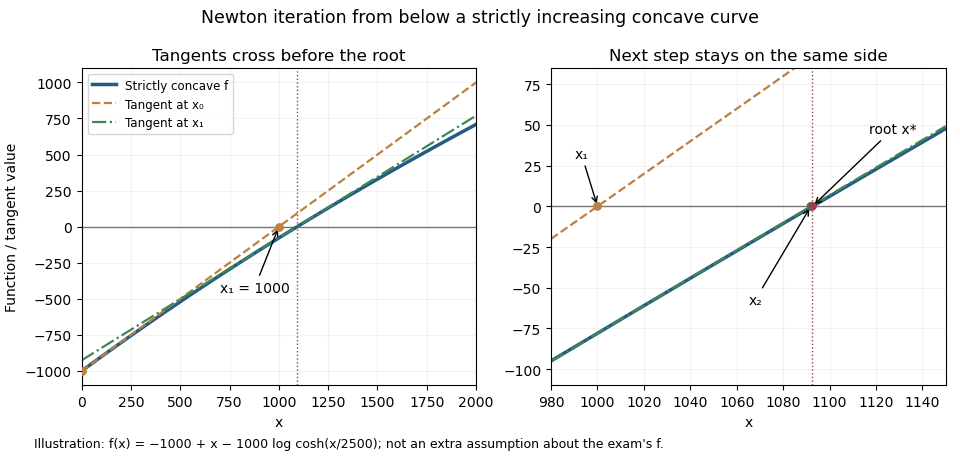

Set . By Taylor's theorem,The first two terms cancel by the definition of the Newton root-finding iteration. Thuswith between the consecutive iterates. In particular, a nonzero step has negative new residual under the stated strict concavity.
The Newton root-finding iteration gives .
Taylor's theorem at zero gives for a point between zero and . At , strict negativity of the second derivative gives . At , its lower bound givesBy the intermediate value theorem there is a root strictly between these values. The given uniqueness identifies it as .
The Newton root-finding iteration isIt requires and its derivative to be defined at the current point, and requires . A step can leave the domain, making a subsequent iteration undefined. In floating-point arithmetic, division by zero, overflow or non-finite function evaluations can also prevent a usable step. At a root where is zero the displayed quotient itself remains undefined unless the implementation stops before evaluating it.
Eliminate the constraint by writing , with . The logarithms cancel, so the objective becomes . Its derivatives are and . Thus the unique stationary point is the unique global minimum, at . Restoring givesAs a direct global check, the arithmetic-geometric mean inequality gives , with equality exactly at the same point.
No. Both and are affine functions, hence convex functions. Their product is not convex: at the midpoint of and , . Thus products of convex functions need not be convex, even for smooth functions on all of .
Put . For , convexity gives , henceBy the first-order form of Taylor's theorem, the right side tends to as . ThereforeThis is the supporting inequality for a differentiable convex function. The stated partial derivatives are enough: coordinate derivatives give directional Taylor expansion for convex functions, so no unmentioned continuity assumption on the second partial derivatives is needed. The result in fact needs less smoothness than the question assumes.
The allowed primes are exactly . DefineThe fundamental theorem of arithmetic makes this definition unambiguous and proves injectivity. For every , the positive integer belongs to and maps to that tuple, proving surjectivity. The inverse function is explicitly . In particular, maps to . This is the prime-exponent parametrization of smooth numbers.
There are unlisted articles, also show them or only show them.