The Newton root-finding iteration seeks a zero of a function by repeatedly solving its tangent line approximation. At a current guess with derivative , setGeometrically, follow the tangent line to the horizontal axis, then return to the function graph for the next tangent line. Close to a suitable zero of a function, the error becomes dramatically smaller.[ref]
https://ocw.mit.edu/courses/18-330-introduction-to-numerical-analysis-spring-2012/5b325bfa56a599794c7196de926844b0_MIT18_330S12_Chapter4.pdf. Laurent Demanet, MIT 18.330, Chapter 4, §4.1, 2012
For a concrete square root calculation, take the polynomial and start at . The Newton root-finding iteration becomes , givingThe errors use the unrounded iterates. After the first step, each iterate overestimates , and the exact identityexhibits quadratic convergence: once close, the number of correct decimal digits roughly doubles per step. This speed makes the Newton root-finding iteration useful when accurate derivatives are available.
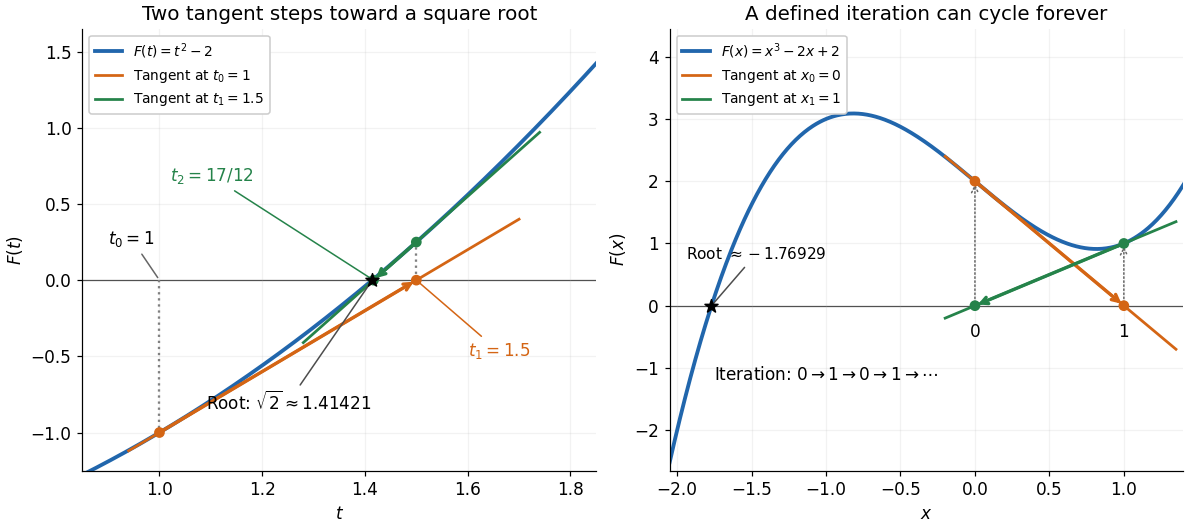

Global convergence requires additional care. For the polynomial , starting at gives , , hence . Then , gives . The sequence repeats forever, although a real polynomial root lies in by the intermediate value theorem. Neither point in the cycle is a zero of a function, and neither has zero derivative. A maintained sign-changing interval and fallback bisection method can protect a root solver from unsuitable Newton steps.
Articles by others on the same topic
There are currently no matching articles.