
Past exam of the quantum condensed matter course of the University of Cambridge 2006 Section B B6 Solution Created 2026-10-18 Updated 2026-10-20
For a lattice-periodic potential, Bloch's theorem permits energy eigenfunctions , where for every lattice translation . The crystal momentum is , defined modulo a reciprocal lattice vector. A reciprocal vector satisfies , so is lattice-periodic.
Expand the Bloch wave as plane waves in one momentum class, with . Substitution into the Schrödinger equation, using , gives a kinetic coefficient and potential coefficient . Independence of the plane waves therefore givesThis uses for the paper's running plane-wave index, to distinguish it from the fixed reduced Bloch wavevector.
For , the sine potential has coefficients , . At the Brillouin zone boundary, the free states and are degenerate. Keeping these two resonant waves in the nearly-free electron model givesThe determinant is , so the two energies are , separated by . With , the lower combination has coefficients and density proportional to ; the upper has and density . The lower wave places less weight where the potential is positive. Coupling to nonresonant plane waves gives higher-order corrections beyond this two-wave approximation.
The first Brillouin zone of a primitive cubic lattice is the cube . Its boundary along is the face center , while along it is the corner . ThereforeA spin-degenerate band accommodates two electrons per cell. To be a band insulator, the filled first band must be separated from the second at every wavevector; a direct local splitting alone is insufficient. Under the paper's uniform-boundary-gap estimate, take the lower edge as and the upper edge as . The highest lower edge is and the lowest upper edge is . Thus the indirect gap in a uniformly split zone-boundary model isEquality gives touching rather than a positive gap; for smaller , overlapping energy bands prevent a band insulator. This final threshold is the stated uniform-splitting band-edge estimate. A quantitative three-dimensional potential mixes several plane waves at corners and requires its full band structure rather than assuming the two-wave sine calculation remains exact there.
Past exam of the quantum condensed matter course of the University of Cambridge 2006 Section B B5 Solution Created 2026-10-18 Updated 2026-10-20
An intrinsic semiconductor has negligible electrically active impurity doping, and thermal excitation across its band gap produces equal electron and hole densities . In an extrinsic sample, semiconductor doping supplies donor impurities or acceptor impurities, so one carrier species dominates over a range of temperatures. Doping does not remove the possibility of low-temperature dopant freeze-out or high-temperature intrinsic behavior.
Assume parabolic isotropic band edges, spin degeneracy two, a single valley, thermal equilibrium and nondegenerate carriers. Write for the Fermi level, and measure conduction-band energy by . Counting momentum states gives the density of states per unit volumeThe low-occupation Maxwell–Boltzmann statistics givesThe substitution and give the coefficient. Similarly and . Multiplication eliminates , proving the semiconductor mass-action lawHere the supplied effective masses are treated as the masses entering the effective density of states. A detailed multivalley silicon model would require the appropriate valley degeneracy and density-of-states masses consistently; adding an extra factor without changing the stated model would alter the requested expression.
A pentavalent arsenic impurity supplies a weakly bound excess electron. In the hydrogenic donor state approximation, dielectric screening reduces the Coulomb attraction and the band effective mass replaces the free mass. Hence the donor binding energy isThis is the effective-mass estimate, without a material-specific central-cell correction.
For the temperature plot use donor density and no acceptors. The charge neutrality with partial donor ionization model puts and includes the twofold spin degeneracy of an occupied donor:These equations give three regimes. At low temperature, is negligible and strong dopant freeze-out gives . At intermediate temperature, the donors are almost ionized and intrinsic holes remain rare, so . At high temperature, . Thus the log-density plot against inverse temperature has a steep intrinsic segment on the left, a nearly horizontal extrinsic plateau, and a freeze-out decline on the right; the and factors give slight curvature.
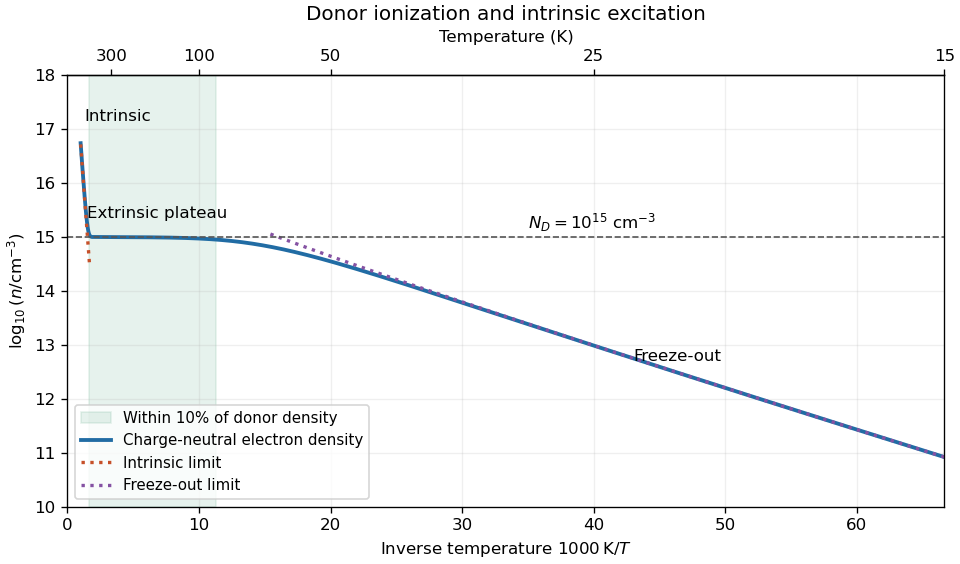
Carrier freeze-out, extrinsic plateau and intrinsic excitation in the specified donor model
. Original charge-neutral calculation using , constant , the supplied single-valley effective masses and donor degeneracy factor two. Dotted lines show limiting expressions where they apply; the shaded temperature interval uses a stated ten-percent plateau tolerance. Details.
To quantify “approximately constant”, require . At , the specified model gives , and . The full neutrality equations give the ten-percent plateau intervalThe lower boundary is set by donor ionization and the upper boundary by intrinsic electron-hole production. The large ratio allows substantial donor ionization even when ; using only would incorrectly exclude much of the plateau. The quoted interval depends on the chosen tolerance and the constant-gap band model, rather than being an exact measured range for arsenic-doped silicon.
There are unlisted articles, also show them or only show them.