
Past exam of the quantum condensed matter course of the University of Cambridge 2005 Section B B6 Solution Created 2026-10-18 Updated 2026-10-20
In the Bloch wave sum, is the number of sites, the equilibrium position of site , a localized atomic orbital there, and the crystal wavevector. The phase factor gives the translation character of the Bloch state. The factor normalizes it when the site orbitals are treated as orthonormal; appreciable intersite overlap requires an overlap-dependent normalization.
For a tight-binding model, choose localized orbitals and calculate the on-site and intersite Hamiltonian matrix elements. Form Bloch sums for each orbital type and solve at each , where is the orbital-overlap matrix. In the orthogonal tight-binding approximation, . The eigenvalues give the energy bands and the eigenvectors their orbital composition; the nonorthogonal nearest-neighbour tight-binding band illustrates how retained overlap modifies this procedure.
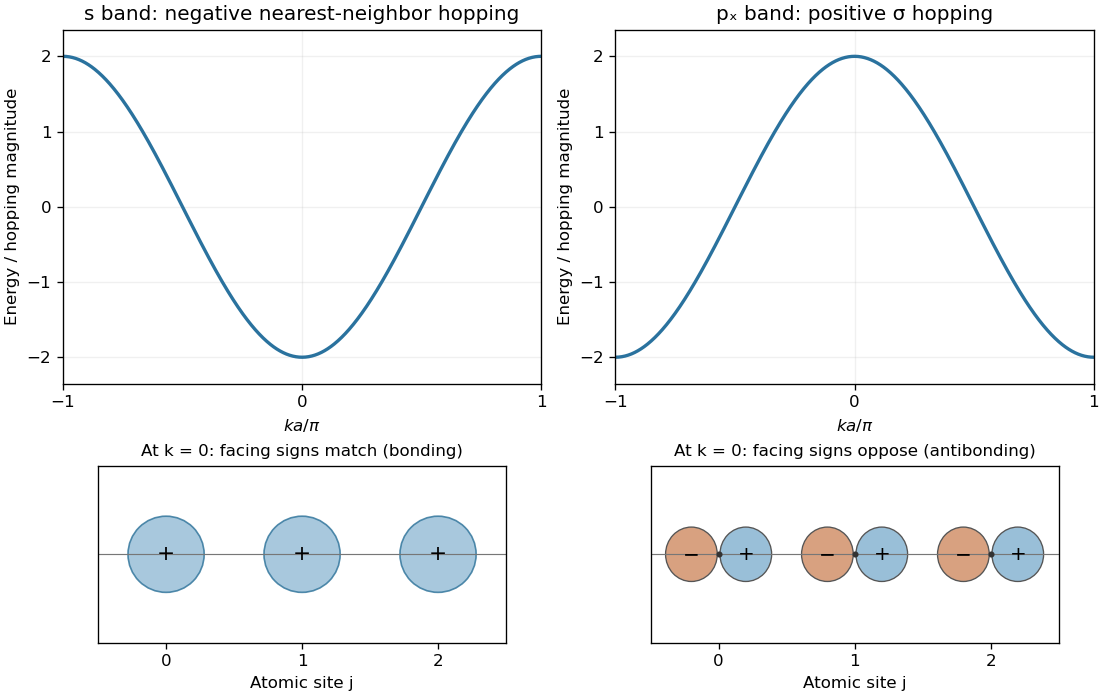
For one orthonormal s orbital per site, keep on-site energy and real nearest-neighbor hopping integral . The two neighbors contribute phases , giving . The band-curvature definition givesWith the usual bonding convention for these s orbitals, the center is a minimum with positive electron effective mass and the edge a maximum with negative electron effective mass. Hole masses near a filled-band maximum have the opposite sign.
For p orbitals aligned along the chain, the orbital phase and the sign of one-dimensional hopping reverse the usual center-versus-edge ordering. Choose every orbital with its positive lobe on the right. Equal neighboring Bloch coefficients then bring opposite-sign lobes together between sites, giving an antibonding state at . Alternating coefficients at make those facing lobes have the same sign, producing the lower bonding state. Thus a nearest-neighbor model has with the usual , maximum at zero and minima at the zone edges. This uses a fixed common orbital-phase convention at all sites.

Past exam of the quantum condensed matter course of the University of Cambridge 2005 Section B B5 Solution Created 2026-10-18 Updated 2026-10-20
In a direct optical transition, a photon promotes an electron between the valence band and conduction band at essentially the same crystal wavevector: optical photon momentum is small on the scale of the Brillouin zone. An indirect optical transition also needs a phonon or another momentum source. Near an indirect gap, phonon emission requires photon energy approximately , while phonon absorption permits with a thermally occupied phonon.
Strong direct interband absorption needs both many allowed transitions and a nonzero optical matrix element. The joint density of states counts pairs with ; nearly parallel bands and critical points of this energy difference can enhance it. Dipole selection rules and polarization weight that count, so a large joint density of states alone does not guarantee a strong absorption peak.
The supplied infrared spectrum lies below the interband threshold and instead probes free-carrier response. In the Drude model, , with . At long wavelengths the mobile electrons screen the field and the reflectivity is high. As wavelength decreases through the screened plasma edge, the real dielectric function becomes positive and propagating light can enter. The reflectivity reaches its minimum near index matching, , then rises toward the bound-electron background reflectance.
For background , its refractive index is four and the normal-incidence Fresnel equations give . The short-wavelength side of the figure is approaching a reflectance of this order, consistent with that background; its shortest plotted wavelength still has a carrier correction. Here “infinity” means high frequency relative to the free-carrier scale while remaining below the remote interband resonances.
The Drude-Lorentz reflectivity minimum is near , not the plasma-edge zero . Reading the deep minimum as and neglecting damping there gives . The carrier effective mass from a reflectivity minimum is thereforeThe graph supports only a rough read-off: shifting the minimum by changes this mass by about five percent. The deep narrow minimum supports the weak-loss assumption in this region, although finite scattering explains why the long-wavelength reflectivity is below unity. The estimate also assumes one dominant carrier species, a nonmagnetic bulk sample and a nearly constant background dielectric function. If the plasma-edge zero is used instead, its denominator is and its wavelength is slightly longer; the two wavelengths must not be interchanged.
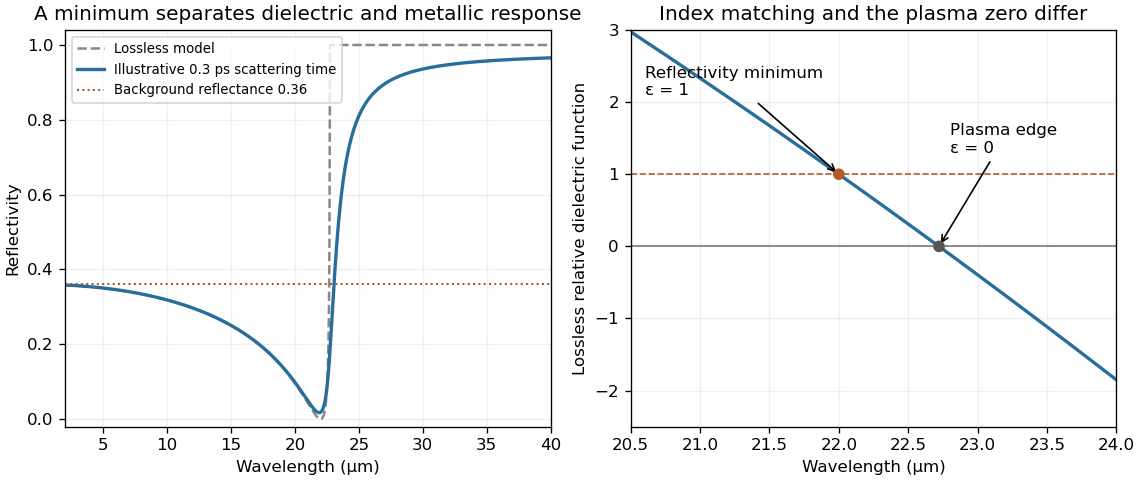
Drude-model reflectivity minimum and screened plasma edge
. Original calculation using , and a mass chosen to place the lossless reflectivity minimum at . The finite-scattering curve uses an illustrative relaxation time, not a fit to the exam's data. The supplied figure has not been copied or traced. Details.
Past exam of the quantum condensed matter course of the University of Cambridge 2005 Section A A3 Solution Created 2026-10-18 Updated 2026-10-20
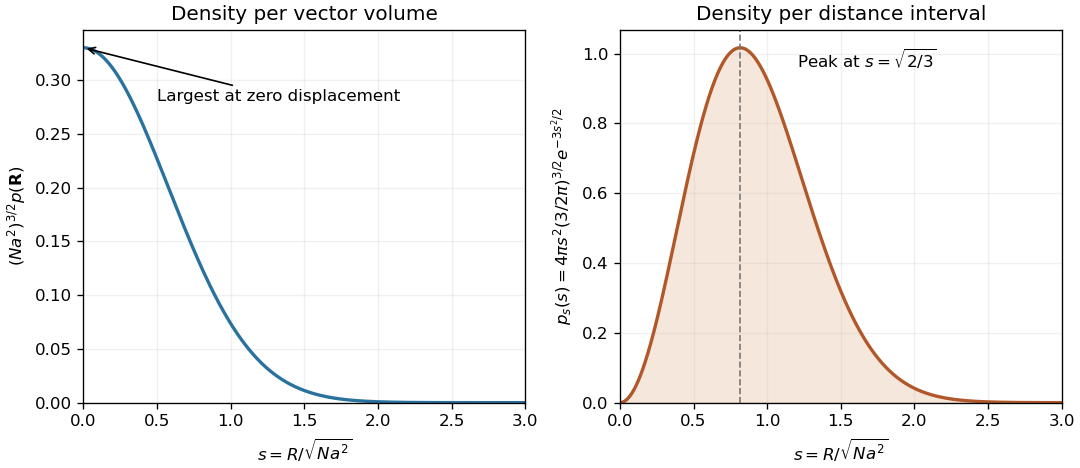
An ideal chain can be treated as a random walk when effective segment orientations are independent and isotropic, segment length is fixed, and interactions such as long-range excluded volume are absent or effectively screened. A large number of segments is needed for the Gaussian continuum approximation. Write . Each Cartesian component has mean zero and variance , so the central limit theorem gives the Gaussian limit of the end-to-end distribution of a freely jointed chainEquivalently, one step has characteristic function ; taking its th power and expanding its logarithm gives , whose inverse Fourier transform is this density. It is a density per vector volume . The scalar end-to-end-distance density is . Thus the printed expression must be interpreted as a vector density; it is also a large- approximation, not the exact finite-chain distribution near .
For a freely rotating chain, neighboring forward bond vectors have fixed angle , and independently uniform torsion angles give with . Squaring the sum of bonds therefore givesThere are pairs separated by bonds, so the characteristic ratio of a freely rotating chain isFor fixed , the geometric sums give . The correction vanishes as , yieldingFor the specified polyethylene parameters, , so and . HenceThe negative sign of the stated angle does not affect its cosine. The forward-bond angle is supplementary to the chemical internal bond angle. This freely rotating estimate includes fixed-angle correlations but omits torsional energy preferences; the Kuhn length of a freely rotating chain expresses the same long-chain persistence as .

Past exam of the quantum condensed matter course of the University of Cambridge 2005 Section A A2 Solution Created 2026-10-18 Updated 2026-10-20
For a dilute suspended sphere in Stokes flow, the translational friction coefficient is , with dynamic viscosity and hydrodynamic radius . To derive the diffusion-friction relation, put particles in a weak conservative force . Their drift velocity is , while the diffusive flux is . At equilibrium the Boltzmann distribution gives . Zero total flux therefore gives , hence the Stokes–Einstein relationHere is the Boltzmann constant, absolute temperature and the translational diffusion coefficient. The sphere, no-slip continuum-fluid and dilute thermal-equilibrium assumptions enter through the drag law and flux balance.
At and the supplied viscosity, the predicted product is . The derived predictions and radii inferred from the measured diffusion coefficients are:
| Protein | Predicted | Inferred hydrodynamic radius / nm |
|---|---|---|
| Ribonuclease | ||
| Beta-lactoglobulin | ||
| Haemoglobin | ||
| Collagen |
The last three agree closely at the precision of the supplied data. The ribonuclease diffusion coefficient is about below the spherical prediction, corresponding to a larger frictional radius than the stated radius. Hydration, shape, a different operational radius and coarse measurement precision can matter; molar mass is not an independent parameter in the spherical diffusion law. A compact constant-density globule would have , whereas collagen's large frictional radius relative to its mass is consistent with an extended nonspherical molecule. The inferred Stokes radius is a friction-equivalent radius, not automatically a geometric half-length.
In analytical ultracentrifugation, scan the radial protein concentration while a rotor spins at known angular speed . Optical absorbance or refractive-index interference records a moving sedimentation boundary and its diffusive broadening.[ref]
Optical Systems Used for AUC by Beckman Coulter Life Sciences. Radial scans during rotation, absorbance spectrophotometry and Rayleigh interference detection
With solvent density , partial specific volume and molar mass in , the buoyant mass is . Force balance gives , so the sedimentation coefficient is . A boundary trajectory gives ; diffusion gives .Combining them gives the molar mass from sedimentation and diffusion:Known mass and buoyancy can instead determine friction from alone, and comparison with a compact sphere tests shape or hydration. In sedimentation equilibrium, the stationary radial profile obeys , providing buoyant mass without a friction model. This is a sedimentation-diffusion balance in a uniform solvent, rather than density-gradient banding at an isopycnic point.
Past exam of the quantum condensed matter course of the University of Cambridge 2004 Section C C14 Solution Created 2026-10-18 Updated 2026-10-20
Semiconductor doping introduces electrically active impurities. In gallium arsenide, silicon has one more valence electron than gallium but one fewer than arsenic. Silicon on a gallium site can therefore supply a shallow donor electron, while silicon on an arsenic site can accept an electron and leave a mobile hole. It is an amphoteric dopant, so its net effect depends on site occupation and growth conditions.[ref]
Thermal equilibrium concentrations of the amphoteric dopant Si and the associated carrier concentrations in GaAs by Chang-Ho Chen and others. 1999 abstract: neutral and ionized donors on Ga sites and acceptors on As sites
For isotropic parabolic bands, shift the energy origin in the given free-electron density of states to the appropriate band edge and use its effective mass:and, for valence electron states,The stated normalization includes the two spin states and assumes one effective valley. In a nondegenerate semiconductor, the conduction occupation is approximately and the probability of a valence hole is approximately . Substituting in the first integral, and the corresponding hole energy in the second, giveswhere the effective density of states values are and . The factor comes from the supplied Gaussian-weighted integral. Multiplying cancels the shared thermodynamic equilibrium chemical potential and proves the semiconductor mass-action law:For the given sample and . With complete donor ionization and occupied acceptors, charge neutrality gives . At the given masses and gap giveSolving the compensated semiconductor equations, or using , yieldsThe very small minority density is consistent with the wide gap and the strongly n-type balance. Also and , checking the nondegenerate approximation. The acceptor levels are occupied in this n-type regime; complete acceptor ionization in the compensation equation is appropriate to the model.
At low temperature dopant freeze-out reduces the conduction-electron population; a quantitative curve would require dopant binding energies and occupation factors. Once donors are ionized while intrinsic excitation is negligible, gives an extrinsic plateau. At higher temperature intrinsic pairs eventually dominate, so if the gap and masses are treated as constant. Real gap and mass changes modify that last expression.
There are unlisted articles, also show them or only show them.