
Past exam of the mathematics course of the year 1 of the natural sciences course of the University of Cambridge 2008 Paper 2 14 a Solution Created 2026-10-18 Updated 2026-10-20
Put and . For , differentiation gives and therefore . The Korteweg-De Vries equation reduces toSince is nonconstant, both coefficients must vanish. Thus the nonzero solitary wave isThere is also the trivial solution , for which has no effect. The negative amplitude follows from the minus sign of the nonlinear term; it agrees with the sech-squared solitary wave of the KdV equation.
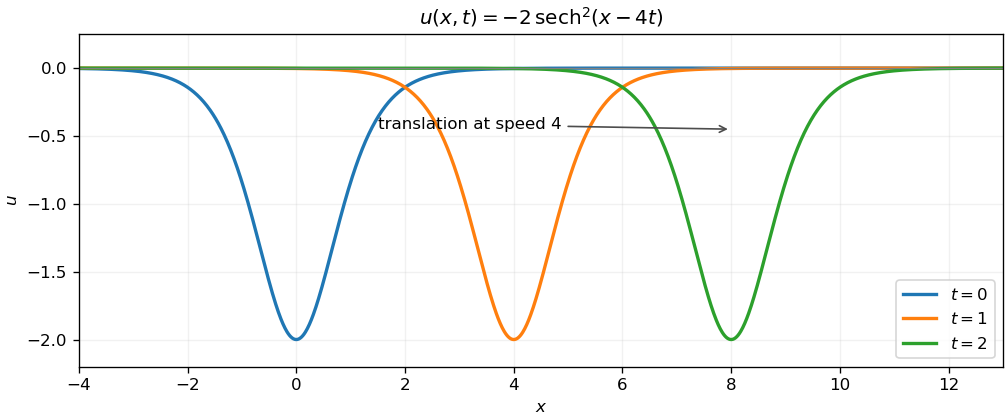
A negative solitary wave translates to the right without changing its profile
. Details. 
Past exam of the mathematics course of the year 1 of the natural sciences course of the University of Cambridge 2008 Paper 2 13 iii Solution Created 2026-10-18 Updated 2026-10-20
The repeated characteristic root is , matching the exponential forcing. Put ; then , so . The zero initial conditions give , henceThe extra quadratic factor is the resonance associated with the double root.
Past exam of the mathematics course of the year 1 of the natural sciences course of the University of Cambridge 2008 Paper 2 13 ii Solution Created 2026-10-18 Updated 2026-10-20
The complementary characteristic roots are . Substituting into the differential operator gives , so a particular solution is . The initial conditions then require and , giving
Past exam of the mathematics course of the year 1 of the natural sciences course of the University of Cambridge 2008 Paper 2 13 i Solution Created 2026-10-18 Updated 2026-10-20
The characteristic equation gives complementary terms . A linear particular solution is , since its substitution gives . The initial conditions give and , hence
Past exam of the mathematics course of the year 1 of the natural sciences course of the University of Cambridge 2008 Paper 2 11 c Solution Created 2026-10-18 Updated 2026-10-20
The lecture attendances are independent Bernoulli trials with success probability . Their count has the binomial distribution:
Past exam of the mathematics course of the year 1 of the natural sciences course of the University of Cambridge 2008 Paper 2 11 b Solution Created 2026-10-18 Updated 2026-10-20
By symmetry, each student in the university has probability of being in the college and then selected. Hence the prior probability is
Past exam of the mathematics course of the year 1 of the natural sciences course of the University of Cambridge 2008 Paper 1 7 ii Solution Created 2026-10-18 Updated 2026-10-20
The domain is , and from below as . Its derivative is , so it decreases up to and then increases, with its unique global minimum at . It crosses the horizontal axis at and tends to as . Its second derivative is , so it is strictly convex. The right panel of the preceding figure shows these features; zero is an excluded endpoint with a finite limiting value, rather than a vertical asymptote.
There are unlisted articles, also show them or only show them.