
Past exam of the mathematics course of the year 1 of the natural sciences course of the University of Cambridge 2008 Paper 1 7 i Solution Created 2026-10-18 Updated 2026-10-20
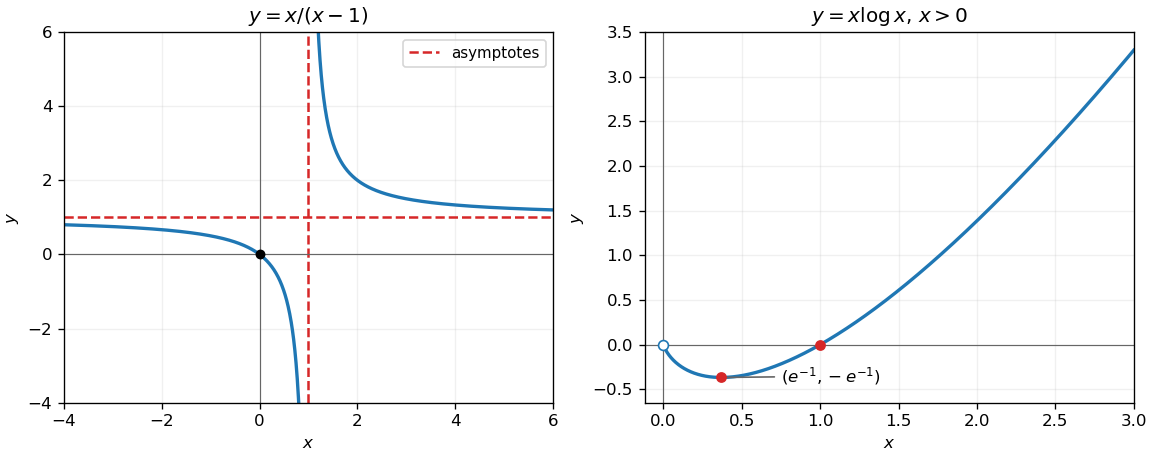

Past exam of the mathematics course of the year 1 of the natural sciences course of the University of Cambridge 2008 Paper 1 3 ii Solution Created 2026-10-18 Updated 2026-10-20
Past exam of the mathematics course of the year 1 of the natural sciences course of the University of Cambridge 2008 Paper 1 3 i Solution Created 2026-10-18 Updated 2026-10-20
Use the change of variables , . ThenDifferentiating verifies this antiderivative on the whole real line.
Past exam of the mathematics course of the year 1 of the natural sciences course of the University of Cambridge 2008 Paper 1 20 b Solution Created 2026-10-18 Updated 2026-10-20
For real square-integrable , nonnegativity of gives a quadratic in the real number . If , choose to obtainIf , then almost everywhere and the same inequality is immediate. This proves the integral Cauchy-Schwarz inequality.
Put and . The forward speed satisfies , so . The change of variables gives . Apply the Cauchy-Schwarz inequality to and the constant function one:Equality holds exactly when is constant almost everywhere. Equivalently, the time and distance averages of speed satisfy , which identifies the excess as a measure of speed variation.
Past exam of the mathematics course of the year 1 of the natural sciences course of the University of Cambridge 2008 Paper 1 20 a Solution Created 2026-10-18 Updated 2026-10-20
For functions with the required derivatives, the Leibniz rule isAt it is immediate. If it holds at , differentiating each summand gives two sums. The coefficient of after regrouping is by Pascal's identity, including the two endpoint terms. This proves the formula by mathematical induction.
Apply it to and then expand the derivatives of . For , the resulting coefficient is . Consequentlywhere range over nonnegative integers. This is the three-factor generalized Leibniz rule.
Past exam of the mathematics course of the year 1 of the natural sciences course of the University of Cambridge 2008 Paper 1 2 ii Solution Created 2026-10-18 Updated 2026-10-20
Past exam of the mathematics course of the year 1 of the natural sciences course of the University of Cambridge 2008 Paper 1 2 i Solution Created 2026-10-18 Updated 2026-10-20
The chain rule gives
Past exam of the mathematics course of the year 1 of the natural sciences course of the University of Cambridge 2008 Paper 1 19 c i Created 2026-10-18 Updated 2026-10-20
Past exam of the mathematics course of the year 1 of the natural sciences course of the University of Cambridge 2008 Paper 1 19 b Solution Created 2026-10-18 Updated 2026-10-20
If , divide numerator and denominator by . The expression becomes , which tends to since . If , the same argument gives . If , the expression equals for every . ThusThis is the two-term case of exponential concentration of a weighted mean, and holds for negative as well as positive parameters.
Past exam of the mathematics course of the year 1 of the natural sciences course of the University of Cambridge 2008 Paper 1 19 a i Created 2026-10-18 Updated 2026-10-20
Past exam of the mathematics course of the year 1 of the natural sciences course of the University of Cambridge 2008 Paper 1 18 c Solution Created 2026-10-18 Updated 2026-10-20
The coefficient matrix has determinantA homogeneous linear system has a nonzero solution exactly when this is a singular matrix. ThereforeAt this value all solutions are , with for a nonzero solution.
There are unlisted articles, also show them or only show them.