
Past exam of the mathematics course of the year 1 of the natural sciences course of the University of Cambridge 2008 Paper 2 9 i Solution Created 2026-10-18 Updated 2026-10-20
For a uniform distribution on the unit square, probability is the ratio of areas. The incircle has radius , so
Past exam of the mathematics course of the year 1 of the natural sciences course of the University of Cambridge 2008 Paper 2 8 ii Solution Created 2026-10-18 Updated 2026-10-20
Within this polynomial family, already holds and gives . Thus one solution isTwo specified point values alone do not give uniqueness among all solutions of the heat equation.
Past exam of the mathematics course of the year 1 of the natural sciences course of the University of Cambridge 2008 Paper 2 8 i Solution Created 2026-10-18 Updated 2026-10-20
The proposed function has partial derivatives and . Substitution in the heat equation requires , henceThe coefficient remains arbitrary.
Past exam of the mathematics course of the year 1 of the natural sciences course of the University of Cambridge 2008 Paper 2 4 ii Solution Created 2026-10-18 Updated 2026-10-20
Past exam of the mathematics course of the year 1 of the natural sciences course of the University of Cambridge 2008 Paper 2 4 i Solution Created 2026-10-18 Updated 2026-10-20
Past exam of the mathematics course of the year 1 of the natural sciences course of the University of Cambridge 2008 Paper 2 2 ii Solution Created 2026-10-18 Updated 2026-10-20
The integrand is an odd function, because is odd and is even. Its integral over the symmetric interval is therefore
Past exam of the mathematics course of the year 1 of the natural sciences course of the University of Cambridge 2008 Paper 2 2 i Solution Created 2026-10-18 Updated 2026-10-20
Past exam of the mathematics course of the year 1 of the natural sciences course of the University of Cambridge 2008 Paper 2 19 b Solution Created 2026-10-18 Updated 2026-10-20
For a separated harmonic function , Laplace's equation gives . Bounded periodic dependence in has ; decay on each half-plane selects for , when the potential is matched continuously at the sheet. These are the separated decaying modes. General decaying solutions can be superpositions of them; decay alone does not force a single value of .
The prescribed cosine density selects and . Its normal derivative jump is . Matching the stated jump givesThis is the gravitational potential of a sinusoidal sheet in the normalization of the question. It is continuous at the sheet and decays on both sides. Since changes sign, it can physically describe a Fourier component of a density perturbation rather than an everywhere positive isolated mass sheet.
Past exam of the mathematics course of the year 1 of the natural sciences course of the University of Cambridge 2008 Paper 2 19 a Solution Created 2026-10-18 Updated 2026-10-20
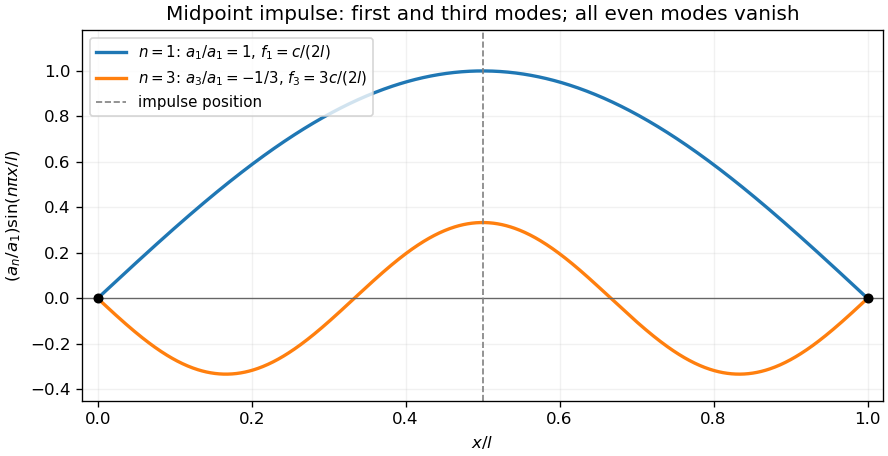
For and , the zero-endpoint Dirichlet boundary conditions select the Fourier sine basis functions . Separation of variables gives temporal factors with angular frequencies . Zero initial displacement removes the temporal cosine terms, givingDifferentiating at and using Fourier orthogonality givesThe evaluation property of the given initial velocity means in the sense of a Dirac delta, an idealized impulsively struck fixed-end string. Thus : every even mode vanishes, while the lowest two excited modes have . Their ordinary frequencies and amplitude ratio areThe signed coefficient ratio is . The impulse solution is interpreted as a distributional weak solution, rather than one with a smooth initial velocity.

Past exam of the mathematics course of the year 1 of the natural sciences course of the University of Cambridge 2008 Paper 2 18 c Solution Created 2026-10-18 Updated 2026-10-20
The identity reduces to when is constant. In components, this follows by differentiating and using the antisymmetry of the Levi-Civita symbol. The divergence theorem and the cyclic scalar triple product identity now giveSince is arbitrary,The order of the cross product determines the minus sign, as in the vector curl form of the divergence theorem.
Past exam of the mathematics course of the year 1 of the natural sciences course of the University of Cambridge 2008 Paper 2 18 b Solution Created 2026-10-18 Updated 2026-10-20
Since is constant, componentwise differentiation gives . Applying the divergence theorem to this vector field givesThis holds for every constant vector , so the vector integrals agree. This is the vector gradient form of the divergence theorem. With , the gradient is the constant unit vector . Therefore
Past exam of the mathematics course of the year 1 of the natural sciences course of the University of Cambridge 2008 Paper 2 18 a Solution Created 2026-10-18 Updated 2026-10-20
For a bounded region with piecewise smooth closed boundary , outward unit normal vector and continuously differentiable vector field , the divergence theorem states . Here is scalar surface area, is volume, and is the oriented area element.
For , its divergence is three. The ellipsoid has semiaxes , so its volume is , obtained by scaling the unit ball. Consequently
Past exam of the mathematics course of the year 1 of the natural sciences course of the University of Cambridge 2008 Paper 2 17 c Solution Created 2026-10-18 Updated 2026-10-20
The periodic ramp is an odd function, so . Integration by parts givesThus the Fourier series of a periodic sawtooth isThe periodic function is smooth at , so the Dirichlet-Jordan convergence theorem permits evaluation there. Even-index terms vanish and odd-index sines alternate in sign, giving
Past exam of the mathematics course of the year 1 of the natural sciences course of the University of Cambridge 2008 Paper 2 17 b Solution Created 2026-10-18 Updated 2026-10-20
Write . For the partial sum , ordinary multiplication givesOn , the integrals of every nonconstant sine or cosine vanish. Fourier orthogonality further gives and the same identity for two sines, while every sine-cosine integral is zero. ThusFor square-integrable , its Fourier partial sums converge to in L2 space, so their squared norms converge to the squared norm of . Passing to the limit proves Parseval's identity:Working with finite partial sums before taking the norm limit avoids an unjustified interchange of an infinite double series and integration.
Past exam of the mathematics course of the year 1 of the natural sciences course of the University of Cambridge 2008 Paper 2 17 a Solution Created 2026-10-18 Updated 2026-10-20
Every harmonic in this Fourier series has period . Since the first-harmonic coefficient is nonzero, the fundamental period cannot be smaller: translating by a period must multiply that nonzero complex coefficient by . Thus, taking ,
There are unlisted articles, also show them or only show them.