
For , the first two derivatives are and . At they giveUse the first three Taylor expansion terms with increment :The positive third derivative shows that this quadratic approximation underestimates the true value. The Taylor remainder is at most , since decreases on and the cubic remainder is .
Past exam of the mathematics course of the year 1 of the natural sciences course of the University of Cambridge 2009 Paper 2 2 ii Solution Created 2026-10-18 Updated 2026-10-20
Past exam of the mathematics course of the year 1 of the natural sciences course of the University of Cambridge 2009 Paper 2 2 i Solution Created 2026-10-18 Updated 2026-10-20
The function is an odd function, since is even and the sine is odd. Its integral on the symmetric interval therefore cancels:
Past exam of the mathematics course of the year 1 of the natural sciences course of the University of Cambridge 2009 Paper 1 8 b Solution Created 2026-10-18 Updated 2026-10-20
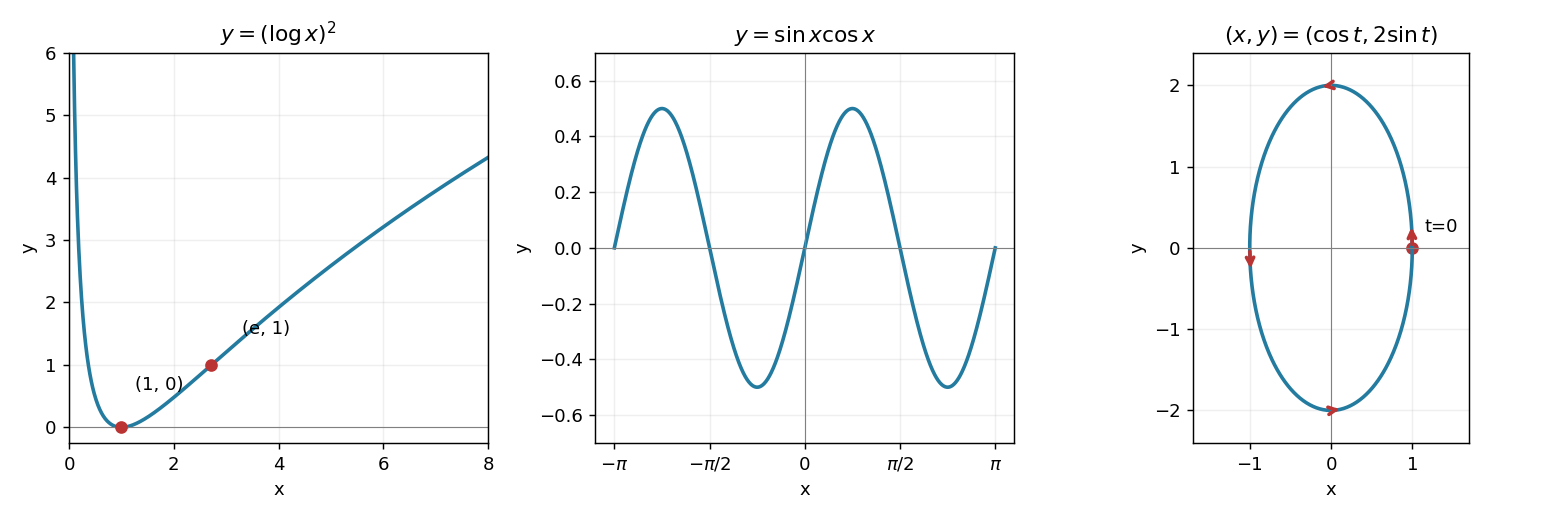
Write . It is an odd function with amplitude and period . Its zeros on the specified interval are . The maxima are at and the minima at , with values and . The middle panel of the preceding figure shows the two full oscillations.
Past exam of the mathematics course of the year 1 of the natural sciences course of the University of Cambridge 2009 Paper 1 8 a Solution Created 2026-10-18 Updated 2026-10-20
The graph is nonnegative, tends to as and as , and vanishes only at . Its derivative is , negative before one and positive after one, so is the unique global minimum. The second derivative is : the graph is convex for and concave for , with an inflection point at . These features determine the sketch in the left panel.

Past exam of the mathematics course of the year 1 of the natural sciences course of the University of Cambridge 2009 Paper 1 7 b Solution Created 2026-10-18 Updated 2026-10-20
This geometric series has first term one and ratio , whose absolute value is less than one. Therefore
Past exam of the mathematics course of the year 1 of the natural sciences course of the University of Cambridge 2009 Paper 1 7 a Solution Created 2026-10-18 Updated 2026-10-20
Past exam of the mathematics course of the year 1 of the natural sciences course of the University of Cambridge 2009 Paper 1 4 b Solution Created 2026-10-18 Updated 2026-10-20
Past exam of the mathematics course of the year 1 of the natural sciences course of the University of Cambridge 2009 Paper 1 4 a Solution Created 2026-10-18 Updated 2026-10-20
Use partial fraction decomposition:Integrating the two logarithmic derivatives givesThis holds on each interval avoiding the two poles and , with an independent integration constant on each interval.
Past exam of the mathematics course of the year 1 of the natural sciences course of the University of Cambridge 2009 Paper 1 3 b Solution Created 2026-10-18 Updated 2026-10-20
Past exam of the mathematics course of the year 1 of the natural sciences course of the University of Cambridge 2009 Paper 1 3 a Solution Created 2026-10-18 Updated 2026-10-20
Past exam of the mathematics course of the year 1 of the natural sciences course of the University of Cambridge 2009 Paper 1 10 b Solution Created 2026-10-18 Updated 2026-10-20
For a parametric curve with , the chain rule givesThe specified point has , hence in the given traversal. Therefore
Past exam of the mathematics course of the year 1 of the natural sciences course of the University of Cambridge 2009 Paper 1 10 a Solution Created 2026-10-18 Updated 2026-10-20
Past exam of the mathematics course of the year 1 of the natural sciences course of the University of Cambridge 2008 Paper 2 9 ii Solution Created 2026-10-18 Updated 2026-10-20
Conditioned on being inside the circle, the point is a uniform random point in a disk of radius . The annulus from to has area . Dividing by the disk's area givesThe radial probability density function is on and integrates to one. Without conditioning, the corresponding annulus probability for a point in the original square is .
There are unlisted articles, also show them or only show them.