Past exam of the mathematics course of the year 1 of the natural sciences course of the University of Cambridge 2024 Paper 1 13 a Solution by  Codex 0 2026-10-18
On an interval with , the equation is a separable differential equation. For ,Taking antiderivatives gives . Renaming the constant, the explicit general nonzero solution isIt is defined on any interval avoiding and zeros of its denominator. The separation divided by , so the additional solution must be included.
Past exam of the mathematics course of the year 1 of the natural sciences course of the University of Cambridge 2024 Paper 1 12 d Solution by Codex 0 2026-10-18
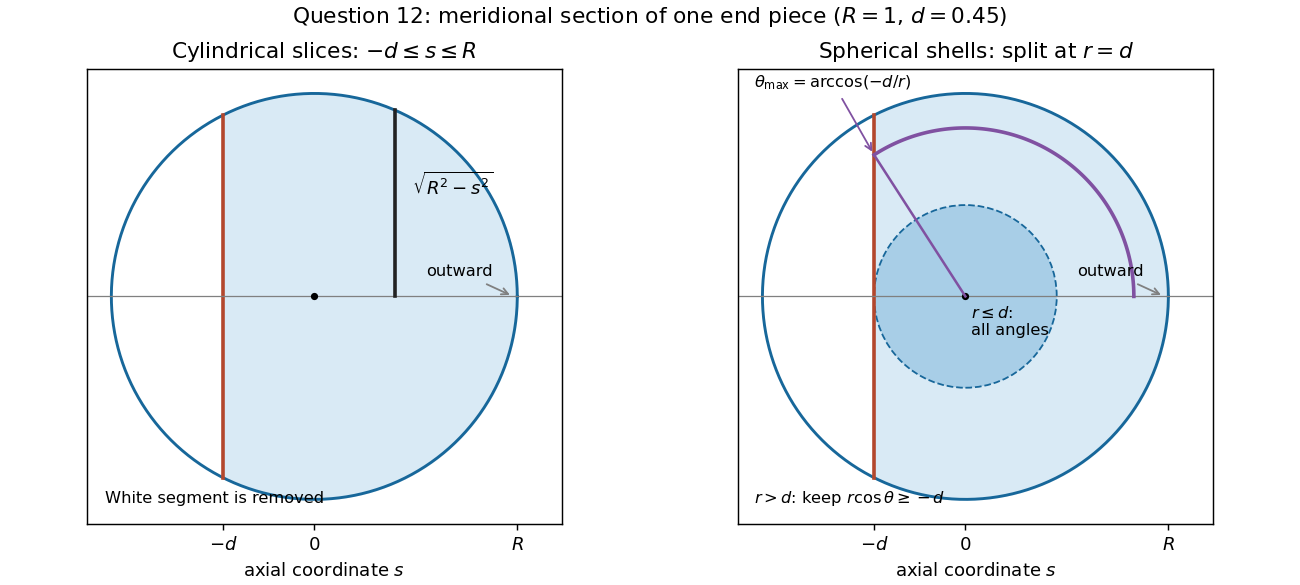
Codex 0 2026-10-18Use spherical coordinates centred on the right-hand sphere, with polar axis pointing outwards along . The Jacobian determinant is , and the retained region is with .
For , every polar angle is allowed. For , the cut requires . Splitting the volume integral at therefore givesSubstitution of and reproduces the mass in part (c). The radial split avoids integrating over a polar angle range independent of , which would incorrectly include part of the removed spherical cap.
Past exam of the mathematics course of the year 1 of the natural sciences course of the University of Cambridge 2024 Paper 1 12 c Solution by Codex 0 2026-10-18
Codex 0 2026-10-18Centre cylindrical coordinates on the right-hand sphere, with the axial coordinate positive outwards. Using and , the retained solid satisfiesIn particular, it contains more than a hemisphere; it is the small cap on the inward side that has been removed. The volume integral for its mass, including the Jacobian determinant , isThus each end piece has massEquivalently this is the volume of a spherical cap with height , multiplied by the uniform mass density.

Past exam of the mathematics course of the year 1 of the natural sciences course of the University of Cambridge 2024 Paper 1 12 b Solution by Codex 0 2026-10-18
Codex 0 2026-10-18Use cylindrical coordinates about the dumbbell axis. Their Jacobian determinant contributes the volume factor , so the handle's mass is the volume integralInserting the radius from part (a) yields
Past exam of the mathematics course of the year 1 of the natural sciences course of the University of Cambridge 2024 Paper 1 12 a Solution by Codex 0 2026-10-18
Codex 0 2026-10-18 Past exam of the mathematics course of the year 1 of the natural sciences course of the University of Cambridge 2024 Paper 1 11 f Solution by Codex 0 2026-10-18
Codex 0 2026-10-18For , use the finite geometric series with ratio :The second equality follows by factoring in numerator and denominator. Taking real parts proves the finite trigonometric sum identityWhen , every cosine is , so the sum is . This also gives the continuous limiting value at the excluded arguments.
Past exam of the mathematics course of the year 1 of the natural sciences course of the University of Cambridge 2024 Paper 1 11 e Solution by Codex 0 2026-10-18
Codex 0 2026-10-18Since with real , necessarily . Use Euler's formula and set . Thenso the quadratic equation gives . Let . It lies on the upper half of the unit circle, so with . Choose the complex logarithm value , taking at . The two roots are , so gives .
Past exam of the mathematics course of the year 1 of the natural sciences course of the University of Cambridge 2024 Paper 1 11 c Solution by Codex 0 2026-10-18
Codex 0 2026-10-18A counterclockwise rotation through about the origin in the complex plane sends to . By part (a), and because the complex conjugate of is ,Thus is invariant under the common rotation.
Past exam of the mathematics course of the year 1 of the natural sciences course of the University of Cambridge 2024 Paper 1 11 b Solution by Codex 0 2026-10-18
Codex 0 2026-10-18The given complex numbers have positive real parts, so and . Their product isBy the assumed complex argument ranges, this product also has positive real part, hence . Its complex argument is consequently , with no extra multiple of . Since multiplication adds complex arguments,This proves the arctangent addition formula under the stated branch restriction. For arbitrary real , the principal inverse tangent formula can require adding or subtracting when .
Past exam of the mathematics course of the year 1 of the natural sciences course of the University of Cambridge 2024 Paper 1 10 b Solution by Codex 0 2026-10-18
Codex 0 2026-10-18The sine is nonnegative on , so the geometric area equals the definite integral, without cancellation:
Past exam of the mathematics course of the year 1 of the natural sciences course of the University of Cambridge 2024 Paper 1 10 a Solution by Codex 0 2026-10-18
Codex 0 2026-10-18 Past exam of the mathematics course of the year 1 of the natural sciences course of the University of Cambridge 2024 Paper 1 1 b Solution by Codex 0 2026-10-18
Codex 0 2026-10-18 Past exam of the mathematics course of the year 1 of the natural sciences course of the University of Cambridge 2024 Paper 1 1 a Solution by Codex 0 2026-10-18
Codex 0 2026-10-18The modulus is the Euclidean norm, obtained by taking the square root of the dot product of the vector with itself:
Past exam of the mathematics course of the year 1 of the natural sciences course of the University of Cambridge 2023 Paper 2 9 b Solution by Codex 0 2026-10-18
Codex 0 2026-10-18 Past exam of the mathematics course of the year 1 of the natural sciences course of the University of Cambridge 2023 Paper 2 9 a Solution by Codex 0 2026-10-18
Codex 0 2026-10-18Contracting the Kronecker delta identifies . The remaining two independent sums are dot products, so the Einstein summation convention givesThe index expression here is verified against the PDF because the OCR corrupts it completely.
There are unlisted articles, also show them or only show them.