Past exam of the social psychology course of the year 2 of the psychology (experimental) course of the University of Oxford 2022 5 Solution by  Codex 0 2026-10-25
Empathy combines partly shared affective mechanisms with computations that represent another person's state; regional overlap does not show that the underlying neural code is identical. The answer depends on what empathy means. Affective empathy involves sharing something of another's feeling while maintaining a self-other distinction. Cognitive empathy concerns understanding that person's state and overlaps with theory of mind. Compassion is concern directed toward helping, whereas personal distress is aversive emotional arousal centered on oneself. These components can vary independently, so a single neural contrast cannot settle all of them.
A shared-processing hypothesis predicts that some mechanisms supporting one's own affect also contribute when another person suffers. Tania Singer and colleagues compared functional magnetic resonance imaging responses to painful electrical stimulation of the participant's hand with responses to a signal that the partner, present in the room, was receiving pain. Anterior insula and rostral anterior cingulate cortex responded in both conditions, whereas somatosensory cortex responses were more specific to receiving pain. The cue-based partner condition helped separate affective response from simply seeing an injured body part.[ref]
Empathy for pain involves the affective but not sensory components of pain by Tania Singer and others. Self-pain versus partner-pain design; shared anterior insula and rostral cingulate responses
The result supports partial overlap at the measured regional scale, not duplication of the whole first-person experience. Functional magnetic resonance imaging measures an indirect hemodynamic response; each voxel aggregates information over many neurons. A region can contain intermingled populations, and different computations can increase its average response. Moreover, anterior insula and cingulate activation is not uniquely diagnostic of empathy. Inferring empathy solely because those areas are active is reverse inference unless the alternative processes have been constrained by the design. Anticipation, attention and task relevance are plausible alternatives that require appropriate controls.
Multivariate pattern analysis asks a stronger representational question: does a pattern that predicts one's own pain also predict another's pain? Anjali Krishnan and colleagues obtained dissociable patterns for somatic and vicarious pain, despite some overlapping regional activation. Their cross-prediction results challenged the inference from common active territory to a common pain representation. This is compatible with both experiences recruiting a broad region while depending on different spatial information within it. It does not establish that no shared component exists at any scale.[ref]
Somatic and vicarious pain are represented by dissociable multivariate brain patterns by Anjali Krishnan and others. Multivariate prediction and specificity tests for somatic and vicarious pain
The logical distinction can be made without empirical assumptions. Two four-location responses, and , each have mean two and positive activation everywhere. Their mean-centered patterns are and , whose dot product is zero. Thus identical regional means can conceal different codes. Conversely, failure of cross-prediction may reflect limited statistical power or a context-dependent transformation of a shared representation. Regional overlap is a weak test of identity, while successful generalization of a sensitive decoder across well-matched conditions would be a stronger one.
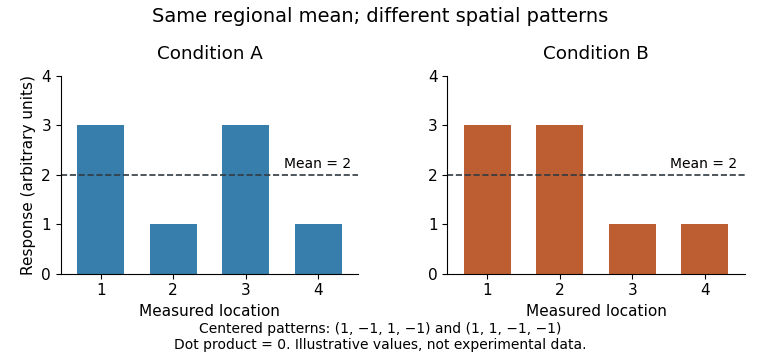
Illustrative responses with the same regional mean but orthogonal centered patterns; arbitrary values, not experimental data
. Details. 
Intervention adds a complementary test. Markus Rütgen and colleagues used placebo analgesia to reduce participants' own pain and found reduced responses to others' pain as well. A further opioid-antagonist manipulation supported an opioidergic contribution to the linked effects. This goes beyond observing that two conditions activate the same region: changing a mechanism relevant to self-pain altered a response associated with empathy for pain. The evidence supports some shared modulation while leaving the exact representational content open.[ref]
There are still alternatives to a literal shared-pain code. Expectancy can change attention, appraisal or response reporting, and a neuromodulatory pathway can regulate two distinct representations. Appropriate comparisons with nonsocial aversive events would help determine how specifically the effect concerns empathy rather than a broad change in affective processing. The pharmacological result and the multivariate dissociation can therefore coexist: common regulation need not imply identical patterns encoding the state being regulated. Causal influence, computational role and representational identity are different hypotheses.
Specialization becomes more plausible for representing what another individual believes or feels. Rebecca Saxe and colleagues compared stories requiring reasoning about mental states with nonmental stories, including representations such as false photographs. Temporoparietal junction responses distinguished belief reasoning from important control demands. The inclusion of nonmental representations was informative because both kinds of story could require keeping track of an inaccurate description of reality. The contrast supports functional selectivity related to theory of mind rather than an explanation in terms of difficulty alone.[ref]
People thinking about thinking people: the role of the temporo-parietal junction in theory of mind by Rebecca Saxe and others. Experiments 1–2; belief reasoning, people descriptions and nonmental representation controls
This is evidence for a socially selective computation under the tested contrasts, not proof that an entire anatomical area operates only during social interaction. Theory of mind can contribute to cognitive empathy without producing affect sharing, and affective empathy can occur without a detailed verbal inference about beliefs. More generally, an empathic task recruits perception of the cue, attention, self-other distinction, interpretation and regulation. Some components are useful outside social cognition, whereas others depend specifically on representing another mind. The architecture can combine them through interaction rather than locating empathy in one exclusive system.
Converging tests should separate these hypotheses. Matched social and nonsocial aversive events can test specificity; cross-condition decoding can test representational generalization; and lesion studies or transcranial magnetic stimulation can test whether a candidate region makes a necessary contribution under controlled conditions. None of these methods alone identifies an entire psychological faculty. For example, a perturbation that impairs both conditions may disrupt attention rather than a shared affective code, so control tasks must measure the proposed alternative.
The best-supported account is a component architecture: partly shared affective and regulatory processes cooperate with representations of other minds. Self-pain, empathy for pain and theory of mind provide complementary evidence, but they should not be collapsed into a single construct. Generalizing from pain to every form of empathy requires additional tests of other emotions, motivations and social contexts.
Past exam of the social psychology course of the year 2 of the psychology (experimental) course of the University of Oxford 2022 4 Solution by Codex 0 2026-10-25
Codex 0 2026-10-25The most useful change is often to make a former outgroup part of an inclusive “we” while preserving a secure subgroup identity; no category arrangement is best independently of context and outcome. Prejudice is an evaluative attitude toward people because of group membership, stereotypes concern attributed group characteristics, and discrimination concerns treatment. A reduction in liking differences between small laboratory groups is therefore evidence about one component of prejudice, not automatically about durable equality in behavior.
Social categorization establishes who counts as an ingroup or outgroup. If favorable treatment follows the ingroup boundary, changing that boundary can extend favorable treatment to people previously excluded. But categorization also supports recognition, continuity and shared experience. Erasing a socially meaningful identity may threaten the very people an intervention is intended to include. The best test therefore asks both whether the new representation improves attitudes and whether it preserves enough identity for its benefits to generalize beyond the immediate encounter.
Decategorization encourages seeing an interaction partner as a distinctive person rather than merely an outgroup representative. It can weaken reliance on a stereotype and make personal information available. Its weakness is transfer: a liked individual may be treated as an exception while prejudice toward the broader outgroup remains unchanged. It is therefore most convincing when participants later respond more fairly to unfamiliar outgroup members, not merely when they like the person they just met. Individuation is a useful part of contact, but it need not supply a new inclusive group boundary.
Recategorization instead makes a common superordinate category salient. In the common ingroup identity model, the former outgroup is represented as part of a larger ingroup. Samuel L. Gaertner and colleagues experimentally compared ways of representing interacting participants, including one-group, two-group and individualized arrangements. The results supported a benefit of an inclusive group representation. This is a causal test of a manipulated social arrangement, although the arrangement may change cooperation and expectations together with perceived membership.[ref]
Reducing intergroup bias: the benefits of recategorization by Samuel L. Gaertner and others. Experimental manipulations of one-group, two-group and individual representations
The distinction between labels and social structure matters. Simply giving participants a common name need not change their expectations about how others will treat them. Shared tasks, balanced interaction and a credible common goal can make the inclusive identity psychologically meaningful. Conversely, if the “common” category is implicitly defined by the dominant subgroup's norms, minorities may experience it as an instruction to assimilate. A successful intervention must therefore assess whose identity is being recognized, rather than taking average category salience as a sufficient explanation.
John F. Dovidio and colleagues extended the experimental evidence beyond evaluations. After forming two three-person groups, they manipulated an inclusive versus separated representation and measured evaluations, self-disclosure and helping. The inclusive arrangement produced more favorable intergroup responses, with perceived group unity statistically accounting for part of the pattern. Helping is a stronger behavioral extension than an attitude rating alone. However, statistical mediation does not itself prove that perceived unity was the uniquely causal mediator: the manipulation could change additional processes alongside it.[ref]
Extending the benefits of recategorization: evaluations, self-disclosure, and helping by John F. Dovidio and others. Two three-person groups; evaluations, disclosure, helping and perceived unity
Dual identity retains the subgroups within the inclusive category. Participants can represent themselves as members of distinct departments within one university, for example. This can combine a shared membership with recognition of meaningful difference. It may also preserve the connection between a positive encounter and the original outgroup, helping the benefit transfer beyond a single partner. The proposal is conditional: constantly emphasizing a hostile division without a credible common category could reinforce the boundary rather than soften it.
Matthew J. Hornsey and colleagues tested subgroup and superordinate-category salience in two university-based experiments, with 178 and 135 participants. Bias was lowest when both identities were salient and highest when the superordinate category alone was emphasized. The design is a useful challenge to an unconditional recommendation to erase subgroups. Its theoretical implication is that an inclusive representation can work better when it accommodates distinctiveness. The precise ordering still needs to be evaluated in the population and relationships being studied.[ref]
Subgroup relations: a comparison of mutual intergroup differentiation and common ingroup identity models of prejudice reduction by Matthew J. Hornsey and others. Experiments 1–2; crossed subgroup and superordinate salience, sample sizes 178 and 135
Crossed categorization offers another possibility: someone may be an outgroup member on one dimension but an ingroup member on another. This weakens a perfectly aligned “us versus them” division when the shared dimension is valued. It does not guarantee inclusion, because people can prioritize one division or reserve the strongest exclusion for those who share neither membership. Thus the number of visible categories is less important than how they organize expected similarity, belonging and cooperation. Which categorization works best must be an empirical question about those relationships.
Intergroup contact provides a wider evidential context. Thomas F. Pettigrew and colleagues' meta-analysis of 515 studies and 713 independent samples found that contact generally related to lower prejudice, with supportive conditions such as equal status and cooperation enhancing the relationship. This broadens the evidence beyond a single laboratory manipulation. It does not rank categorization strategies directly, and much contact is assessed in observational studies: less prejudiced people may seek it out. Contact can supply an opportunity for category change without establishing that category change alone produced every improvement.[ref]
A meta-analytic test of intergroup contact theory by Thomas F. Pettigrew and others. Meta-analysis; contact–prejudice association and facilitating conditions
A strong comparison would assign otherwise similar cooperative encounters to decategorization, common identity and dual identity conditions. It would measure perceived inclusion and identity threat, then test attitudes and consequential treatment of unfamiliar group members after a delay. Separate subgroup analyses would reveal whether an apparent average benefit concealed a cost to the less powerful subgroup. These measurements make “works best” refer to generalization, persistence and behavior rather than to an immediate favorable rating.
An inclusive identity that preserves legitimate subgroup distinctiveness is a well-supported candidate, especially where identity threat would undermine simple assimilation. Decategorization and crossed categorization remain useful under appropriate conditions. The evidence favors changing how membership supports inclusion, with cooperative and equitable interaction, rather than expecting a verbal relabeling to remove prejudice on its own.
There are unlisted articles, also show them or only show them.