Past exam of the social psychology course of the year 2 of the psychology (experimental) course of the University of Oxford 2022 3 Solution by  Codex 0 2026-10-25
The evidence supports some prospective associations between violent media exposure and later aggression, but it does not establish a large, general causal effect on serious violence outside the laboratory. Aggression is behavior intended to harm; violence is its severe physical subset. Angry thoughts, physiological activation and an aggression-task score are not interchangeable with either. The relevant claim requires an exposure contrast, an outcome that captures harmful behavior in everyday life, and a design that distinguishes influence from selection.
Laboratory experiments can randomize immediate exposure, but a brief game followed by a noise-blast choice mainly tests a short-term response in an artificial setting. Competition, frustration, difficulty and expectations can differ between games as well as violent content. A statistically detectable laboratory effect therefore needs both construct validity and ecological validity before it supports a claim about everyday aggression. A plausible social learning mechanism supplies a hypothesis about acquiring aggressive responses; it does not by itself demonstrate that media caused a particular real-world outcome.
An important source of evidence is L. Rowell Huesmann and colleagues' follow-up from childhood television viewing to young adulthood. The study related violent television exposure at ages six to ten to later aggression, using follow-up interviews and archival information. Associations persisted after adjustment for measured childhood and family characteristics. Unlike a single laboratory task, the design addressed a long interval and outcomes beyond the immediate viewing session. It also tested exposure before the later outcome, making simple simultaneity an inadequate explanation.[ref]
Longitudinal relations between children's exposure to TV violence and their aggressive and violent behavior in young adulthood: 1977–1992 by L. Rowell Huesmann and others. Childhood measures, adult interview/archival outcomes and adjusted longitudinal models
Temporal order is necessary but insufficient for causal inference. Earlier aggression may both encourage violent-media selection and persist into adulthood. Family conflict, peer environments or poorly measured dispositions may influence both variables. Adjustment for baseline aggression helps, but imperfect measurement leaves residual confounding, and including a variable in a model does not ensure that its causal role was correctly represented. Attrition can further change the composition of the observed follow-up sample. These limitations qualify the causal interpretation without making the association irrelevant.
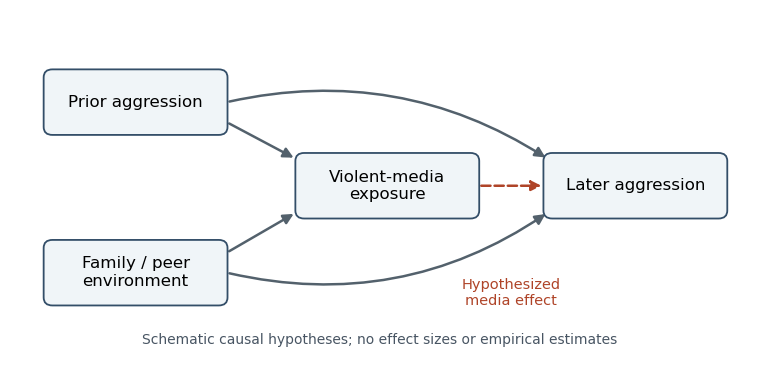
Competing causal explanations for a prospective media–aggression association; arrows are hypotheses rather than estimated effects
. Details. 
Andrew K. Przybylski and colleagues provide a useful contrasting design: a registered report studied 1,004 adolescent–carer pairs, combining adolescent gaming information and independently rated violent content with carers' reports of aggressive behavior. The confirmatory analysis did not support the predicted positive relationship. Separating the exposure and outcome reporters reduced one source of common-method bias, while preregistration reduced flexibility in choosing an attractive analysis. The design was a cross-sectional study, however, so it did not estimate a randomized causal effect or settle effects of earlier exposure.[ref]
Violent video game engagement is not associated with adolescents' aggressive behaviour: evidence from a registered report by Andrew K. Przybylski and others. Registered hypotheses, exposure classification and carer-reported aggression analyses
A null finding constrains a claim under the measurements and precision of that study. It does not prove that every form of violent media has exactly zero effect on every child. Conversely, explaining away every null result after observing it makes a general hypothesis difficult to test. The useful question is whether a prespecified exposure–outcome prediction survives an adequately sensitive test, and whether any estimated effect is large enough to matter outside the measurement scale.
Longer experiments strengthen a different part of the argument. Simone Kühn and colleagues randomized adults with little recent gaming to a violent game, a nonviolent game or no gaming for two months, with later testing. They did not find the predicted increase in aggression across their outcome battery. Exposure occurred beyond a brief laboratory session, which improves the relevance of the manipulation. Yet many endpoints were questionnaires or experimental tasks, rather than observed assaults, and the modest adult sample cannot settle small effects in children. The violent and nonviolent games also differed in more than violent content.[ref]
Does playing violent video games cause aggression? A longitudinal intervention study by Simone Kühn and others. Randomization, two-month intervention, outcome battery and follow-up
The distinction between naturalistic exposure and naturalistic outcome is crucial. A home-based intervention can establish a change in a laboratory score without demonstrating everyday harm; a real-world outcome can be valuable even when its exposure is assessed in an observational study. No single study here simultaneously supplies perfectly isolated content, prolonged exposure, representative participants and high-quality measurement of rare violence. Triangulation should ask whether the different weaknesses plausibly explain a pattern, rather than counting positive and negative papers as votes.
Meta-analysis helps estimate that pattern, but pooling does not repair a shared design limitation. Anna T. Prescott and colleagues combined 24 prospective studies with over 17,000 participants. They found a small positive association between violent-game exposure and later physical aggression after baseline adjustment; estimates decreased when available additional covariates were included. Aaron Drummond and colleagues' later meta-analysis emphasized weak associations and their sensitivity to study quality. The disagreement makes inclusion rules, measurement and analytic decisions central to interpretation.[ref]
Metaanalysis of the relationship between violent video game play and physical aggression over time by Anna T. Prescott and others. Abstract and adjusted-effect analyses; prospective physical aggression
[ref]Do longitudinal studies support long-term relationships between aggressive game play and youth aggressive behaviour? A meta-analytic examination by Aaron Drummond and others. Study-quality analyses and discussion of the longitudinal association
Even a small, reproducible association would not automatically identify a small causal effect: a consistent confound can also replicate. On the other hand, limited statistical power means an individual nonsignificant experiment need not contradict a small association. Effect sizes and uncertainty should therefore be compared on compatible outcome scales. Publication bias and selective analysis can favor alarming positive findings, while insensitive measures can hide genuine effects; both possibilities require evidence rather than assertion. The available studies also concern particular media, populations and time intervals, so their conclusions should not be extended automatically to all violent content.
The strongest next tests would preregister longitudinal exposure contrasts, measure baseline behavior carefully, obtain outcomes from independent sources and retain participants across follow-up. Where ethical and practical, randomization to matched content would separate violent imagery from competition and frustration. Everyday aggression and severe violence would be analyzed separately. By the examination date, large causal claims about real-world violence exceeded the evidence; small or context-dependent effects on aggression remained possible and required better identification. This conclusion takes the positive prospective findings seriously while keeping their causal and behavioral scope explicit.
Past exam of the social psychology course of the year 2 of the psychology (experimental) course of the University of Oxford 2022 2 Solution by Codex 0 2026-10-25
Codex 0 2026-10-25Cross-cultural agreement can arise from shared facial anatomy, shared sensory functions and recurring social experience without requiring an identical, innate dictionary of facial expressions. The central distinction is between common production mechanisms, agreement about visible features and agreement about the emotion those features signify. Evidence for one does not establish the others. Emotion recognition is an inference about an unobserved state from a signal and its context, rather than a direct reading of a label written on the face.
Shared anatomy constrains the movements that faces can make. Common problems such as obtaining sensory information, avoiding contamination and coordinating approach or withdrawal can make some configurations useful across communities. Similar environments may also teach similar associations between events and expressions. These explanations make different predictions: a biological production constraint predicts similarities even without observing other faces, whereas a culturally learned label predicts sensitivity to language, experience and local conventions. Cross-cultural consistency alone cannot separate these explanations because both can produce agreement.
Paul Ekman and colleagues' early work with relatively isolated New Guinea participants reduced the objection that all agreement arose from exposure to Western films. Participants matched narrated situations to posed photographs of facial expressions, with substantial agreement on several intended categories. This was an important extension beyond educated Western observers. However, choosing among a small set of photographs after an emotion-relevant story establishes agreement within that task. It does not show that the same label would arise spontaneously from an ambiguous face without the story.[ref]
Constants across cultures in the face and emotion by Paul Ekman and others. New Guinea story-matching procedure and cross-cultural recognition results
The distinction matters experimentally. A forced-choice emotion recognition task supplies candidate interpretations and excludes many alternatives. Translation can make a story more diagnostic of one response than another, and selected posed photographs maximize category contrasts. These features do not make the result meaningless; they specify its evidential scope. Agreement under constrained alternatives is evidence that participants can map those stimuli onto those situations. Strong universality would additionally require similar distinctions with natural expressions, broader response options and comparable meanings of the labels across languages. Measurement invariance is therefore a substantive problem, not merely a translation check.
Evidence from expression production provides an independent constraint. David Matsumoto and colleagues coded spontaneous expressions in blind and sighted athletes around competition outcomes. Similarities including congenitally blind athletes weaken the claim that the observed facial patterns require visual imitation of others. The study is especially useful because it examines emotionally significant events rather than only instructions to pose an expression. Nonetheless, blindness does not remove nonvisual social learning, and similar production does not establish identical recognition by observers in every culture.[ref]
Spontaneous facial expressions of emotion of congenitally and noncongenitally blind individuals by David Matsumoto and others. Blind and sighted athletes; facial coding and competition-outcome observations
The distinction between production and interpretation also clarifies a functional explanation. Joshua M. Susskind and colleagues asked people to produce fear, disgust and neutral configurations and measured sensory consequences. Fear configurations increased the reported visual field, accelerated target-directed eye movements and altered nasal inspiration in the direction of greater sensory acquisition; disgust showed an opposing tendency. Eye-movement recordings and respiratory measurements therefore linked expression geometry to a physical function rather than relying only on emotion labels.[ref]
Such a mechanism could help explain why certain visible signals recur: widening sensory access may be useful during uncertain threat, whereas limiting exposure may help during rejection. This is a functional hypothesis supported by the measured consequences of posed movements. It is not direct evidence that natural selection produced every component for that function, that every fearful person makes that face, or that every observer identifies fear from it. A facial movement can change sensory input, acquire a communicative meaning and be modified by a display rule; these processes can coexist.
The recognition code itself shows cultural variation. Rachael E. Jack and colleagues generated dynamic computer faces by varying facial movements and their timing. Fifteen Western and fifteen East Asian observers each categorized thousands of animations. Reverse correlation estimated which movements supported each observer's judgments. The resulting representations differed in their separation of the six candidate categories and in the timing and location of cues to intensity, including the importance of early eye movements for the East Asian sample.[ref]
Facial expressions of emotion are not culturally universal by Rachael E. Jack and others. Figure 1 and Results; 30 observers, randomized animations and reconstructed expression representations
This method weakens the assumption that everyone starts with the same six concept prototypes, because the prototypes were estimated from responses rather than selected by the experimenter. It still uses specified labels and small, culturally restricted samples; it cannot establish the absence of every shared component. A shared sensitivity to eye opening or positive versus negative significance could coexist with different category boundaries. Equally, agreement about broad emotional valence would be weaker than agreement about the exact distinction between fear and surprise. The level of description at which universality is claimed must remain explicit.
A decisive research program would combine production and recognition measures. Natural dynamic expressions should be sampled from comparable situations, with context independently manipulated. Observers should provide open descriptions as well as constrained choices; analyses should test whether translations and response scales support equivalent comparisons. Comparing early and late visual cues could separate common sensitivity to a feature from later category interpretation. Blind participants and culturally diverse populations provide complementary tests rather than interchangeable proof of innateness. These designs also prevent a common error: interpreting disagreement over a category name as absence of any shared perceptual sensitivity.
The most defensible universal factors are common biological constraints and recurring opportunities to learn useful signals; their contribution does not fix every category boundary or social meaning. The evidence supports substantial shared structure together with culturally shaped interpretation. A good explanation therefore specifies which feature, judgment or mechanism is shared, instead of treating all cross-cultural agreement as proof of a universal facial code.
Past exam of the social psychology course of the year 2 of the psychology (experimental) course of the University of Oxford 2022 1 Solution by Codex 0 2026-10-25
Codex 0 2026-10-25Dispositional attribution is most biased when a person's conduct is easy to encode as a trait but the constraints on that conduct are poorly represented or insufficiently used. The bias is conditional on attention, cognitive load, expectations and learned explanatory practices. Calling an inference biased requires a defensible benchmark: behavior sometimes really is informative about a person's enduring preferences. Correspondence bias concerns excessive correspondence between observed conduct and inferred disposition after relevant situational causes are taken into account, rather than the mere existence of a trait judgment.
The classic demonstration separates the direction of a political essay from whether its author chose that position. In the assigned-position condition, readers nevertheless inferred attitudes corresponding to the essay. Readers also distinguished choice from assignment, so the result supports insufficient discounting rather than complete blindness to constraint. The experiment by Edward E. Jones and colleagues makes the situation explicit and therefore challenges the explanation that perceivers simply had no situational information. It does not show that all information in an assigned essay is necessarily nondiagnostic: enthusiasm, wording or willingness to comply could still be informative under a different task model.[ref]
The attribution of attitudes by Edward E. Jones and others. Experiment 1; choice, no-choice and essay-position manipulations
Conditional diagnosticity in attribution provides a useful normative benchmark. Let denote a disposition, the observed behavior and the situation. By Bayes' theorem, posterior odds equal prior odds times a conditional likelihood ratio:If assignment makes the same behavior almost equally likely under either disposition, its likelihood ratio is near one. Treating this behavior as if it had been freely chosen exaggerates its diagnosticity. Conversely, repeated voluntary actions across varied situations can justify a strong dispositional attribution. The benchmark must therefore distinguish an inference from a single constrained act from an inference supported by a history of choices.
One mechanism is asymmetric attention. The actor is a discrete, changing object; the constraints can be dispersed across instructions, other people and background circumstances. A perceiver may accurately remember that a constraint existed without representing its causal force when interpreting the action. Explaining a nervous performance as anxiety is also economical: one familiar trait compresses many movements, whereas reconstructing an unfamiliar interview situation requires additional assumptions. This reasoning predicts more correspondence bias when the actor dominates attention, contextual information is ambiguous or perceivers lack relevant situational knowledge. Social salience alone, however, does not identify which trait will be inferred; expectations and category knowledge also shape interpretation.
The cognitive-load account receives a more direct test in Daniel T. Gilbert and colleagues' experiments. Participants watched silent videotaped clips of an apparently anxious target, with subtitles describing her discussion topics. Those required to rehearse the topics in order used this situational information less to adjust their trait judgments. The load therefore involved processing the context itself, rather than simply removing that information. Related experiments used constrained speech. The proposed sequence distinguishes identifying the behavior, deriving a characterization and correcting for context; the last step was especially vulnerable to cognitive load. This explains why merely telling observers about a constraint need not remove correspondence bias.[ref]
On cognitive busyness: when person perceivers meet persons perceived by Daniel T. Gilbert and others. Experiments 1–2; cognitive busyness and situational correction
The experimental manipulation supports a contribution from limited cognitive resources, but it does not prove that every social attribution follows a rigid three-stage sequence. A concurrent task may also alter attention to instructions or memory for diagnostic details. Context could influence the earliest interpretation when it is obvious and familiar. Thus the strongest claim is that effective situational use can require additional processing in these tasks, rather than that dispositional inference is universally automatic and situational inference universally controlled. A discriminating experiment would measure comprehension of the constraint as well as the final social attribution and vary processing time independently of contextual clarity.
Culture also changes the starting point of explanation. Michael W. Morris and colleagues compared American and Chinese explanations of social and physical events, using animated displays and accounts of killings in newspapers. The social explanations differed in their emphasis on individual characteristics and contextual causes; the comparison with physical events constrained an account based on a general inability to reason about causes. These findings suggest that learned explanatory frameworks influence which causes come readily to mind.[ref]
Culture and cause: American and Chinese attributions for social and physical events by Michael W. Morris and others. Animated social/physical events and newspaper explanations; domain-specific cultural comparisons
These comparisons do not warrant treating national populations as uniform psychological types. Nationality was not randomly assigned, newspaper writing is not a transparent measure of private judgment, and language or knowledge of the events can affect the explanations elicited. Their theoretical importance is that a supposedly universal default must accommodate systematic variation. An observer who routinely represents relationships and constraints may need less later correction, rather than merely possessing more cognitive resources. Cross-cultural psychology therefore complements the resource account by asking what information is represented before correction becomes necessary.
Motivation matters through the same conditional logic. A consequential decision can encourage searching for alternatives, but a desire for a quick, blame-consistent explanation can instead favor a dispositional attribution. Neither effect follows from motivation alone; the relevant question is which information the motive makes useful. Clear constraints, sufficiently understood instructions, time to use them and observations across multiple settings should improve calibration. These are mechanistic predictions, not guarantees that deliberation removes every cognitive bias.
The evidence is best explained by an interaction between behavioral diagnosticity and the perceiver's representation of context. Correspondence bias is strongest when salient conduct is readily characterized but situational alternatives receive too little weight; it weakens when constraints are understood and effectively incorporated. This account preserves the genuine usefulness of trait inference while explaining why its accuracy varies across tasks, resources and cultural experience.
There are unlisted articles, also show them or only show them.