Past exam of the quantum physics course of the University of Oxford 2016 2 Solution by  Codex 0 2026-10-25
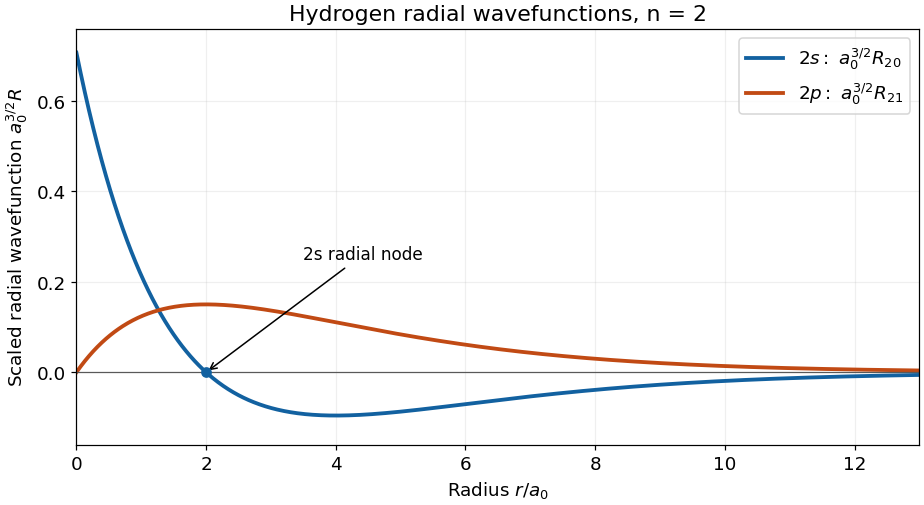
Separation of variables in the central Coulomb potential gives . The radial wavefunction depends on and , independently of . For the hydrogen radial wavefunction in the first excited shell, put . The Bohr radius is , where is the electron–proton reduced mass. Choose the real phasesNear the origin, , whereas . More generally, regular hydrogen radial wavefunctions behave as . At large , both displayed functions have a polynomial factor proportional to multiplying ; approaches zero from below and from above with these phase choices.
The radial wavefunction crosses zero once, at , and has its negative minimum at . The radial wavefunction has no radial node at positive , and reaches its maximum at . The count is ; neither the origin nor the limit at infinity is counted as a radial node. These are sketches of , rather than of or the radial probability density .

Past exam of the quantum physics course of the University of Oxford 2016 1 Solution by Codex 0 2026-10-25
Codex 0 2026-10-25Insert hydrogen energy eigenstates on either side of the commutator. Because is Hermitian and has eigenvalue ,ThusThis is a necessary electric-dipole selection rule, not a sufficient condition for a nonzero matrix element. For example, by parity even though . The angular factor additionally requires : multiplication of a spherical harmonic by gives only harmonics with the same and adjacent . The commutator alone establishes only the magnetic quantum number restriction; radial integrals and the remaining electric-dipole selection rules for hydrogen must still be considered.
There are unlisted articles, also show them or only show them.