Past exam of the theoretical physics I course of the University of Cambridge 2012 Paper 1 5 Solution by  Codex 0 2026-10-20
Noether's theorem associates a continuous one-parameter differentiable symmetry of the action with an on-shell conserved current. If a first-derivative Lagrangian density varies by , the current is . The integral of is conserved when the spatial boundary flux vanishes. This connects symmetries to conservation laws; time translation, spatial translation and internal phase symmetry furnish familiar examples.
For the strict fixed-coordinate invariance in the question, . In one space dimension, integration by parts at the density level givesThe bracket vanishes by the field equation. Thus yieldsIn four spacetime dimensions the same identity gives with . In particular, for the usual scalar kinetic term the spatial current has the minus sign inherited from .
For the quartic density in dimensions,To evaluate the displayed dilation current, abbreviate and . Product differentiation givesHere makes the differentiated kinetic terms cancel, and . On shell, the on-shell divergence of a quartic scalar dilation current reduces toHence this current is conserved for generic solutions in four spacetime dimensions. Special field configurations with vanishing density do not alter the generic dimensional statement.
The subtraction has a symmetry explanation: for , direct variation gives . At the action is invariant up to a boundary term, so . Strict invariance of the density is not required. This is a classical result; no claim about quantum scale invariance is needed.
Past exam of the theoretical physics I course of the University of Cambridge 2012 Paper 1 4 Solution by Codex 0 2026-10-20
Codex 0 2026-10-20Use metric signature and units with propagation speed one. The scalar Euler-Lagrange equation givesWith the stated spatial Fourier convention, becomes . Each transformed mode obeysHere and are the initial transformed field and velocity. Reality requires and the same for ; the Fourier convention places no extra in these evolution formulas.
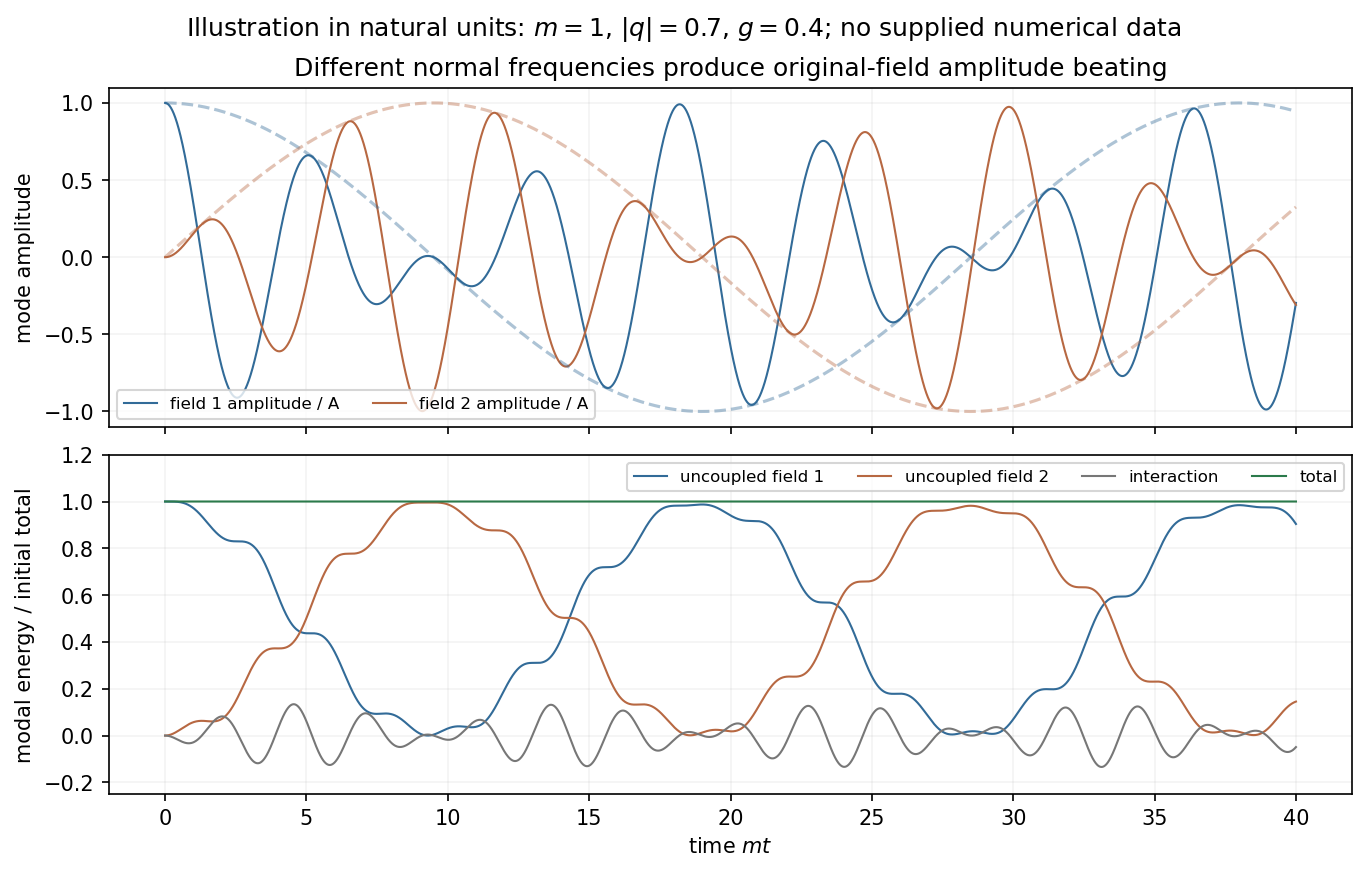
Including the interaction gives the two coupled real Klein-Gordon fields,Adding and subtracting diagonalizes them:Both squared masses are positive for . For arbitrary initial data and , defineThen the general solution is , , with the corresponding reality conditions on initial data.
For the specified sinusoidal initial displacement, put . Both normal fields initially have amplitude and zero time derivative. ConsequentlyWriting and gives and . This is field-amplitude beating of coupled Klein-Gordon modes. The conserved energy includes the interaction term ; separate uncoupled-field energies need not be conserved, and an envelope zero is not by itself exact complete energy transfer.

There are unlisted articles, also show them or only show them.