Past exam of the relativity course of the University of Cambridge 2012 Paper 1 1 a Solution by  Codex 0 2026-10-20
In the rest frame, conservation of energy would require , whereas conservation of momentum would require the photon momentum to vanish. These contradict . More generally, four-momentum conservation would equate the initial massive four-momentum to a null four-momentum, although their Minkowski norms differ:An isolated massive particle cannot decay into one photon in any inertial frame. Directly, a laboratory speed gives and ; matching a photon would require , hence . Recoil against another object could change the kinematics, but would introduce an additional participant.
Past exam of the relativistic Astrophysics and Cosmology course of the University of Cambridge 2012 Paper 1 3 e Solution by Codex 0 2026-10-20
Codex 0 2026-10-20A galaxy cluster deflects light from background galaxies according to its projected gravitational field. In a thin gravitational lens approximation,The distances are angular-diameter distances; only mass in the appropriate foreground/background geometry lenses the chosen source this way. Near critical curves, strong gravitational lensing produces highly magnified arcs and multiple images of the same source. Farther out, weak gravitational lensing produces small coherent shear distortions, inferred statistically because individual galaxies have unknown intrinsic ellipticities. The measured reduced shear is . Transparent lensing obeys surface-brightness conservation in gravitational lensing at fixed source redshift while changing solid angle and integrated flux.
Strong-lensing image positions and source redshifts constrain the central projected mass; weak shear extends the map to larger radii. Multiple source planes help constrain geometry and degeneracies, but the mass-sheet degeneracy illustrates why image shapes alone do not uniquely fix absolute mass. Point-spread-function anisotropy, selection, shape calibration, cluster-member contamination, source redshift errors and unrelated line-of-sight structure require controls. Lensing does not require hydrostatic equilibrium, making it valuable for disturbed clusters, although interpretation still depends on the gravitational model.
An instructive observation is the merging Bullet Cluster: weak-lensing mass concentrations approximately follow the collisionless galaxies while the dominant visible baryonic plasma, traced by X-rays, is displaced. Clowe and collaborators combined ground-based and Hubble images for lensing reconstruction and compared them with the gas distribution, providing evidence for mass beyond the observed baryons.[ref]
Cluster lensing maps total projected gravitating mass and magnifies background sources; it does not by itself identify the microscopic dark-matter particle.
Past exam of the relativistic Astrophysics and Cosmology course of the University of Cambridge 2012 Paper 1 3 d Solution by Codex 0 2026-10-20
Codex 0 2026-10-20The weak equivalence principle says that freely falling test bodies with identical initial conditions follow the same trajectory independently of composition, when nongravitational forces and appreciable self-gravity are negligible. In Newtonian language it implies universal gravitational-to-inertial mass ratio. The Einstein equivalence principle additionally requires local Lorentz invariance and local position invariance of nongravitational experiments: a sufficiently small freely falling laboratory realizes special relativity. The strong equivalence principle extends universality to gravitational experiments and self-gravitating bodies.
A falling elevator makes the local content clear. Uniform gravitational acceleration can be removed along a freely falling worldline by a suitable frame, but curvature cannot generally be removed over an extended region. Nearby geodesics have relative accelerationfor the displayed Riemann-sign convention. tidal forces therefore remain detectable even in free fall. Equivalence motivates a metric description and gravitational clock shifts, but does not uniquely select Einstein's field equations.
Tests compare accelerations of different materials, frequencies of clocks at different gravitational potentials, or the response of self-gravitating bodies. lunar laser ranging times pulses reflected by lunar retroreflectors and fits Earth-Moon motion in the Sun's field; a differential free-fall violation would add a characteristic periodic range perturbation. The fit must also model tides, station and reflector geometry and propagation delays, with solar-radiation pressure and reflector thermal effects checked as possible mimics. Williams and collaborators' 2012 analysis is a concrete example of this method, published after this examination.[ref]
Lunar Laser Ranging Tests of the Equivalence Principle by James G. Williams and others. §§2–4, pulse ranging, orbital fits and solar-radiation/thermal corrections
Equivalence is a local universality statement; tidal curvature and the detailed gravitational field equations are additional physics.
Past exam of the relativistic Astrophysics and Cosmology course of the University of Cambridge 2012 Paper 1 3 c Solution by Codex 0 2026-10-20
Codex 0 2026-10-20A quasar is a luminous active galactic nucleus powered by gas accretion onto a supermassive black hole. The hot disc produces much of the optical/ultraviolet continuum; surrounding gas gives broad and narrow emission lines, while some systems have relativistic jets. A small emitting region is inferred from rapid variability, when beaming is absent. Sustaining a high luminosity from such a compact region favours accretion over ordinary stellar power. For approximately spherical, ionized hydrogen with electron-scattering opacity,Comparing luminosity with this Eddington scale constrains mass only after assumptions about anisotropy, opacity and accretion state. The emitted power obeys ; high binding-energy efficiency makes growth of a massive compact accretor energetically plausible.
Broad-line reverberation mapping estimates a gas radius from a continuum-to-line time lag, , and combines it with line velocity width to infer . Geometry, inclination and nongravitational gas motions enter the factor . Independent evidence for compact massive nuclei comes from resolved stellar or gas orbits in nearby galaxies. Andrea M. Ghez and collaborators' Galactic-centre stellar-orbit study fitted a common central potential and distance, demonstrating a compact dark mass of order four million solar masses; the Galactic centre is a low-luminosity example rather than a quasar.[ref]
quasars are an accretion phase of massive nuclear black holes; luminosity, variability and dynamical evidence constrain different aspects of that interpretation. A finite-resolution dark-mass measurement by itself is not a direct image of an event horizon.
Past exam of the relativistic Astrophysics and Cosmology course of the University of Cambridge 2012 Paper 1 3 b Solution by Codex 0 2026-10-20
Codex 0 2026-10-20A positive cosmological constant contributes a constant vacuum energy density and negative pressure. In the time-unit convention of Question 2,It therefore causes accelerating expansion once its negative-pressure effect outweighs the decelerating components. Its density stays constant while matter dilutes, so a small early contribution can dominate late. For an isolated positive-vacuum component the scale factor grows exponentially. The cosmological constant problem is the mismatch between the small inferred vacuum density and generic quantum-field vacuum-energy expectations, rather than a failure of the background solution itself.
The key direct expansion evidence came from Type Ia supernova distance-redshift measurements. After light-curve and colour standardization, distant events were fainter than expected in simple decelerating matter-only models, indicating larger luminosity distances. Riess and collaborators' 1998 analysis and Perlmutter and collaborators' independent 42-supernova study favoured an accelerating low-matter-density cosmology with a positive vacuum contribution. Dust, source evolution, selection effects, photometric calibration and peculiar velocities must be controlled: faintness alone is not a model-independent measurement of .[ref]
Observational Evidence from Supernovae for an Accelerating Universe and a Cosmological Constant by Adam Riess and others. abstract; distance fitting and systematic-error discussion
[ref]Measurements of Omega and Lambda from 42 High-Redshift Supernovae by Saul Perlmutter and others. abstract; cosmological likelihoods and systematic checks
cosmic microwave background acoustic geometry and independent matter-density constraints help break the supernova parameter degeneracy: nearly flat geometry with substantially less than critical matter requires another component within the FLRW model. large-scale structure of the universe and distance measurements provide further consistency tests. The combined evidence supports a dark-energy contribution compatible with a constant; accelerating expansion by itself does not prove exactly constant vacuum energy or rule out every alternative gravity model.
Past exam of the relativistic Astrophysics and Cosmology course of the University of Cambridge 2012 Paper 1 3 a Solution by Codex 0 2026-10-20
Codex 0 2026-10-20A donor star can feed a compact companion through Roche-lobe overflow near the inner Lagrange point, or through capture of a stellar wind. The transferred gas usually carries angular momentum; when its circularization radius exceeds the accretor's effective inner radius it forms an accretion disc. Outward angular momentum transport permits inward mass flow, while dissipation converts gravitational binding energy into heat and radiation. For a compact object with a surface ; for a black hole write , with efficiency determined by the flow and inner boundary. Optically thick disc regions emit a sum of thermal radiation spectrum components; a hot optically thin accretion corona can inverse-Compton scatter softer photons into a harder X-ray component. A black hole has no material surface on which to radiate a stellar boundary layer.
An explicit example is the wind-fed black-hole binary Cygnus X-1. Its massive stellar companion supplies gas, and the accretion flow produces strong X-ray emission.[ref]
Wind Accretion and State Transitions in Cygnus X-1 by D. R. Gies and others. abstract, H-alpha wind monitoring and X-ray-state comparison
Compact-object evidence comes from orbital dynamics rather than X-ray brightness alone. The single-lined binary mass function constrains the unseen mass; inclination, donor properties and distance refine it. Jerome A. Orosz and collaborators combined optical photometry, radial velocities, rotation and a distance constraint to obtain a black-hole mass of in their 2011 analysis. The inference depends on the stellar and orbital model, and that historical value should not be confused with a latest measurement.[ref]The Mass of the Black Hole in Cygnus X-1 by Jerome A. Orosz and others. abstract; dynamical modelling and observational constraints
Binary accretion converts orbital mass transfer into compact gravitational-energy release; a dynamical mass measurement identifies the accretor more securely than luminosity alone.
Past exam of the relativistic Astrophysics and Cosmology course of the University of Cambridge 2012 Paper 1 2 c Solution by Codex 0 2026-10-20
Codex 0 2026-10-20Comparing photons with the constant vacuum density gives , soMatter dominates both at this crossing: its density in units of today's critical density is , compared with for each of the other components. radiation-vacuum density equality therefore does not itself mark a switch in the dominant component.
Past exam of the relativistic Astrophysics and Cosmology course of the University of Cambridge 2012 Paper 1 2 b Solution by Codex 0 2026-10-20
Codex 0 2026-10-20Vacuum density is constant for a true cosmological constant. Hence givesmatter-vacuum density equality is not the same event as the start of accelerating expansion: neglecting radiation, acceleration begins when .
Past exam of the relativistic Astrophysics and Cosmology course of the University of Cambridge 2012 Paper 1 2 a Solution by Codex 0 2026-10-20
Codex 0 2026-10-20Density parameters at the same epoch share a common critical-density denominator. Thus compare the densities directly: and . Equality givesThis is the photon-only matter-radiation equality appropriate to the specified radiation density, not the equality including all relativistic species.
Past exam of the quantum Condensed Matter Field Theory course of the University of Cambridge 2012 Paper 1 3 e Solution by Codex 0 2026-10-20
Codex 0 2026-10-20The coupled quantum rotor chain has a compact phase and conjugate integer number . Expanding the cosine givesIn the phase-space Euclidean path integral, using inverse-energy time, each rotor has the action term . Completing its Gaussian square produces . Equivalently, apply the short-time free-rotor kernel locally and retain winding sectors. The smooth-sector continuum limit at unit spacing is consequentlyThe overall constant is omitted when the reference bond energy is subtracted. With the same physical J as the Hamiltonian, the printed spatial coefficient has an extra factor . The imaginary-time normalization for a coupled rotor chain requires inside a bracket with common prefactor . Setting hides the discrepancy; it cannot establish the printed formula with explicit physical units.
Returning to physical time gives . The harmonic phase mode of a quantum rotor chain therefore hasThis is a gapless sound-like collective phase mode, analogous to neutral superfluid sound. In rotor-chain phase-number hydrodynamics, number fluctuations supply the compressibility and the intersite coupling supplies phase stiffness. The mode is a phase-density oscillation, not a free single-rotor transition. The global phase zero mode of a finite rotor chain is a compact rotor with inertia NI, which should not be counted as an independent zero-frequency oscillator.
The compactness qualification of a harmonic rotor chain matters here. The smooth harmonic theory requires small neighbouring phase differences and cannot settle the entire strong-fluctuation phase diagram. In one dimension its zero-temperature phase variance grows logarithmically, so the gapless regime has algebraic phase correlations rather than a true condensate. Thermal fluctuations and compact phase slips require additional care; phase-slip proliferation can produce a gapped phase outside the Gaussian regime. [ref]
Physics 215C: Quantum Field Theory, Part 3 by John McGreevy. §5.2, rotor phase/number variables and limits of smooth superfluid theory
Past exam of the quantum Condensed Matter Field Theory course of the University of Cambridge 2012 Paper 1 3 d Solution by Codex 0 2026-10-20
Codex 0 2026-10-20Analytically continue the supplied free propagator using and . This gives without an arbitrary measure constant.
Apply the Poisson summation formula to , with . Its Gaussian integral isThe prefactors cancel exactly because . Therefore the momentum-winding duality of the quantum rotor givesin agreement with the spectrum. The thermal winding dominance of a free rotor interchanges between the two representations. At low temperature the momentum sum is dominated by n=0 and . At high temperature the winding sum is dominated by m=0 and , the classical angular phase-space integral. Winding and momentum labels are dual descriptions; keeping only m=0 at low temperature would be incorrect.
Past exam of the quantum Condensed Matter Field Theory course of the University of Cambridge 2012 Paper 1 3 c Solution by Codex 0 2026-10-20
Codex 0 2026-10-20In winding sector m write the lifted path asThe cross term vanishes since . The action separates into and the same fixed-endpoint Gaussian path integral for every m. Neither term depends on the initial angle, so its integral supplies :The fixed-endpoint rotor fluctuation normalization isIt is the diagonal free-particle thermal kernel on the lifted line, or the amplitude density for a zero-displacement fluctuation bridge. It is not by itself the circle partition function or a separately countable angular zero mode. The integration over has already counted that mode. Quadraticity makes the saddle-plus-fluctuation evaluation exact.
Past exam of the quantum Condensed Matter Field Theory course of the University of Cambridge 2012 Paper 1 3 b Solution by Codex 0 2026-10-20
Codex 0 2026-10-20First lift the angle to the real line. The time-sliced configuration-space path integral for a free coordinate with inertia I has kinetic action . The rotor kernel sums lifted endpoints separated by , because all such endpoints represent the same final angle on the circle.
Continue real time as . Then and the end of the thermal interval is , in inverse-energy units. ThusThe trace integrates the initial angle over one copy of the circle, not the whole lifted line. It yields the rotor winding-sector path integralThe integer m is temporal winding number, not the angular-momentum label n. Locally the measure has the free-kernel normalization per time slice. Summing topological sectors and retaining this normalization are necessary for the correct thermal trace.
Past exam of the quantum Condensed Matter Field Theory course of the University of Cambridge 2012 Paper 1 3 a Solution by Codex 0 2026-10-20
Codex 0 2026-10-20For the untwisted quantum rotor, periodicity on the angle circle requires . The normalized energy eigenstates and their angular momentum areTaking the trace in this orthonormal basis therefore givesThe n=0 state is nondegenerate and each nonzero has two opposite-angular-momentum states. No flux or twisted angular boundary condition is present.
Past exam of the quantum Condensed Matter Field Theory course of the University of Cambridge 2012 Paper 1 2 c Solution by Codex 0 2026-10-20
Codex 0 2026-10-20Use the reduced attractive reduced BCS pairing Hamiltonian with volume V, and attraction :A specified pairing shell or an ultraviolet renormalization is part of the model. The trace is grand canonical. Insert fermionic coherent states into its time-sliced trace. The resulting Grassmann variables are antiperiodic, and with inverse-energy imaginary time the dimensionless action isThis boundary condition is essential for Fermi-Dirac statistics; replacing it by a bosonic periodic trace changes the answer. A complex Hubbard–Stratonovich transformation uses the local identitywith time-slice factors understood. The pairing field renders the fermion action quadratic. For a uniform static field the independent Nambu spinor block hasIts determinant is . The phase-independent determinant sign cancels under consistent reference normalization. Integrating the fermions gives the BCS pairing-field effective action, , with the normal-ordering/reference term retained. The fermionic pairing-block determinant normalization uses one independent pairing block for every k; a fully doubled spin-particle-hole trace instead needs one half. The subtracted grand potential of the reduced BCS model is particularly unambiguous:Performing the Matsubara frequency sum yieldsup to a common constant. At zero gap this reduces exactly to the two-spin free-gas result. The Matsubara derivation of the BCS saddle follows by differentiating with respect to and using givesThe second equation fixes the chemical potential at specified number. This stationary action is BCS mean-field theory, not an exact integration of pairing-field fluctuations. With constant single-spin density of states per volume and a symmetric energy cutoff , weak coupling gives and . The zero-temperature condensation grand-potential density is to leading weak-coupling order; using a spin-summed density would change these displayed factors. The BCS coherence factors are and , and the associated BCS ground state is the normalized product of empty and occupied pair states. [ref]
Lecture Notes for Quantum Matter by Steven H. Simon. Chapter11, BCS variational state, coherence factors, gap and thermal occupations
Allowing a slowly varying complex pairing field generates phase stiffness and, near the transition, the Ginzburg-Landau theory of superconductivity. A neutral paired system has a gapless phase sound mode; in a charged bulk superconductor electromagnetic coupling produces the Anderson-Higgs mechanism in a superconductor and the Meissner effect. These collective fluctuations are distinct from the gapped fermionic excitations. A microscopic dynamical calculation is needed to fix collective-mode dispersion and damping; the static saddle alone does not determine them. [ref]
Physics 215C: Quantum Field Theory, Part 3 by John McGreevy. §§3.1–3.2, coherent-state construction; §2.3, pair-field integration and charged phase dynamics
Past exam of the quantum Condensed Matter Field Theory course of the University of Cambridge 2012 Paper 1 2 b Solution by Codex 0 2026-10-20
Codex 0 2026-10-20Insert position resolutions between short-time evolution factors for . Integrating the momenta gives the path integral, with real-time slice factor and weight . A real classical trajectory cannot pass through a barrier with insufficient energy, but the path integral includes nonclassical paths.
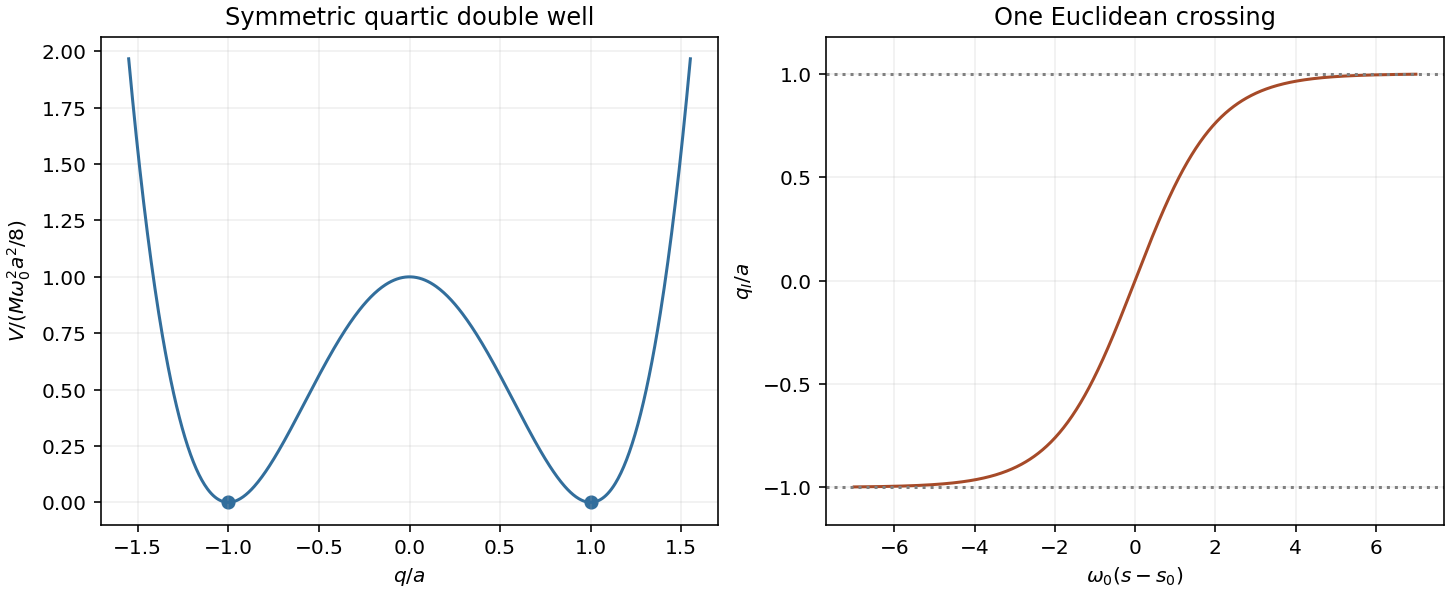
Continue , with s physical imaginary time. The damped kernel isThe Euclidean action saddle obeys : motion in the inverted potential. For degenerate minima at , subtract their common potential energy. A trajectory joining them with zero Euclidean energy satisfiesIt is an instanton; reversing its direction gives an anti-instanton. Thus a crossing amplitude is nonperturbative, proportional to . For the representative quartic well , direct integration givesThe arbitrary center is an instanton translation zero mode. Expanding gives a Gaussian path integral involving . Treating the zero mode as a collective coordinate rather than a zero Gaussian denominator produces the instanton fluctuation prefactorCommon endpoint regularization defines the functional determinant ratio; K and kappa have inverse-time units. The prime removes only the zero eigenvalue, while integrating the center supplies the total available time. Large and justify a dilute instanton gas.
Multiple crossings alternate direction. Integrating n ordered centers gives . Return paths contain even n, and transfer paths contain odd n, so their common local-well factor multiplies and respectively. The two lowest levels are consequentlyThe lower state is the even combination of the two localized states. Local anharmonic corrections modify and higher semiclassical corrections modify K. The thermal trace as a closed Euclidean path integral gives when higher local levels are negligible. This describes coherent level splitting in a stable well, not irreversible decay.
For a scattering barrier at energy E, the leading WKB tunnelling exponent gives an amplitude and a transmission probability with twice that exponent. Endpoint matching fixes prefactors. Metastable escape instead uses a Euclidean bounce, with a negative fluctuation mode and a decay rate. Neither its negative mode nor the probability/amplitude factor should be transplanted into the stable double-well splitting. [ref]
Gauge Theory by David Tong. Chapter2, §§2.3.2–2.3.3, printedpp.56–60: quantum-mechanical tunnelling, fluctuation determinants and repeated instanton events
Past exam of the quantum Condensed Matter Field Theory course of the University of Cambridge 2012 Paper 1 2 a Solution by Codex 0 2026-10-20
Codex 0 2026-10-20Use dimensionless spin operators and nearest-neighbour exchange on a regular bipartite graph with N sites and coordination number of a lattice z. Count each bond once and define , real for the inversion-symmetric examples considered here.
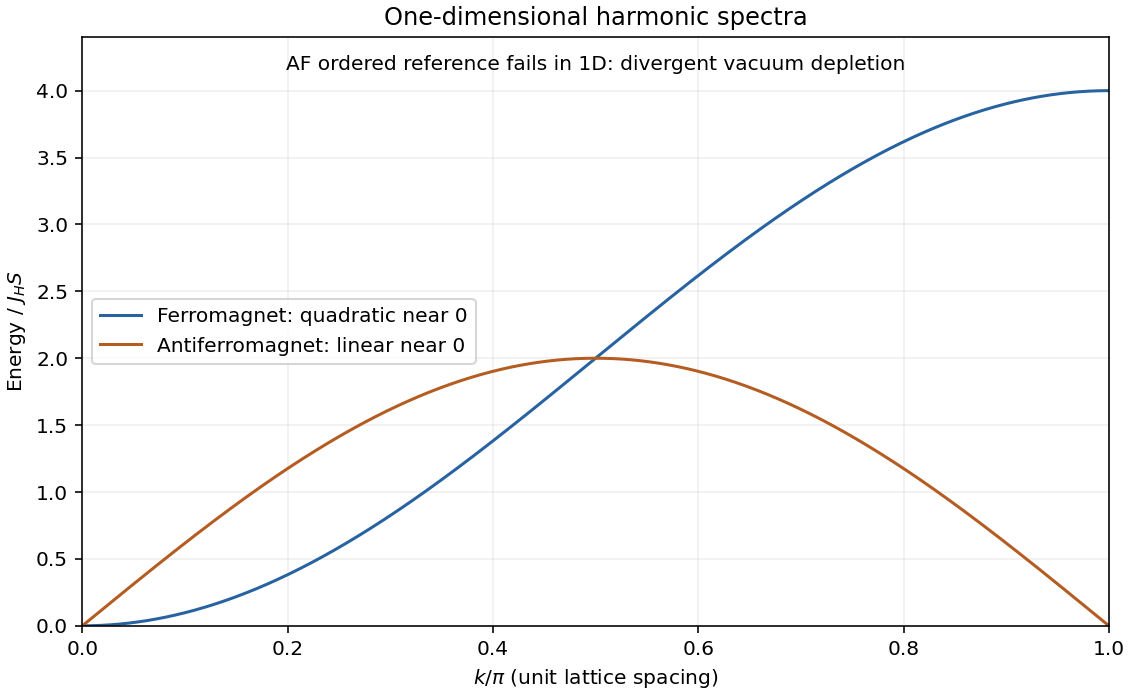
For the ferromagnetic Heisenberg model, . Expanding the Holstein–Primakoff transformation about all spins along +z givesup to interactions of higher order in boson density, with . The isotropic spin-wave vacuum energy comparison starts with this normal ordering. The linear spin-wave approximation then givesEach ferromagnetic magnon lowers total by one. The fully aligned state is an exact eigenstate and ground state; there is no harmonic vacuum depletion or added zero-point energy in this normal-ordered Hamiltonian. The global spin-rotation multiplet remains degenerate. On a hypercubic lattice of spacing a, and , so . The exact one-magnon sector agrees with this result even at finite S; interactions enter for multiple magnons.
For the Heisenberg antiferromagnet, take and expand around a Néel state. On A, and ; on B, and . A bond becomesWith N/2 momenta in the magnetic Brillouin zone,The bosonic Bogoliubov transformation has and . For example and . It gives two branches in this reduced zone,The reduced-zone counting of bipartite spin waves gives N oscillators in total, not 2N. The negative vacuum correction and quantum depletion of Néel order, , distinguish the antiferromagnet from the ferromagnet. At nonzero temperature replace by . Hypercubic small-momentum modes have , hence linear physical frequency .
Self-consistency requires depletion much smaller than S and respects the Holstein–Primakoff occupation constraint. In one dimension the antiferromagnetic vacuum depletion diverges logarithmically, invalidating ordered spin-wave theory; it does not alone prove an exact gap or its absence. At positive temperature, isotropic short-range models in d≤2 cannot sustain such magnetic order by the Mermin-Wagner theorem. In three dimensions the quadratic ferromagnetic modes give the low-temperature magnetization reduction proportional to , whereas the antiferromagnetic thermal reduction scales as . Anisotropy, fields, frustration and magnon interactions alter these conclusions. [ref]
Physics 215C: Quantum Field Theory, Part 3 by John McGreevy. §4.1, contrasting ferromagnetic and antiferromagnetic low-energy dynamics


Past exam of the quantum Condensed Matter Field Theory course of the University of Cambridge 2012 Paper 1 1 e Solution by Codex 0 2026-10-20
Codex 0 2026-10-20The Hellmann–Feynman theorem applied to the source field normalization givesDifferentiating the Ising-chain ground-state energy, using , therefore provesThis is the Ising-chain field derivative and transverse polarization, not its spontaneous x-order parameter. It tends to zero at g=0 and to N/2 at large positive field. The critical transverse polarization of an Ising chain is finite: in the thermodynamic critical limit this gives . A zero-energy isolated momentum is treated by the appropriate limiting state, rather than by assigning a value to a literal 0/0 summand.
There are unlisted articles, also show them or only show them.