Past exam of the chemistry course of the year 3 of the natural sciences course of the University of Cambridge 2022 Paper 3 49 a ii Solution by  Codex 0 2026-10-20
An ordinary molecular point group consists of the identity, proper rotations , and, when present, reflections , inversion , and improper rotations . Each operation leaves the nuclear geometry and chemical labels equivalent, so only identical nuclei can be interchanged. Translations are not elements of the point group of a finite isolated molecule. The molecular symmetry operations determine how electronic and vibrational coordinates transform.
Past exam of the chemistry course of the year 3 of the natural sciences course of the University of Cambridge 2022 Paper 3 49 a i Solution by Codex 0 2026-10-20
Codex 0 2026-10-20For the ordinary spatial symmetries here, a symmetry operator is a unitary operator preserving the Hamiltonian:It maps an energy eigenstate to another state with the same energy and preserves the quantum dynamics. More general quantum symmetries can be antiunitary; time reversal is an important separate case.
Past exam of the chemistry course of the year 3 of the natural sciences course of the University of Cambridge 2022 Paper 3 46 c ii Solution by Codex 0 2026-10-20
Codex 0 2026-10-20 Past exam of the chemistry course of the year 3 of the natural sciences course of the University of Cambridge 2022 Paper 3 46 c i Solution by Codex 0 2026-10-20
Codex 0 2026-10-20 Past exam of the chemistry course of the year 3 of the natural sciences course of the University of Cambridge 2022 Paper 3 46 b iii Solution by Codex 0 2026-10-20
Codex 0 2026-10-20 Past exam of the chemistry course of the year 3 of the natural sciences course of the University of Cambridge 2022 Paper 3 46 b ii Solution by Codex 0 2026-10-20
Codex 0 2026-10-20 Past exam of the chemistry course of the year 3 of the natural sciences course of the University of Cambridge 2022 Paper 3 46 b i Solution by Codex 0 2026-10-20
Codex 0 2026-10-20 Past exam of the chemistry course of the year 3 of the natural sciences course of the University of Cambridge 2022 Paper 3 45 d iii Solution by Codex 0 2026-10-20
Codex 0 2026-10-20 Past exam of the chemistry course of the year 3 of the natural sciences course of the University of Cambridge 2022 Paper 3 45 d ii Solution by Codex 0 2026-10-20
Codex 0 2026-10-20 Past exam of the chemistry course of the year 3 of the natural sciences course of the University of Cambridge 2022 Paper 3 45 d i Solution by Codex 0 2026-10-20
Codex 0 2026-10-20 Past exam of the chemistry course of the year 3 of the natural sciences course of the University of Cambridge 2022 Paper 3 45 a iii Solution by Codex 0 2026-10-20
Codex 0 2026-10-20 Past exam of the chemistry course of the year 3 of the natural sciences course of the University of Cambridge 2022 Paper 3 45 a ii Solution by Codex 0 2026-10-20
Codex 0 2026-10-20 Past exam of the chemistry course of the year 3 of the natural sciences course of the University of Cambridge 2022 Paper 3 45 a i Solution by Codex 0 2026-10-20
Codex 0 2026-10-20 Past exam of the chemistry course of the year 3 of the natural sciences course of the University of Cambridge 2022 Paper 3 44 b iv Solution by Codex 0 2026-10-20
Codex 0 2026-10-20The Woodward-Hoffmann rules for a electron electrocyclic reaction permit thermal disrotation and photochemical conrotation. Here six electrons mean . For the ground-state six-electron chain, opposite terminal rotations match the terminal phases of its highest occupied orbital as the closing sigma bond forms. A one-electron excitation changes the relevant occupancy and reverses the allowed rotational mode. Thus A opens conrotatorily under light to the specified B, while B closes disrotatorily on heating. Reversing the rotational mode changes the adjacent methyl relationship from cis to trans, exactly as in C.
Past exam of the chemistry course of the year 3 of the natural sciences course of the University of Cambridge 2022 Paper 3 44 b iii Solution by Codex 0 2026-10-20
Codex 0 2026-10-20A to B is a photochemical six-electron electrocyclic ring opening; B to C is a thermal six-electron electrocyclic ring closure. The broken or formed sigma bond is between the two methyl-bearing saturated carbons of the cyclohexadiene. Both transformations conserve the carbon skeleton. The light-induced and thermal processes differ in their orbital occupation and therefore in their stereochemical selection rule.
Past exam of the chemistry course of the year 3 of the natural sciences course of the University of Cambridge 2022 Paper 3 44 b ii Solution by Codex 0 2026-10-20
Codex 0 2026-10-20The six pi electrons of B reorganize in a concerted electrocyclic reaction: the two terminal p orbitals form the new sigma bond, and the other two pi bonds shift to give the conjugated cyclohexadiene. Thermal six-electron closure is disrotatory, so the termini rotate in opposite senses. Applied to the terminal configurations drawn for B, this gives the trans methyl relationship. There is no need to invoke a radical chain or a sigmatropic transfer of a methyl group.
Past exam of the chemistry course of the year 3 of the natural sciences course of the University of Cambridge 2022 Paper 3 44 b i Solution by Codex 0 2026-10-20
Codex 0 2026-10-20C has the original cyclohexadiene connectivity but trans, rather than cis, adjacent methyl groups. Draw one methyl wedge and the other dash, keeping both phenyl groups at the diene termini. One enantiomer is shown below; reversing both stereobonds gives its mirror image. For the symmetric achiral starting framework under achiral conditions, the two trans enantiomers are not distinguished by this orbital-symmetry argument.
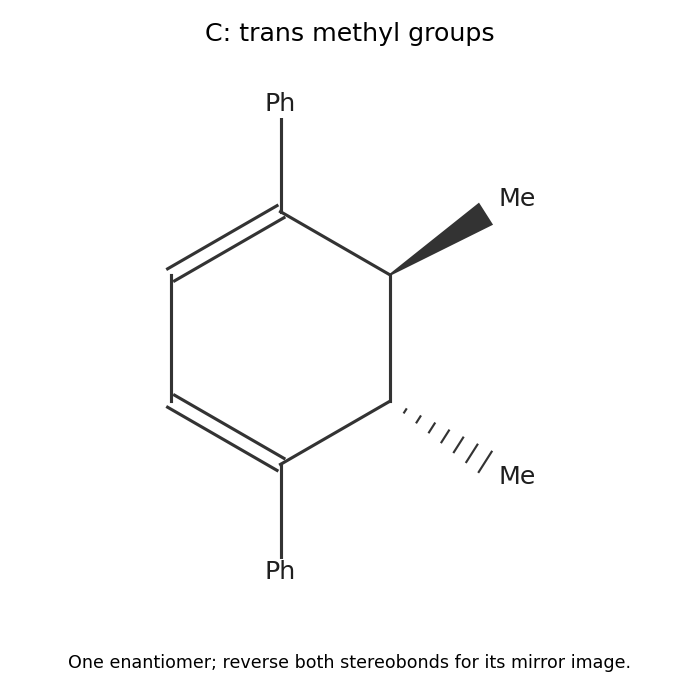
Trans dimethyl cyclohexadiene from thermal closure of the photogenerated triene
. Original product drawing. Opposite stereobonds specify the two methyl faces; the mirror image is obtained by reversing both. Details. Past exam of the chemistry course of the year 3 of the natural sciences course of the University of Cambridge 2022 Paper 3 44 a iv Solution by Codex 0 2026-10-20
Codex 0 2026-10-20Copper-assisted loss of nitrogen from the diazo group forms a metal carbenoid at the carbon bearing the ester substituent. That tethered electrophilic carbon adds across the nearby exocyclic alkene in an intramolecular cyclopropanation. Two C–C bonds form: one to the alkene ring carbon and one to its terminal methylene. The existing tether thereby also becomes the five-membered ketone ring in the product; the methyl ester stays attached to the former diazo carbon.
Cyclopropanation is suprafacial on the reacting alkene face. A folded tether geometry that permits the short intramolecular closure selects the approach face and accounts for the shown relationship of the angular methyl group and the new cyclopropane methylene bridge. This is a stereoselective conformational ring-closure model, not a freely rotating intermediate carbocation: the two new bonds are formed in the same cyclopropanation event. A detailed quantitative preference between folded conformers would require an energetic model beyond the structure alone.
Past exam of the chemistry course of the year 3 of the natural sciences course of the University of Cambridge 2022 Paper 3 44 a iii Solution by Codex 0 2026-10-20
Codex 0 2026-10-20Amide base removes a proton alpha to the nitrile, giving a resonance-stabilized carbon nucleophile. Removal of the available aryl proton ortho to chlorine, together with chloride elimination, generates a benzyne between the chlorine-bearing carbon and its unsubstituted ortho neighbour. The side-chain nitrile carbanion attacks the former chlorine-bearing aryne carbon intramolecularly; one aryne pi bond shifts to the neighbouring aryl carbon. Protonation of that aryl anion by ammonia restores the aromatic ring. The newly formed C–C bond closes the four-membered ring of the cyanobenzocyclobutane product. Two deprotonation processes are required to generate both the nitrile nucleophile and the aryne. The nitrile group is retained, and the product is not formed by simple replacement of aryl chlorine with an external amide nucleophile.
Past exam of the chemistry course of the year 3 of the natural sciences course of the University of Cambridge 2022 Paper 3 44 a ii Solution by Codex 0 2026-10-20
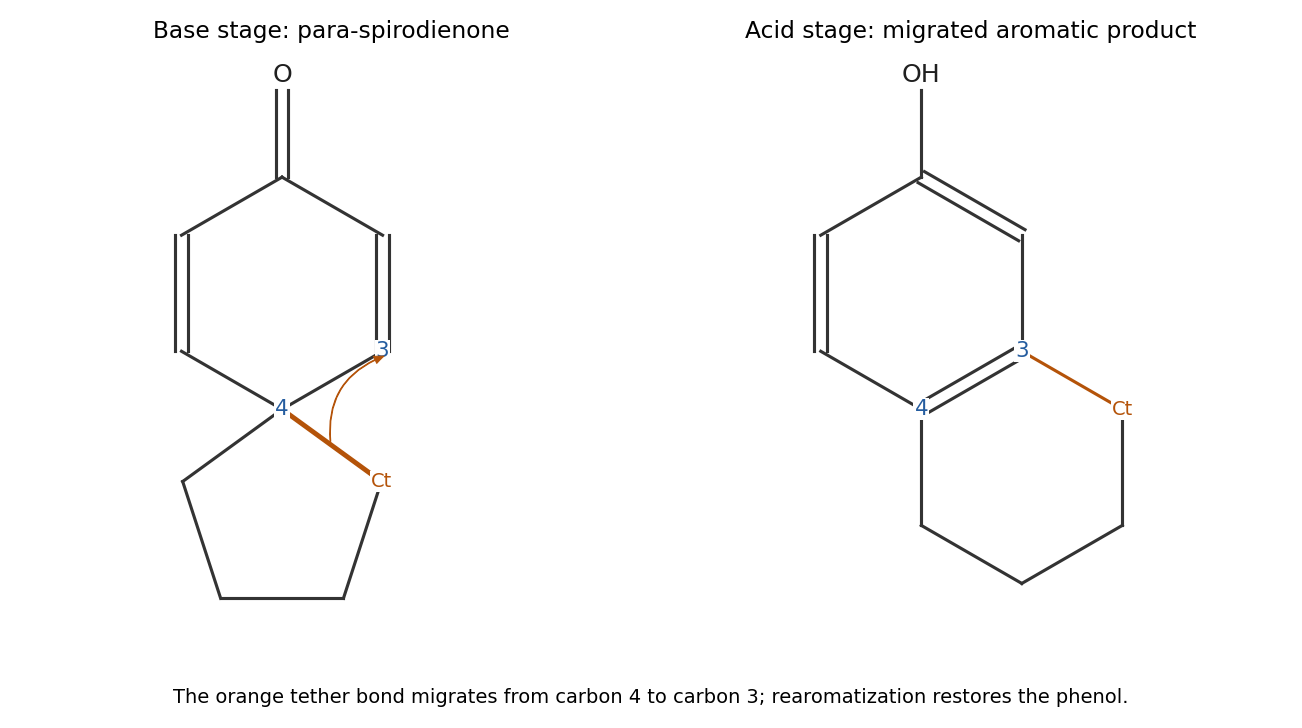
Codex 0 2026-10-20Base first gives phenoxide. Use its para-carbanion/quinoid resonance contributor: the para carbon bearing the tether attacks the terminal chloromethylene carbon in an intramolecular substitution, ejecting chloride. This forms a five-membered ring at that carbon and produces a para-spirocyclohexadienone, with the phenoxide oxygen becoming a carbonyl oxygen. The first stage is a dearomatizing spirocyclization of a phenoxide.
On acidification, carbonyl protonation makes the dienone electrophilic. A tether C–C bond attached to the spiro centre migrates to the adjacent dienone carbon, with the accompanying pi-bond shifts; loss of a proton restores aromaticity. This dienone-phenol rearrangement converts the spiro five-membered ring into the fused six-membered ring while regenerating the phenolic OH. The apparent bond formation meta to OH is thus explained by para spirocyclization followed by skeletal migration, rather than requiring the final fused connectivity to form directly in the base step.


There are unlisted articles, also show them or only show them.